


Dieter's Blog

North and South
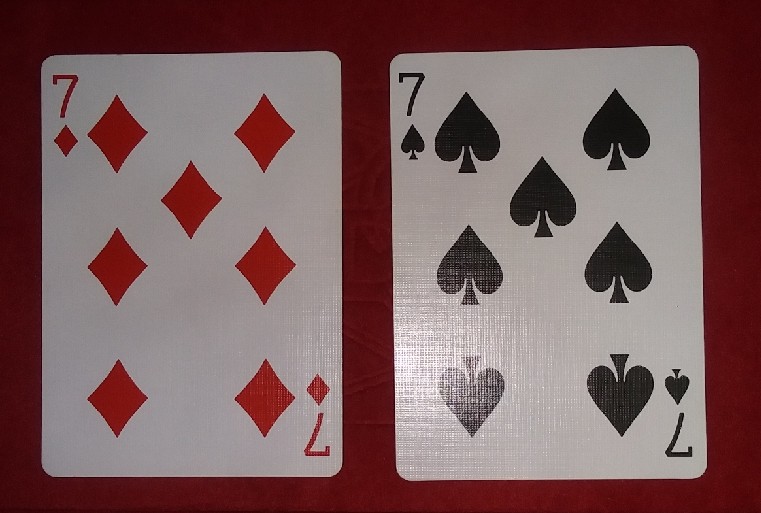
While this may have little value in standard play, I believe that people who play card games should know some trivia about playing cards.Many playing card designs are asymmetrical.
I believe the patterns are generally discernable on cards of Standard, Enhanced Imaging, and Jumbo index sizes (in USPCC parlance). Super Jumbo and LoVision card face designs remove the pip area, if memory serves.
North:
South:
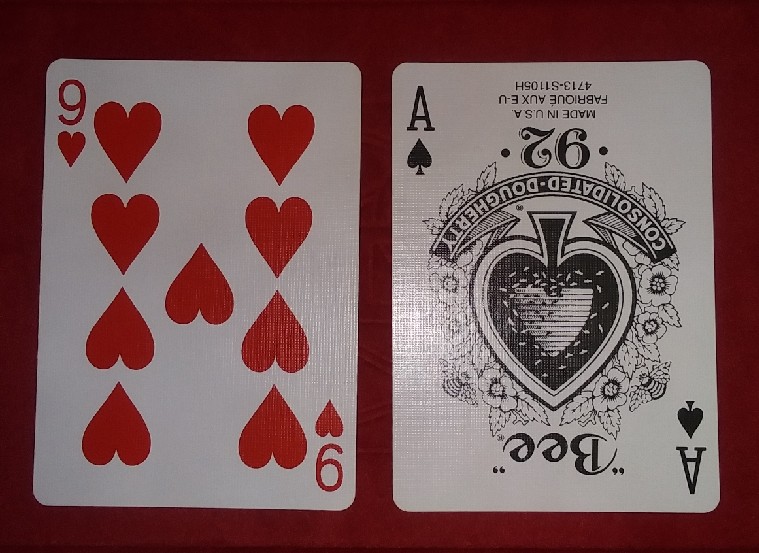
Images are of USPCC Bee 92, Standard index.
Coin flips are lousy
Coin flips are lousy.It's a useful metaphor to simplify a binary decision to a common object; "heads or tails?" is a ubiquitous phrase.
Coins were not designed to serve as dice. One side is heavier than the other (or "the center of mass is not coincident with the physical center of the object").
Persi Diaconis has done considerable research into this.
Numberphile - Persi Diaconis on coin tosses
That's fascinating stuff, documenting the inherent bias in a deterministic coin toss. There are much longer lectures and presentations on Youtube as well.
This wholly ignores the more real problem: some people can and do add further bias to the process. You can probably learn it yourself in an afternoon. It involves the set (starting heads up or tails up), making a consistent toss (surprisingly easy), and then repetition. Once you have a consistent toss, you can further bias the outcome with a controlled catch.
If you're not convinced there is a bias, do an experiment.
I'm assuming you're in the US for this.
Select a coin.
Prepare to flip it.
There is a quarter dollar coin sitting heads up on your right thumb.
What to do about it
Don't toss coins. Instead of heads or tails, ask even or odd - roll some dice. Ask red or black - pick a card (any card).
You probably have some common dice or playing cards around, and they're considerably less likely to show a bias.
Comments

OnceDear
Aug 23, 2021

tuttigym
Aug 29, 2021
A coin toss that is allowed to land on a hard surface, i.e., bounce and not be caught is again random. Also, allowing a third disinterested party who has sufficient motor skills to toss the coin will also provide randomness.
tuttigym

marryhile
Apr 17, 2026
nce you have a consistent toss, you can further bias the outcome with a controlled catch the baby in yellow free.


Comments
If you look closely at that 7 of spades it is printed (or strictly speaking cut) with a slight but discernible sideways offset. The gap between the number 7 and the edge is MUCH smaller on the top number 7.
If the backs are printed as badly, that might be used in edge sorting???
Many cards are asymmetrical.