


Easy math puzzles
Poll
 | 25 votes (49.01%) | ||
| | 16 votes (31.37%) | ||
| | 7 votes (13.72%) | ||
| | 4 votes (7.84%) | ||
| | 12 votes (23.52%) | ||
| | 3 votes (5.88%) | ||
| | 6 votes (11.76%) | ||
| | 5 votes (9.8%) | ||
| | 12 votes (23.52%) | ||
| | 10 votes (19.6%) |
51 members have voted

DisagreeQuote: ThatDonGuy
I'll go with the obvious answer: I expect him to be on the sidewalk.
Since the sidewalk runs north-south, the distance from the sidewalk will be the difference between the number of steps east and the number of steps west. However, since these are equally likely with each step, the expected number of steps east equals the expected number of steps west.
For that matter, since the expected number of steps north equals the number of steps south, I expect him to be at his starting location.
link to original post
The answer is (10,000/π)^.5 =~ 56.419 steps from the sidewalk. That’s technically an approximation though a very accurate one. The formula comes from integrating the normal curve times x from zero to infinity then multiplying times two. This gives the expected distance from the mean.Quote: Ace2Here’s another easy one:
A drunkard starts walking on a straight sidewalk that runs north-south. His goal is to walk northward, but for each step he’s equally likely to go one foot directly north, south, east or west.
After 10,000 steps, how far off the sidewalk would you expect him to be?
Closed form solutions only.
link to original post
The exact answer (shown to ten digits) of 56.41825312 can be obtained via Markov chain, though that’s not a closed form solution.
If you were to start searching for the drunkard, the best place to start would be at the sidewalk since you don’t know which side of it he’s on, but you’d be an average of ~56 steps away from it when you found him. The chance of him being on the sidewalk is <1%


Quote: Ace2The answer is (10,000/π)^.5 =~ 56.419 steps from the sidewalk. That’s technically an approximation though a very accurate one. The formula comes from integrating the normal curve times x from zero to infinity then multiplying times two. This gives the expected distance from the mean.
The exact answer (shown to ten digits) of 56.41825312 can be obtained via Markov chain, though that’s not a closed form solution.
link to original post
Technically, an approximation isn't one either.
The closest to a "closed form solution" that I got was this:
Each step has probability 1/4 of adding 1 to the number of steps to the left of the sidewalk, 1/4 of subtracting 1, and 1/2 of keeping it the same.
Let (m, n, 10,000 - (m + n)) represent the number of steps to the left, the number to the right, and the number forward/backward, with each one being >= 0 and <= 10,000.
The number of steps away from the sidewalk is |m - n|, and the probability of that particular triple is C(10,000, m) C(10,000 - m, n) (1/4)^10,000, or C(10,000, m) C(10,000 - m, n) / 2^20,000.
The solution is the sum over all m from 0 to 10,000 of (the sum over all n from 0 to (10,000 - n) of ( |m - n| C(10,000, m) C(10,000 - m, n) ) ), divided by 2^20,000.
However, I could not find a way to simplify that.

-62-36

Quote: WizardI get a lot of simple math problems on my Facebook feed. Usually there is a strong consensus on the answer, but this one is split about 50/50.
-62-36-72
link to original post
My answer would be:
- 6² - 36
= - (6 * 6)-36
= - 36 - 36
= - 72
An alternate solution using brackets is:
(-6 * -6) - 36
= 0

Quote: WizardI get a lot of simple math problems on my Facebook feed. Usually there is a strong consensus on the answer, but this one is split about 50/50.
-62-36-72
link to original post
Quote: WizardI get a lot of simple math problems on my Facebook feed. Usually there is a strong consensus on the answer, but this one is split about 50/50.
-62-36-72
link to original post
Wizard is correct

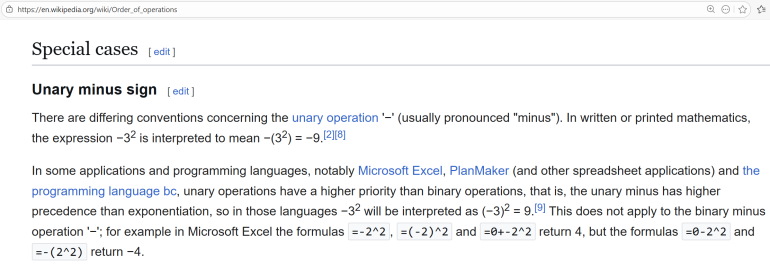
Thus, state the convention you are using to decide whether exponentiation or unary minus has precedence.
Dog Hand


(-6)^2 (-36) = -1,296
I don’t agree with that answer but one could make the argument if parentheses can be implied
Quote: Ace2If parentheses are implied around the -6 to get (-6)^2 - 36 =0, then we should be consistent and assume parentheses are implied around the -36. Therefore:
(-6)^2 (-36) = -1,296
I don’t agree with that answer but one could make the argument if parentheses can be implied
link to original post
Except that, since that minus sign is between two numbers, it is not unary, but binary.
Quote: Ace2Are you saying “unary” -6 is not the same as “binary” 0 - 6 ?
link to original post
Not at all.
However, I am saying that 0 - 6 = -6, and not 0 - 6 = (0)(-6) = 0.
Quote: Ace2Using a random number generator, you pick a number (x) between zero and one. You then apply the formula x^(x^2) = y. What x value will give the lowest value of y?
link to original post
We are asked to find the minimum of y = x^(x^2) where 0 <= x <= 1.
dy = d(x^(x^2))
= d(e^(x^2 ln x))
= e^(x^2 ln x) d(x^2 ln x)
= x^(x^2) (x + 2x ln x) dx
This = 0 when 2x ln x = -x, so ln x = -1/2, and x = e^(-1/2) = 1 / the square root of e, or about 0.60653
For some reason I was surprised to find an e in that one
Quote: Ace2Agree.
For some reason I was surprised to find an e in that one
link to original post
e shows up a lot with exponentiation, since the first derivative of a^x is (a^x ln a) dx.
Bonus problem:
Prove that x^(x^2)) approaches 1 as x approaches 0 from the positive side
Quote: Ace2Any positive number raised to the exponent of zero equals one. So as (x^2) approaches zero, x^(x^2) approaches one
link to original post
Not passing the smell test. As x^2 approaches 0, x^(x^2) approaches 0^0.
x^(x^2)) = e^(ln (x^(x^2))
= e^(x^2 ln x)
Since e^x is strictly increasing, the limit of e^(x^2 ln x) = e^(the limit of x^2 ln x)
= e^(the limit of ln x / x^(-2))
Using L'Hopital's rule, this is e^(the limit of x^(-1) / ((-2) x^(-3)))
= e^(the limit of -x^2 / 2)
Since x is approaching 0, this approaches e^(-0/2) = 1.
As a simple example consider 1+1/2+1/4... which tends to 2. If you give me a delta of say 1/500, then I can show the total of 1+1/2+1/4...+1/512 is within 1/500 of 2. If you give me a smaller delta, then I just keep on going until I reach a small enough fraction.
Exactly. Since 0^0 = 1, it confirms the aforementioned proof. Additionally, the exponent of x^2 will always be less than the base of x for any value of 0<x<1, so the function gets closer to 1 as x approaches zeroQuote: ThatDonGuyAs x^2 approaches 0, x^(x^2) approaches 0^0.
link to original post
Quote: Ace2Exactly. Since 0^0 = 1, it confirms the aforementioned proof. Additionally, the exponent of x^2 will always be less than the base of x for any value of 0<x<1, so the function gets closer to 1 as x approaches zeroQuote: ThatDonGuyAs x^2 approaches 0, x^(x^2) approaches 0^0.
link to original post
link to original post
Excuse me? 0^0 = 1?
Would you agree that, for example, combin(5,0) = 1?
Regardless, we are evaluating the function as x approaches zero, not at x equals zero
What size bankroll should you bring to give yourself a 1/3 chance of busting, 1/3 chance of doubling and 1/3 chance of finishing the 1200 hands without busting or doubling?
Assume a standard deviation of 1.1547, flat betting $500 one hand at a time and perfect basic strategy to realize the 0% edge
Quote: Ace2You go to Vegas over a long weekend to play a single-deck blackjack game with a 0% edge ($500 minimum). You decide to play 1,200 hands but you will quit if you bust or double your initial bankroll before reaching 1200 hands.
What size bankroll should you bring to give yourself a 1/3 chance of busting, 1/3 chance of doubling and 1/3 chance of finishing the 1200 hands without busting or doubling?
Assume a standard deviation of 1.1547, flat betting $500 one hand at a time and perfect basic strategy to realize the 0% edge
link to original post
What does the SD of 1.1547 refer to?
The blackjack game being played.Quote: ThatDonGuy[
What does the SD of 1.1547 refer to?
link to original post
Out of curiosity, what else could it refer to ?
Quote: Ace2The blackjack game being played.Quote: ThatDonGuy[
What does the SD of 1.1547 refer to?
link to original post
Out of curiosity, what else could it refer to ?
link to original post
I understand it has to do with the blackjack game - but in what way? 1.1547 of what, exactly, is within 1 SD of the mean? Is it the final win/loss result after 1200 hands?
I’m quite surprised I have to explain what standard deviation means. Look up the SD for just about any blackjack game and it’s in the 1.13 - 1.16 range

I have $50 to buy tickets. If I buy $50 worth of boxes in one pool, I have a very good chance of winning something, but am limited to one final prize. If I buy $10 worth of boxes in five pools, I have less chance in each pool, but my odds of winning multiple top prizes increase.
How do I determine the odds in each scenario?

Quote: Ace2If you play n hands of a game with an edge of x, your expectation is nx +/- n^.5 * SD. N, x and SD are defined in the problem.
I’m quite surprised I have to explain what standard deviation means. Look up the SD for just about any blackjack game and it’s in the 1.13 - 1.16 range
link to original post
I counted cards at bj for several years
but I admit that standard deviation as indicated in the question is something I did not fully understand
but I knew enough to know there was a large difference possible in the outcomes of a session or sessions even though I had a smallish advantage
the following does not answer the question posed but it helped me understand calculations behind standard deviation
it's not based on the game being equal but in a game where the player is using basic strategy and the house has about a .5% edge
it indicates that because of the rules of bj - splitting, doubling, and drawing bj the standard deviation of a game of bj is greater than that of a 50/50 coin flip
the standard deviation of a coin flip (assuming equal chance of coming heads or tails) is 0.5
the question posed is interesting and hopefully Ace or someone else will answer it and explain the calculations
"AI Overview
In blackjack, a standard deviation (SD) of approximately 1.15 units per round is the standard measure of volatility for a player using basic strategy. It quantifies how much your bankroll will fluctuate around the expected outcome (the average) due to the luck of the draw. Here is a detailed breakdown of what 1.1547 (often rounded to 1.14–1.15) means and how to use it: 1. What "1.15 Units" Means The Unit: The unit refers to your base bet. If you bet $10 per hand, your SD is $11.50 ($10 \(\times \) 1.15).Volatily Measure: Because blackjack involves doubling down and splitting pairs, the variance is higher than a simple 50/50 coin flip. The 1.15 value accounts for these extra payouts, indicating that a session of blackjack is quite volatile.Context: While the house edge might be a tiny fraction of a percent (e.g., -0.5%), the standard deviation is massive in comparison (115% of your bet).
2. How to Use 1.15 for Session Planning Standard deviation helps you determine how much money (bankroll) you need to survive, as actual results are likely to fall within 1 SD of your expected value (EV) about 68% of the time. Example (1 Hour/100 Hands):Bet: $10/hand.Expected Value (EV): Roughly -$5 (assuming -0.5% edge).SD per round: $11.50.SD for 100 hands: $11.50 \(\times \) \(\sqrt{100}\) (10) = $115.Result: In one hour, you are likely to be somewhere between winning $110 ($115 - $5) and losing $120 (-$115 - $5).
3. Key Takeaways Short-Term vs. Long-Term: In the short term (one night), standard deviation dwarfs the house edge. You can win with a negative expectation or lose with a positive one.Bankroll Requirement: The 1.15 figure helps players calculate the necessary bankroll to avoid going broke (risk of ruin).Accumulation: Standard deviation does not grow linearly. 400 hands do not have 4 times the SD of 100 hands; they have roughly 2 times (square root of the number of hands)."
.
The proper comparison would be a coin flip game in which you lose on tails and get paid 2 for 1 every time a head comes up. The standard deviation of the game is 1.Quote: lilredrooster
the standard deviation of a coin flip (assuming equal chance of coming heads or tails) is 0.5
Blackjack’s SD is a bit higher than 1 since you have <50% chance of winning a hand (before cards are dealt) and since some payouts are higher than 2 for 1.
Quote: Ace2You go to Vegas over a long weekend to play a single-deck blackjack game with a 0% edge ($500 minimum). You decide to play 1,200 hands but you will quit if you bust or double your initial bankroll before reaching 1200 hands.
What size bankroll should you bring to give yourself a 1/3 chance of busting, 1/3 chance of doubling and 1/3 chance of finishing the 1200 hands without busting or doubling?
Assume a standard deviation of 1.1547, flat betting $500 one hand at a time and perfect basic strategy to realize the 0% edge
link to original post
$19,189
I might like your answer but I need to see your methodQuote: davethebuilder$19,189
You flip a fair coin one million times. What’s the probability of getting exactly 501,000 heads ?
Quote: Ace2I might like your answer but I need to see your methodQuote: davethebuilder$19,189
link to original post
The first method is to plug the data into a proprietary Blackjack software program that can handle the calculations.
The second method is a pure mathematical solution which I have, however, it is not my work, and I don't have permission to reproduce it. If you look at Blackjacktheforum.com under the Blackjack Puzzle thread this problem was recently asked and the answer provided. You need to be a member to view the solution.
Sorry, I can’t give credit without seeing the solution method.Quote: davethebuilderQuote: Ace2I might like your answer but I need to see your methodQuote: davethebuilder$19,189
link to original post
The first method is to plug the data into a proprietary Blackjack software program that can handle the calculations.
The second method is a pure mathematical solution which I have, however, it is not my work, and I don't have permission to reproduce it. If you look at Blackjacktheforum.com under the Blackjack Puzzle thread this problem was recently asked and the answer provided. You need to be a member to view the solution.
link to original post
On the other forum you wrote “ we all know that the house edge against basic strategy is not 0”. You mean better than zero. In a single-deck 3:2 game (dealer stands on soft 17) the player has about a 0.2% advantage over the casino playing basic strategy
Quote: Ace2Sorry, I can’t give credit without seeing the solution method.Quote: davethebuilderQuote: Ace2I might like your answer but I need to see your methodQuote: davethebuilder$19,189
link to original post
The first method is to plug the data into a proprietary Blackjack software program that can handle the calculations.
The second method is a pure mathematical solution which I have, however, it is not my work, and I don't have permission to reproduce it. If you look at Blackjacktheforum.com under the Blackjack Puzzle thread this problem was recently asked and the answer provided. You need to be a member to view the solution.
link to original post
On the other forum you wrote “ we all know that the house edge against basic strategy is not 0”. You mean better than zero. In a single-deck 3:2 game (dealer stands on soft 17) the player has about a 0.2% advantage over the casino playing basic strategy
link to original post
Ok, understand.
By the way, the contributor you refer to is not me. I did not participate in that thread.
Ace - I was the one who posted on the other forum
Norm Wattenberger a well known blackjack expert and author first posted this:
"About $19,000. But I cheated using CVData instead of solving it with pure math."
then another poster on that forum provided the answer with his solution method and came up with $19,189
it was a very difficult question to answer - I can't really follow his method but here it is with his comment:
"I obtained the same answer via PDEs, Fourier analysis, and Brownian diffusion approximation. Exactly the same math was used to predict that Akio Kashiwagi would lose $10 million before winning $10 million at high-stakes baccarat in 1990"
I couldn't post his image of the solution - but here is the link:
it's the post on the linked thread at 2:29
you have to create an account and become a member to see the solution - but that's pretty easy to do
https://www.blackjacktheforum.com/showthread.php?46858-Blackjack-puzzle
Norm Wattenberger wrote this on the the post at 4:22 at the link:
"A couple of real world variables that can mess up the conclusion; is what do you do when you have less than your bet left? Should you lower it, leave, or mark it."
.
This is an easy calculation for the player bet. Assuming he flat bets $100,000 (100 unit bankroll) per hand and a probability of 0.493 of winning each hand, his chance of doubling before busting is:Quote: lilredrooster.
"I obtained the same answer via PDEs, Fourier analysis, and Brownian diffusion approximation. Exactly the same math was used to predict that Akio Kashiwagi would lose $10 million before winning $10 million at high-stakes baccarat in 1990"
(1 - ((1-.493)/.493)^100) / (1 - ((1-.493)/.493)^200) =~0.0573
However, these gambling ruin formulas are generally valid only for even-money payouts and “forever” timelines. There is no time limit for the double/bust to happen
Incidentally, I’d assume the probability of doubling for the banker bet would be quite similar because, despite having a payout of .95 to 1, its variance and edge are very close to the player bet
Quote: Ace2Another truly easy math problem:
You flip a fair coin one million times. What’s the probability of getting exactly 501,000 heads ?
link to original post
Approximately 6,171,545,915,841,383,470,132,998 / 15,469,775,358,274,841,016,715,505,650
I did calcualte an exact fraction, but the numerator and denominator each have slightly over 300,000 digits, and I can't post the whole thing here
The solution, of course, is C(1,000,000, 500,001) / 2^1,000,000
Are you confident of that answer? I get something different. Your combination formula says 500,001 but I assume that’s a typoQuote: ThatDonGuyQuote: Ace2Another truly easy math problem:
You flip a fair coin one million times. What’s the probability of getting exactly 501,000 heads ?
link to original post
Approximately 6,171,545,915,841,383,470,132,998 / 15,469,775,358,274,841,016,715,505,650
I did calcualte an exact fraction, but the numerator and denominator each have slightly over 300,000 digits, and I can't post the whole thing here
The solution, of course, is C(1,000,000, 500,001) / 2^1,000,000
link to original post
Quote: Ace2Are you confident of that answer? I get something different. Your combination formula says 500,001 but I assume that’s a typoQuote: ThatDonGuyQuote: Ace2Another truly easy math problem:
You flip a fair coin one million times. What’s the probability of getting exactly 501,000 heads ?
link to original post
Approximately 6,171,545,915,841,383,470,132,998 / 15,469,775,358,274,841,016,715,505,650
I did calcualte an exact fraction, but the numerator and denominator each have slightly over 300,000 digits, and I can't post the whole thing here
The solution, of course, is C(1,000,000, 500,001) / 2^1,000,000
link to original post
link to original post
Not a typo; my answer is for 500,001 heads instead of 501,000
Approximately 10461 23660 36261 18051 84739 60872 28374 44214 / 193 37219 19784 35512 70894 38206 30896 54786 58911
DisagreeQuote: ThatDonGuyQuote: Ace2Are you confident of that answer? I get something different. Your combination formula says 500,001 but I assume that’s a typoQuote: ThatDonGuyQuote: Ace2Another truly easy math problem:
You flip a fair coin one million times. What’s the probability of getting exactly 501,000 heads ?
link to original post
Approximately 6,171,545,915,841,383,470,132,998 / 15,469,775,358,274,841,016,715,505,650
I did calcualte an exact fraction, but the numerator and denominator each have slightly over 300,000 digits, and I can't post the whole thing here
The solution, of course, is C(1,000,000, 500,001) / 2^1,000,000
link to original post
link to original post
Not a typo; my answer is for 500,001 heads instead of 501,000
Approximately 10461 23660 36261 18051 84739 60872 28374 44214 / 193 37219 19784 35512 70894 38206 30896 54786 58911
link to original post
Ace - re the blacjack puzzle - another answer with a solution came from Don Schlesinger, a well known bj expert and author
he came up with a slightly different answer - here it is:
"Three comments:
1. If you look at the top of BJA3, p. 394, you'll see that a single-deck game, S17, NDAS, total-dependent BS has an edge of 0.00 to two decimal places--more than adequate for our problem.
2. As for the solution, the double-barrier formulas on pp. 136-137, which are the third and fifth in Norm's risk calculators at the top of this page, can be used by trial and error, with Goal 76 units (doubling), bankroll 38 units (the result of dividing the answer of $19,000 by $500 units), EV = 0, and SD = 11.5 (it's for 100 hands). Of course, we don't know the $19,000 answer ahead of time, so you'd have to play with it for a while. (Note: For some weird reason, I can't get the calculators to work properly with my inputs. Am trying to find out why.)
3. But, I'm going to give you a very elegant solution that doesn't rely on calculators nor John's rather elaborate math. With SD = 1.1547, the total SD for 1,200 hands is 1.1547 * 1200^0.5 = 40 units exactly. To have 33.33% probability as the END POINT solution (doubling or going broke), using my "bumping into the barrier concept" (see BJA, p. 124, second full paragraph) you need exactly half of that value or 16.67% probability of busting or going broke IF you're guaranteed to get to play all 1,200 hands. If you look at cumulative normal tables, you'll see that, to lose enough to go broke, we have to lose 0.97 standard deviations, which has probability 16.6%. So, we're looking for B/40 = 0.97, whence B = 38.8 units, or $19,400. QED. No fancy math, no calculators!
Don"
Quote: Ace2Disagree
link to original post
As well you should - I had an off-by-one error. What I calculated, both times, was the probability of getting (the stated number + 1) heads, with the further requirement that the first toss had to be heads.
Approximately 261 00889 72960 60829 63691 10800 / 24 17152 39973 04439 08861 79775 78862
which is about about 1 / 9261
Agree. I don’t have the computing power you have so I took the area under the normal distribution to get:Quote: ThatDonGuyQuote: Ace2Disagree
link to original post
As well you should - I had an off-by-one error. What I calculated, both times, was the probability of getting (the stated number + 1) heads, with the further requirement that the first toss had to be heads.
Approximately 261 00889 72960 60829 63691 10800 / 24 17152 39973 04439 08861 79775 78862
which is about about 1 / 9261
link to original post
1 /(500*e^2*(2π)^.5)=~0.000107982
Accurate to six digits. Note that 501,000 is exactly two SDs out


