


Gambling 103
Poll
 | 5 votes (71.42%) | ||
| No votes (0%) | |||
| | 2 votes (28.57%) | ||
| No votes (0%) | |||
| | 2 votes (28.57%) | ||
| No votes (0%) | |||
| No votes (0%) | |||
| No votes (0%) | |||
| No votes (0%) | |||
| | 2 votes (28.57%) |
7 members have voted


Here is an initial chapter list, the first time I've put one in writing.
- How to analyze craps side bets using integral calculus
- Why card counting works in blackjack
- Why fewer decks lower the house edge in blackjack
- How to do a card-counting vulnerability analysis for blackjack and baccarat side bets
- How to analyze a video poker pay table in one second
- Using logistic regression to analyze Super Bowl proposition bets
- Using the Poisson distribution to analyze Super Bowl proposition bets
- Wagering in Final Jeopardy
- Optimal strategy for The Price is Right "Big Wheel"
- Two Envelope Paradox
- Benford's Law and the 2020 election.
- When a must-hit-by jackpot turns positive
- Optimal bet sizing using the Kelly Criterion
- Parlaying side and total in baseball.
That said, do you have any other suggestions?
Please remember I'm trying to break new ground here. Yes, I know Stanford Wong covered using Poisson in his Sharp Sports Betting book, but I think it deserves more attention.
I know some of these chapters have little to do with gambling, but I think the type of person who would buy this book would still find them interesting.
The question for the poll is would you buy Gambling 103?
Thank you for your comments and suggestions.

Quote: WizardI'm in the early stages of writing my next book, Gambling 103. This will be a deep dive into esoteric math-heavy gambling topics. Comparisons could easily be made to Gambling Ramblings by Peter Griffin.
Here is an initial chapter list, the first time I've put one in writing.
- How to analyze craps side bets using integral calculus
- Why card counting works in blackjack
- Why fewer decks lower the house edge in blackjack
- How to do a card-counting vulnerability analysis for blackjack and baccarat side bets
- How to analyze a video poker pay table in one second
- Using logistic regression to analyze Super Bowl proposition bets
- Using the Poisson distribution to analyze Super Bowl proposition bets
- Wagering in Final Jeopardy
- Optimal strategy for The Price is Right "Big Wheel"
- Two Envelope Paradox
- Benford's Law and the 2020 election.
- When a must-hit-by jackpot turns positive
- Optimal bet sizing using the Kelly Criterion
- Parlaying side and total in baseball.
That said, do you have any other suggestions?
Please remember I'm trying to break new ground here. Yes, I know Stanford Wong covered using Poisson in his Sharp Sports Betting book, but I think it deserves more attention.
I know some of these chapters have little to do with gambling, but I think the type of person who would buy this book would still find them interesting.
The question for the poll is would you buy Gambling 103?
Thank you for your comments and suggestions.
link to original post
I wrote an VP analyzer based partly on an article you wrote 25 years ago. It can analyze a quick-quads pay table and create a near optimal strategy in less than a second. I would be interested in your ideas on automatic strategy generation.
It seems online gambling topics are absent in your list except to the extent that sports betting is done online. However, sharp bettors cannot get much money down online. I have been limited to betting less than $2 online in some cases and I am not a sharp bettor.
Does your progressive section assume uniform PDF for mystery progressives triggering? Many interesting mystery progressive have absurdly nonuniform PDFs.


For the book to be successful, you may need to "pick a lane." Some of the topics you mention are for a person with a college level math (our generation) background. And you might find that a majority of people graduating college today do not know the calculus you knew graduating high school.
So the market, while it exists, wouldn't be nearly as big as it would be for a mass market "Gambling For Dummies" edition, which I'd guess you would not be too enthused about writing and that several others have written. But the people who would be interested in a mathematically advanced book (including active or former APs) already know why card counting works, why fewer decks lower the house edge, and some of the other topics and might find those chapters tedious. Thus, in order to place the whole book solidly in one market or another you could replace either some of the more advanced or the less advanced topics.
Just one perspective from a potential buyer of your book!

It’s been awhile but if I remember correctly if you are spinning first you shouldn’t stop until you have 65 or higher. If you’re spinning second then 60 or higher. Unless obviously you’re behind.

Quote: WizardI'm in the early stages of writing my next book, Gambling 103. This will be a deep dive into esoteric math-heavy gambling topics. Comparisons could easily be made to Gambling Ramblings by Peter Griffin.
Here is an initial chapter list, the first time I've put one in writing.
- How to analyze craps side bets using integral calculus
- Why card counting works in blackjack
- Why fewer decks lower the house edge in blackjack
- How to do a card-counting vulnerability analysis for blackjack and baccarat side bets
- How to analyze a video poker pay table in one second
- Using logistic regression to analyze Super Bowl proposition bets
- Using the Poisson distribution to analyze Super Bowl proposition bets
- Wagering in Final Jeopardy
- Optimal strategy for The Price is Right "Big Wheel"
- Two Envelope Paradox
- Benford's Law and the 2020 election.
- When a must-hit-by jackpot turns positive
- Optimal bet sizing using the Kelly Criterion
- Parlaying side and total in baseball.
That said, do you have any other suggestions?
Please remember I'm trying to break new ground here. Yes, I know Stanford Wong covered using Poisson in his Sharp Sports Betting book, but I think it deserves more attention.
I know some of these chapters have little to do with gambling, but I think the type of person who would buy this book would still find them interesting.
The question for the poll is would you buy Gambling 103?
link to original post
The list is already pretty compelling for a math-heavy gambling book. I’d be interested in a chapter on correlated bets and parlays, especially how correlation changes the expected value compared with treating each leg independently.
Other possibilities: variance and risk of ruin, Bayesian updating for sports markets, analyzing progressive/must-hit jackpots from a bankroll perspective, and practical applications of Monte Carlo simulation for games where closed-form math gets ugly.
I’d also keep the non-gambling probability topics. The audience that enjoys this kind of book is probably exactly the audience that would appreciate the Two Envelope Paradox and similar problems. On a separate note, I’ve also come across mostbet casino aviator app download when looking at different sports betting markets. It could be an interesting platform to compare odds and markets while exploring some of these probability and wagering concepts, although I’d check the current terms and availability before using any betting service.

Sportsbooks still frequently offer second chance betting, for example. I think they have little fear of it because so many people do it wrong. Showing why it's +EV for almost every circumstance is one thing to include, but believe me, it is not intuitive that longshot bets on the first bet and the second chance, both, increase the PA, the longer the shot the better [modified by tolerance for the variance]. The average guy will do the complete opposite on at least the second chance bet, if not both bets.
I've never seen you examine why most parlay bets are bad bets.
I personally have difficulty with 'profit bonuses' offered on same game parlays. What is the bonus percent to look for vis a vis the number of legs? I can grind through the math for regular parlays, but don’t know the algorithms used by the sportsbooks for same game parlays.
Speaking of parlays, I have looked for an explanation from Wong and yourself, in what you and he have written, as to why you sometimes like the idea of a parlay, and have never seen the explanation as to what you look for.
I'm glad to hear you are getting busy with a project. I'll definitely buy the book though much will be over my head no doubt.

my suggestion involves people like myself who are curious but cannot follow high level mathematics without a greater explanation
I would like to understand but I cannot follow mathematical notation
so my suggestion is after the notations that you use explain the calculation using English language words to exactly describe what is happening in the calculation that is notated
below is an example of notation that I cannot understand, and I would presume that there are a great many who cannot understand it:
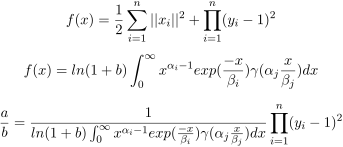
.
Quote: Mental
I wrote an VP analyzer based partly on an article you wrote 25 years ago. It can analyze a quick-quads pay table and create a near optimal strategy in less than a second. I would be interested in your ideas on automatic strategy generation.
Thanks. I'm afraid my strategy generator was created by JB, who is much smarter at such things than I am.
Quote:It seems online gambling topics are absent in your list except to the extent that sports betting is done online. However, sharp bettors cannot get much money down online. I have been limited to betting less than $2 online in some cases and I am not a sharp bettor.
Good point that I should have more content on online gambling. I am open to any specific ideas.
Quote:Does your progressive section assume uniform PDF for mystery progressives triggering? Many interesting mystery progressive have absurdly nonuniform PDFs.
link to original post
Yes, I would make that assumption and be clear about it. I am aware that some makers gaffe their machines to not hit until nearly at the maximum value, which I think is unethical and should be illegal.
Quote: acesideRecently, I have posted several posts in this forum to discuss this topic “Optimal bet sizing using the Kelly Criterion.” Although several authors have cited this terminology in their books, the math formula is still not convincing.
link to original post
I haven't written on this topic for a while, but I believe the goal is to maximum the log of your bankroll after the bet. I would skim Fortune's Formula to see if and how they prove this. I have the book but never read it, to be honest with you.
Quote: AutomaticMonkeyPoisson for sports betting analysis? Seems a bit fishy!
Why is it fishy?
Quote:For the book to be successful, you may need to "pick a lane." Some of the topics you mention are for a person with a college level math (our generation) background. And you might find that a majority of people graduating college today do not know the calculus you knew graduating high school.
So the market, while it exists, wouldn't be nearly as big as it would be for a mass market "Gambling For Dummies" edition, which I'd guess you would not be too enthused about writing and that several others have written. But the people who would be interested in a mathematically advanced book (including active or former APs) already know why card counting works, why fewer decks lower the house edge, and some of the other topics and might find those chapters tedious. Thus, in order to place the whole book solidly in one market or another you could replace either some of the more advanced or the less advanced topics.
Just one perspective from a potential buyer of your book!
link to original post
Well, it would be titled Gambling 103, not Gambling 101. Speaking of which, I may write that book someday too, but am having a hard time mustering the will.
As to card counting, I think most counters don't really know why it works nor why the number of decks matter. Ask them and they will say there are more blackjacks, which help the player more than the dealer, with fewer decks or a high count. However, this is only about 5% of both reasons.
Quote: HunterhillJames Grosjean wrote a paper on optimal strategy for the big wheel on the price is right.
It’s been awhile but if I remember correctly if you are spinning first you shouldn’t stop until you have 65 or higher. If you’re spinning second then 60 or higher. Unless obviously you’re behind.
link to original post
I wrote about it too. I claim the first player should spin again with $0.65 or less. So, we disagree at exactly $0.65.
Quote: odiousgambityou could show the math for some things encountered with online sports gambling that are counter-intuitive.
Sportsbooks still frequently offer second chance betting, for example. I think they have little fear of it because so many people do it wrong. Showing why it's +EV for almost every circumstance is one thing to include, but believe me, it is not intuitive that longshot bets on the first bet and the second chance, both, increase the PA, the longer the shot the better [modified by tolerance for the variance]. The average guy will do the complete opposite on at least the second chance bet, if not both bets.
I've never seen you examine why most parlay bets are bad bets.
I personally have difficulty with 'profit bonuses' offered on same game parlays. What is the bonus percent to look for vis a vis the number of legs? I can grind through the math for regular parlays, but don’t know the algorithms used by the sportsbooks for same game parlays.
Speaking of parlays, I have looked for an explanation from Wong and yourself, in what you and he have written, as to why you sometimes like the idea of a parlay, and have never seen the explanation as to what you look for.
I'm glad to hear you are getting busy with a project. I'll definitely buy the book though much will be over my head no doubt.
link to original post
Thank you for your comments.
Yes, the player should absolutely shoot for the moon with second chance bonuses. A good way to do that is to parlay a lot of games, if you're allowed to.
In straight up gambling (no bonuses) I only like parlays if they are correlated, which can be hard to find. As I listed in my topic list, parlaying the side and total in MLB is an exception.
Quote: Jimmy2TimesWiz - was recently looking for the moment generating function for the doubly-truncated Poisson RV and stumbled across the Skellam distribution. The Skellam distribution is the difference between two independent Poisson RVs. Could there be an application for the Skellam for modeling point spreads in sports like baseball and soccer? Might be a possible topic in your Poisson chapter of the book. Looking forward to your forthcoming book.
link to original post
I'll have to look that up. Until then, I have no good comment on that one.
Quote: lilredrooster.
my suggestion involves people like myself who are curious but cannot follow high level mathematics without a greater explanation
I would like to understand but I cannot follow mathematical notation
so my suggestion is after the notations that you use explain the calculation using English language words to exactly describe what is happening in the calculation that is notated
below is an example of notation that I cannot understand, and I would presume that there are a great many who cannot understand it:
.
link to original post
Point well taken. I'll have to get notational with the chapter on analyzing craps side bets, like the "all." I'll try to explain what I'm doing in layman's terms, but it will be a challenge.
As to an interpretation of that formula, I'd ask Ace2. Second choice would be ThatDonGuy or CharliePatrick.

(Sorry, that's all the fancy math terms i know)
Quote: WizardQuote: AutomaticMonkeyPoisson for sports betting analysis? Seems a bit fishy!
Why is it fishy?Quote:For the book to be successful, you may need to "pick a lane." Some of the topics you mention are for a person with a college level math (our generation) background. And you might find that a majority of people graduating college today do not know the calculus you knew graduating high school.
So the market, while it exists, wouldn't be nearly as big as it would be for a mass market "Gambling For Dummies" edition, which I'd guess you would not be too enthused about writing and that several others have written. But the people who would be interested in a mathematically advanced book (including active or former APs) already know why card counting works, why fewer decks lower the house edge, and some of the other topics and might find those chapters tedious. Thus, in order to place the whole book solidly in one market or another you could replace either some of the more advanced or the less advanced topics.
Just one perspective from a potential buyer of your book!
link to original post
Well, it would be titled Gambling 103, not Gambling 101. Speaking of which, I may write that book someday too, but am having a hard time mustering the will.
As to card counting, I think most counters don't really know why it works nor why the number of decks matter. Ask them and they will say there are more blackjacks, which help the player more than the dealer, with fewer decks or a high count. However, this is only about 5% of both reasons.
link to original post
Poisson is fishy in the same way Joe Pesce is fishy. (I just can't resist a multilingual pun!)
I'd guess you know a lot more APs than I do and better know the typical level of knowledge. For myself, I like to understand the math as thoroughly as possible before taking it to the table. When the inevitable bad luck comes around it helps to stave off the bad feelings of self-doubt, anger, disgust, etc. to have everything in a realistic mathematical perspective.
there are a few APs, I believe Mental is one of them, who can walk up to a slot machine they are not even familiar with, analyze it, and determine if if would be advantageous or not to play it
I would like to learn how that is done
.

You might not disagree I was going by memory and I read that article more than 20 years ago so I might have stated it wrongQuote: WizardQuote: HunterhillJames Grosjean wrote a paper on optimal strategy for the big wheel on the price is right.
It’s been awhile but if I remember correctly if you are spinning first you shouldn’t stop until you have 65 or higher. If you’re spinning second then 60 or higher. Unless obviously you’re behind.
link to original post
I wrote about it too. I claim the first player should spin again with $0.65 or less. So, we disagree at exactly $0.65.
link to original post
Quote: lilredrooster.
there are a few APs, I believe Mental is one of them, who can walk up to a slot machine they are not even familiar with, analyze it, and determine if if would be advantageous or not to play it
I would like to learn how that is done
.
link to original post
The best way to learn is by doing. I am not some sort of slot whisperer. I have played hundreds of different kinds of slots, and I have learned what some of the vulnerabilities are. If I think something might be vulnerable, I collect data, build a model of the mechanic, and analyze the RTP under various scenarios. I play seven days a week, and this gives me a lot of time to think about the games while I am robo-playing on multiple sites simultaneously. Data collection is vastly easier online than in B&M because you can automate the process and collect on multiple sites in parallel.
Most of the B&M slot machines I knew how to exploit have vanished completely from B&M. If you dropped me into Las Vegas today, I wouldn't be able to make any serious money. When I am at home playing online, it is easy for me to make money.
Quote: MentalQuote: lilredrooster.
there are a few APs, I believe Mental is one of them, who can walk up to a slot machine they are not even familiar with, analyze it, and determine if if would be advantageous or not to play it
I would like to learn how that is done
.
link to original post
The best way to learn is by doing. I am not some sort of slot whisperer. I have played hundreds of different kinds of slots, and I have learned what some of the vulnerabilities are. If I think something might be vulnerable, I collect data, build a model of the mechanic, and analyze the RTP under various scenarios. I play seven days a week, and this gives me a lot of time to think about the games while I am robo-playing on multiple sites simultaneously. Data collection is vastly easier online than in B&M because you can automate the process and collect on multiple sites in parallel.
Most of the B&M slot machines I knew how to exploit have vanished completely from B&M. If you dropped me into Las Vegas today, I wouldn't be able to make any serious money. When I am at home playing online, it is easy for me to make money.
link to original post
would you care to give an example of an online slot machine's vulnerability - ?
how you analyzed it and how you determined it was vulnerable
I would presume that in the analysis mode you experience negative expectancy
and only after you have analyzed and determined that it can be played with an advantage that you exerience +EV
it really is quite extraordinary that you are able to do this - I would tend to believe that there are very few who can
the average person would probably think that the idea of winning huge $ from online slot machines consistently is ridiculous - but of course you know that it's not
.
Quote: lilredroosterQuote: MentalQuote: lilredrooster.
there are a few APs, I believe Mental is one of them, who can walk up to a slot machine they are not even familiar with, analyze it, and determine if if would be advantageous or not to play it
I would like to learn how that is done
.
link to original post
The best way to learn is by doing. I am not some sort of slot whisperer. I have played hundreds of different kinds of slots, and I have learned what some of the vulnerabilities are. If I think something might be vulnerable, I collect data, build a model of the mechanic, and analyze the RTP under various scenarios. I play seven days a week, and this gives me a lot of time to think about the games while I am robo-playing on multiple sites simultaneously. Data collection is vastly easier online than in B&M because you can automate the process and collect on multiple sites in parallel.
Most of the B&M slot machines I knew how to exploit have vanished completely from B&M. If you dropped me into Las Vegas today, I wouldn't be able to make any serious money. When I am at home playing online, it is easy for me to make money.
link to original post
would you care to give an example of an online slot machine's vulnerability - ?
how you analyzed it and how you determined it was vulnerable
I would presume that in the analysis mode you experience negative expectancy
and only after you have analyzed and determined that it can be played with an advantage that you experience +EV
it really is quite extraordinary that you are able to do this - I would tend to believe that there are very few who can
the average person would probably think that the idea of winning huge $ from online slot machines consistently is ridiculous - but of course you know that it's not
.
link to original post
When I first saw Scarab, I asked myself how much you loses taking that first of 10 spins and whether you lock in frames on spin 1 often enough to overcome that -EV just by sometimes creating very +EV situations by your own action. This turns out to be solvable if you know the reel set and probabilities. You can get a decent idea of the reel probabilities just by watching online videos of people playing Scarab. Or, you could take pen and paper to a Scarab game in the casino.
This is simple finite-horizon Markov Decision Process with at most ten stages or nodes. There is only one decision at each node: continue or quit. At node ten, the decision is just whether the RTP is greater than 100% based on the current state of the screen. After the reel spin of game 10, all of the locked frames will unlock and turn into wilds for this one spin only. If there are no locked frames, the RTP is about 50%, so the right decision is to stop after spin 9.
You can solve the stopping problem using backward induction, calculating optimal value functions and policies stage-by-stage from the final stage back to the start before the first spin. Once you have done this, you can see if you should stop before stage 1. If your Scarab game is set to a 89% RTP, you should never start. If it is set to 95%, it is +EV to start assuming you have the optimal stopping policy worked out correctly.
Online Scarab games were modified around 2023 to start at node 2 with no frames locked. This prevents APs from taking advantage of node 1 being +EV. They would not have done this if they did not realize they had an initial state vulnerability in the original game.
Quote: billryanShouldn't a book geared towards advance gamblers be Gambling 301?
link to original post
He has authored a book called Gambling 102 so Gambling 103 seems logical
If you have writers block, Google Ai suggests these Advanced Gambling Topics
- Esoteric Math: Analysis of side bets via calculus.
- Probability Models: Using Poisson distributions and logistic regression for sports propositions.
- Optimization: Optimal bet sizing through the Kelly Criterion and analyzing video poker or wheel games.
:)
Quote: 100xOddsMike,
If you have writers block, Google Ai suggests these Advanced Gambling Topics
- Esoteric Math: Analysis of side bets via calculus.
- Probability Models: Using Poisson distributions and logistic regression for sports propositions.
- Optimization: Optimal bet sizing through the Kelly Criterion and analyzing video poker or wheel games.
:)
link to original post
Those sound like they're getting into the 502 courses.
Quote: 100xOddsQuote: billryanShouldn't a book geared towards advance gamblers be Gambling 301?
link to original post
He has authored a book called Gambling 102 so Gambling 103 seems logical
link to original post
Does it? Freshmen take Math 101 and 102.
Advanced classes are at the 200, 300, or 400 level. Advanced courses aren't 100 level.
To me, a book titled Gambling 103 seems geared towards the casual gambler who knows a little more than the basics of strategy. Just a free observation.


