


Uth: EoR if Flush pays 2:1? and a Progressive question

If it paid 2:1, the HE is 0.9%.
(Edit: https://wizardofvegas.com/forum/questions-and-answers/gambling/36944-math-of-ultimate-texas-holdem/#post841494 )
What is the element of risk?
2) Progressive: Flop flush or better with 1st 3 cards + your 2 cards
$1 pays flush $100, full house $150, quads $200
(Don't remember straight flush or royal)
What's the house edge?
3) What if Flush pays 3:2 but Royal only pays 100x?
What's the HE?
Edit:
For every 100 the effective payout on a royal goes down, the house edge will go up by 0.308%?
So if the royal payout is $20k instead of $50k then 30k/100 x .308% is 92% lower???
Obviously wrong.
Help with math?

2). Usually, $1 pays flush $40, full house $50, quads $300.
Quote: aceside1). How do you get the HE of 0.9%? Flush occurs 3.03% of the hands, so the player EV gain is 3.03%x0.5=1.515%; therefore, the new HE is 2.185%-1.515%=0.67%.
2). Usually, $1 pays flush $40, full house $50, quads $300.
link to original post
0.9% HE:
https://wizardofvegas.com/forum/questions-and-answers/gambling/36944-math-of-ultimate-texas-holdem/#post841494
So I should play the $1 Progressive if $100/150/200?
The payout numbers of yours are ridiculous high. Of course.

Quote: acesideI’d like to get a third opinion on this 0.9% HE number.
The payout numbers of yours are ridiculous high. Of course.
link to original post
A Flush is the outcome on 2.5715% of hands (excluding straight flush and royal flush which don't have a change in payout.)
With an increased payout of 0.5 on a flush hand, the incremental player EV is 1.2857%.
The standard UTH EV is 2.185% with perfect strategy. Thus, the new value of house edge with this payout change on flushes is 2.185% - 1.2857% = 0.899222%
Source: UTH Math on increased payout on flushes See in particular the post by charliepatrick
Quote: acesideI see the problem with my calculation. The 3.03% is the total flush hands, while the 2.572% is the player winning flush hands. Thank you.
link to original post
You asked a very intelligent question and I spent a lot of time sweating blood while evaluating everything. here was my explanation before you figured it out yourself.
First, the values in the Wikipedia Poker Probabilities article are correct. The methodology in Wikipedia is poorly documented but I derived the flush probability using my own methods of combination math and I confirm that the 5-card flush combinations with seven cards are 4047664 and the flush probability is 3.0255% - in agreement with Wikipedia.
The Wizard's numbers in the WOO UTH table also appear to be correct. His numbers are the number of player flushes that beat the dealer's hand and receive a payout.
a) The WOO UTH table does not call out instances in which player has a flush but dealer's hole cards include one or two suited cards that allow dealer to make a higher flush than player (or a straight/Royal flush). Those instances are lumped into lines on the WOO UTH table labeled 'Dealer Wins" without calling out what hands the player lost with.
b) Further, there are instances in which the five common cards are all suited (making a flush) and neither the player nor dealer can improve the flush on the board with a card of that suit in their hole cards. So these are when the player has a flush but it is also the identical flush that dealer has. These instances are lumped into rows on the WOO UTH table that are labeled 'Push" without calling out the kind of hand that player had.
The bottom-line: you've been ignoring those instances in which player has made a flush but either loses or pushes. The HE is indeed approximately 0.9% given the rule change on the payout of a winning flush (2:1 rather than 3:2).
EDIT: pwned by aceside.
Quote: 100xOdds
3) What if Flush pays 3:2 but Royal only pays 100x?
What's the HE?
A Royal occurs 0.0032% of the time and normally pays 500:1. If you change the payout to 100:1, the change of house edge is roughly 0.0032%x400=1.28%. Here I assume a player Royal always wins, but this is not the case. I’ve encountered royals within the community five cards several times. The probability of a Royal on the five community cards is 0.000154%. This is as rare as a lifetime event.
Quote: acesideQuote: 100xOdds
3) What if Flush pays 3:2 but Royal only pays 100x?
What's the HE?
A Royal occurs 0.0032% of the time and normally pays 500:1. If you change the payout to 100:1, the change of house edge is roughly 0.0032%x400=1.28%. Here I assume a player Royal always wins, but this is not the case. I’ve encountered royals within the community five cards several times. The probability of a Royal on the five community cards is 0.000154%. This is as rare as a lifetime event.
link to original post
Wow.. house edge goes up 1.28% , almost 50% more.
Community Royal happened to me a couple years ago.
Let's see if I can find my pic.
Quote: gordonm888Quote: acesideI’d like to get a third opinion on this 0.9% HE number.
The payout numbers of yours are ridiculous high. Of course.
link to original post
A Flush is the outcome on 2.5715% of hands (excluding straight flush and royal flush which don't have a change in payout.)
With an increased payout of 0.5 on a flush hand, the incremental player EV is 1.2857%.
The standard UTH EV is 2.185% with perfect strategy. Thus, the new value of house edge with this payout change on flushes is 2.185% - 1.2857% = 0.899222%
Source: UTH Math on increased payout on flushes See in particular the post by charliepatrick
link to original post
Hmm..The HE is based on just the ante bet.
If ante+blind, then the HE is only .45%? :o
Quote: acesideThis is perfectly correct.
link to original post
From WoO https://wizardofodds.com/games/ultimate-texas-hold-em/
'The standard deviation, relative to the Ante bet, is 4.94.'
Does that mean the sd relative to ante+blind is 2.5?
Quote: acesideGood question. But I believe we are not supposed to use standard deviation here. It’s all about variance. If you bet $0.50 on ante, all your payouts are halved, so your variance is quartered. I’d like to hear what other people may say about this.
link to original post
Trips is 974 (1% HE)
I'm betting $10/$10, $2 trips.
Everytime i win at least 3 units, i increase my ante bet by $5 and Trips bet by $1.
i'm down 200x ante bets.
I'm on a huge losing streak and i'm trying to calculate how many sigma's i'm from center.

Quote: 100xOdds1) Normally flush pays 3:2 for the Blind bet.
If it paid 2:1, the HE is 0.9%.
(Edit: https://wizardofvegas.com/forum/questions-and-answers/gambling/36944-math-of-ultimate-texas-holdem/#post841494 )
link to original post
I have been away and just noticed this thread. I calculated the HE for both values of flush payout. My program calculates the basic-strategy HE for known dealer hole cards 2 thru A as a side effect. I included these because there was some interest in these BS dealer hole card calculations recently.
The overall HEs are calculated two ways which must give the same result. The average of the HE for all 13 dealer HC must be the same as the overall HE. So, I present the sum of the 13 HE divided by 13. But, I also calculate the HE for any two specific dealer HC. I don't show the results here, but the program sums them and divides the sum by (52 choose 2) =1326. This is mostly just a sanity check for my new code.
If there is any interest, I can provide these 1326 HE in matrix form in another post.
0.4972237334
0.4080658742
0.3181753448
0.2294870515
0.1711200214
0.1104881192
0.0463495828
-0.0250372845
-0.1224322786
-0.1979561768
-0.3219571567
-0.5332806646
-0.8642924452
-0.2840462789 / 13 = TOT EV: -0.0218497138
-28.9727204494 / 1326 = TOT EV: -0.0218497138
0.5106884901
0.4214458733
0.3314667514
0.2426859398
0.1842243175
0.1234935392
0.0592510662
-0.0122455450
-0.1097568588
-0.1854089761
-0.3095466118
-0.5210158687
-0.8521809363
-0.1168988191 / 13 = TOT EV: -0.0089922169
-11.9236795466 / 1326 = TOT EV: -0.0089922169
I note that charliepatrick's result of -0.899222% is correct to six significant digits in spite of the fact that he did not do the calculation from scratch. He just adjusted the payoffs using the same frequencies from Mike's spreadsheet. This leads to the unsurprising conclusion that the half-unit change in pay table barely affects betting strategy, so the hand frequencies barely change.
I know another strategic change from UTH to Heads-up Hold’em. If there is a quads within the five community cards, player should always raise 1x in Heads-up Hold’em, but not always in UTH.
Quote: acesideYour conclusion sentence is very interesting. However, it can be more convincing if you could list one hand example of the strategic change that is caused by blind payout.
I know another strategic change from UTH to Heads-up Hold’em. If there is a quads within the five community cards, player should always raise 1x in Heads-up Hold’em, but not always in UTH.
link to original post
Well, you have 28,094,757,600 ways the hand can play out (before the dealers cards are turned over) and up to three decision points in each hand. I assume that there are many strategy changes based on a two unit flush payout. If you store the strategy for each way as three bits, the full strategy would occupy 10Gbytes on on the disk. Symmetries would reduce this storage size. You could write a program to compare two strategies if you were curious, but I am not willing to do it. I expect a lot of strategy changes in an absolute sense, but it will be a miniscule number relative to the tens of billions of decisions in the full strategy.
Quote: MentalQuote: 100xOdds1) Normally flush pays 3:2 for the Blind bet.
If it paid 2:1, the HE is 0.9%.
(Edit: https://wizardofvegas.com/forum/questions-and-answers/gambling/36944-math-of-ultimate-texas-holdem/#post841494 )
link to original post
I have been away and just noticed this thread. I calculated the HE for both values of flush payout. My program calculates the basic-strategy HE for known dealer hole cards 2 thru A as a side effect. I included these because there was some interest in these BS dealer hole card calculations recently.
The overall HEs are calculated two ways which must give the same result. The average of the HE for all 13 dealer HC must be the same as the overall HE. So, I present the sum of the 13 HE divided by 13. But, I also calculate the HE for any two specific dealer HC. I don't show the results here, but the program sums them and divides the sum by (52 choose 2) =1326. This is mostly just a sanity check for my new code.
If there is any interest, I can provide these 1326 HE in matrix form in another post.
0.4972237334
0.4080658742
0.3181753448
0.2294870515
0.1711200214
0.1104881192
0.0463495828
-0.0250372845
-0.1224322786
-0.1979561768
-0.3219571567
-0.5332806646
-0.8642924452
-0.2840462789 / 13 = TOT EV: -0.0218497138
-28.9727204494 / 1326 = TOT EV: -0.0218497138
0.5106884901
0.4214458733
0.3314667514
0.2426859398
0.1842243175
0.1234935392
0.0592510662
-0.0122455450
-0.1097568588
-0.1854089761
-0.3095466118
-0.5210158687
-0.8521809363
-0.1168988191 / 13 = TOT EV: -0.0089922169
-11.9236795466 / 1326 = TOT EV: -0.0089922169
I note that charliepatrick's result of -0.899222% is correct to six significant digits in spite of the fact that he did not do the calculation from scratch. He just adjusted the payoffs using the same frequencies from Mike's spreadsheet.This leads to the unsurprising conclusion that the half-unit change in pay table barely affects betting strategy, so the hand frequencies barely change.
link to original post
**bolding added**
I am surprised that the half-unit increase in payout for a flush does not change the strategy to Raise 4x for (T-9 suited).
For the conventional payout table a Td-9d has the following expected values for the pre-flop decision
Raise 4x EV = 0.185169
Check EV = 0.205485
I am expecting that with a half-unit increase in Flush Payout that Raise 4x EV should be at least 0.02 bigger than the Check EV - although the complexity of the calculation makes me not very confident in my analysis.
Mental, could you possibly be able to show the Raise and Check EVs for a starting hand of suited T-9 given the half-unit increase in Flush payout? I'd like to see if the strategy decision for suited T-9 changes.
For Flush paying 3:2, Wiz said his simple uth strategy increases the HE from 2.2% to 2.4%.
What would the HE be if Flush pays 2:1 and using Wiz's uth strategy?
Quote: gordonm888
Quote: Mental
I note that charliepatrick's result of -0.899222% is correct to six significant digits in spite of the fact that he did not do the calculation from scratch. He just adjusted the payoffs using the same frequencies from Mike's spreadsheet.This leads to the unsurprising conclusion that the half-unit change in pay table barely affects betting strategy, so the hand frequencies barely change.
link to original post
**bolding added**
I am surprised that the half-unit increase in payout for a flush does not change the strategy to Raise 4x for (T-9 suited).
For the conventional payout table a Td-9d has the following expected values for the pre-flop decision
Raise 4x EV = 0.185169
Check EV = 0.205485
I am expecting that with a half-unit increase in Flush Payout that Raise 4x EV should be at least 0.02 bigger than the Check EV - although the complexity of the calculation makes me not very confident in my analysis.
Mental, could you possibly be able to show the Raise and Check EVs for a starting hand of suited T-9 given the half-unit increase in Flush payout? I'd like to see if the strategy decision for suited T-9 changes.
link to original post
The new EVs are 0.214718 and 0.235034 and the extra payout raises the EV of both preflop options by about 0.03. My results show that the delta is unchanged at 0.020316 so the preflop strategy does not change.
0.185169,0.205485,-0.020316,,9c,Tc,
0.214718,0.235034,-0.020316,,9c,Tc,
If a preflop strategy changed, there is no way that charliepatrick would get close to the correct result by using counts based on the old preflop strategy.
Quote: 100xOddsMental,
For Flush paying 3:2, Wiz said his simple uth strategy increases the HE from 2.2% to 2.4%.
What would the HE be if Flush pays 2:1 and using Wiz's uth strategy?
link to original post
The Wizard's UTH strategy is of no practical interest to me because I only use use optimal strategy.
I assume the strategy errors would be very similar for both flush payouts, but flush outs would obviously have slightly higher weight with a 2-unit payout.
In principal, I could code up the Wiz strategy into an algorithm and get your answer, but then so could you. Counting outs is really messy to code accurately and might run slowly.
Quote: MentalQuote: 100xOddsMental,
For Flush paying 3:2, Wiz said his simple uth strategy increases the HE from 2.2% to 2.4%.
What would the HE be if Flush pays 2:1 and using Wiz's uth strategy?
link to original post
The Wizard's UTH strategy is of no practical interest to me because I only use use optimal strategy.
I assume the strategy errors would be very similar for both flush payouts, but flush outs would obviously have slightly higher weight with a 2-unit payout.
In principal, I could code up the Wiz strategy into an algorithm and get your answer, but then so could you. Counting outs is really messy to code accurately and might run slowly.
link to original post
Thx.
This plus your previous answer about no change to preflop strategy tells me that using Wiz's strategy for Flush paying 2:1 is fine

On the river, you have to consider all the bets together, so you should bet if you expect to win more than 1/5 (1/4) of the hands.
Quote: TorghattenBefore the river, shouldn’t the Ante/Blind and the Raise be considered completely independent? The only thing that matters for the Raise decision is whether your hand has a greater than 50% chance of winning against two random cards.
On the river, you have to consider all the bets together, so you should bet if you expect to win more than 1/5 (1/4) of the hands.
link to original post
You are absolutely correct. I forgot that the flush payoff is only on the bonus bet and not on the play bet. So the increased flush payoff should never affect strategy.
I've been looking at so many poker variants that I'm losing track of the rules.
Quote: TorghattenBefore the river, shouldn’t the Ante/Blind and the Raise be considered completely independent? The only thing that matters for the Raise decision is whether your hand has a greater than 50% chance of winning against two random cards.
link to original post
I believe this part is problematic. For the Raise 4x decision, the only criterion is EV_4x > EV_check. There are several check decisions in which the winning probabilities are greater than 50%. Right?
Quote: aceside
I believe this part is problematic. For the Raise 4x decision, the only criterion is EV_4x > EV_check. There are several check decisions in which the winning probabilities are greater than 50%. Right?
link to original post
By bidding 4x, you give up the chance to fold the hand, so when i think about it, you have to be right.
Increasing the blind pay table never affects any river decisions. You will never fold a straight or better with the standard pay table, so you will never fold a made flush whether it pays 1.5 or 2 units.Quote: TorghattenBefore the river, shouldn’t the Ante/Blind and the Raise be considered completely independent? The only thing that matters for the Raise decision is whether your hand has a greater than 50% chance of winning against two random cards.
On the river, you have to consider all the bets together, so you should bet if you expect to win more than 1/5 (1/4) of the hands.
link to original post
I think that the entire strategy is the same no even if the blind-bet pay table changes. This means that the frequencies of all final hands are fixed and it appropriate to just change the payoffs and recalculate the HE using fixed frequencies.
Thinking about it in terms of probabilities of winning doesn't get you the right answers. I only look at the EVs and never even calculate the win probabilities. If I fold, I lose two units on the hand. I fold if playing out the hand loses more than two units after putting more money in for the raise.Quote: acesideQuote: TorghattenBefore the river, shouldn’t the Ante/Blind and the Raise be considered completely independent? The only thing that matters for the Raise decision is whether your hand has a greater than 50% chance of winning against two random cards.
link to original post
I believe this part is problematic. For the Raise 4x decision, the only criterion is EV_4x > EV_check. There are several check decisions in which the winning probabilities are greater than 50%. Right?
link to original post
if (river.getEV() < -2.00) {
rivDec[f][rvrCnt] = 'F'; // Fold the river
} else {
rivDec[f][rvrCnt] = 'R'; // Raise the river
}
Quote: MentalIncreasing the blind pay table never affects any river decisions. You will never fold a straight or better with the standard pay table, so you will never fold a made flush whether it pays 1.5 or 2 units.Quote: TorghattenBefore the river, shouldn’t the Ante/Blind and the Raise be considered completely independent? The only thing that matters for the Raise decision is whether your hand has a greater than 50% chance of winning against two random cards.
On the river, you have to consider all the bets together, so you should bet if you expect to win more than 1/5 (1/4) of the hands.
link to original post
I think that the entire strategy is the same no even if the blind-bet pay table changes. This means that the frequencies of all final hands are fixed and it appropriate to just change the payoffs and recalculate the HE using fixed frequencies.
link to original post
I’m confused about your last sentence. Do you say that charliepatrick’s calculation of the EV change because of this 0.5 unit addition on a flush is correct? Or yours is correct? There is still a tiny bit of discrepancy here.
A player flush probability is 3.03%. A flush within the five community cards is 0.1965%, while this situation mostly results in a push. All the remaining player flushes will either win or lose. So, it seems like we may calculate the EV change out? But a player flush may lose to a dealer quads or full house.
Quote: MentalI note that charliepatrick's result of -0.899222% is correct to six significant digits in spite of the fact that he did not do the calculation from scratch.
I said above that Charlie's result agreed with my full calculation to 6-figures, which was all the digits he posted. I assume we agree perfectly if we would compare more digits.
My first intuition told me that there would be some strategy changes for the blind bet payouts, but I had not really thought it through. Now, I believe there are zero strategy changes preflop and on the river. I did some new calculations that suggest that there might not be any strategy changes post-flop either. This is because you never fold a flush on the river.
Quote: MentalQuote: MentalI note that charliepatrick's result of -0.899222% is correct to six significant digits in spite of the fact that he did not do the calculation from scratch.
I said above that Charlie's result agreed with my full calculation to 6-figures, which was all the digits he posted. I assume we agree perfectly if we would compare more digits.
My first intuition told me that there would be some strategy changes for the blind bet payouts, but I had not really thought it through. Now, I believe there are zero strategy changes preflop and on the river. I did some new calculations that suggest that there might not be any strategy changes post-flop either. This is because you never fold a flush on the river.
link to original post
I maintain that there are no strategy changes when you increase the flush payoff on the blind bet. This is because you never fold a flush with a normal payoff. Any flush gives you a significant chance to win the ante or play bets and the blind bet is just gravy at that point. Since you never fold on the river, you get the same number of flush wins for a hand like 9cTc if the flush pays 1.5 or 2 units. Clearly, if you raise preflop, you get the maximum number of flush wins regardless of flush payoff. The delta EV between a preflop raise and a preflop check will be independent of flush payoff for a hand like 9cTc so long as the strategy is unchanged by the flush payoff.
The only way to force strategy changes is to reduce the flush payoff until there are some flushes that you would fold on the river. I ran a set of calculations for delta EV for 9cTc changing only the flush payout on the blind bet. The delta EV is constant (0.0203156508) until the flush payout is decreased to -3.5 units. (That is, you are penalized for winning with a flush.) For flush values below -3.5 units, the delta increases roughly linearly. Here is the hockey stick graph.
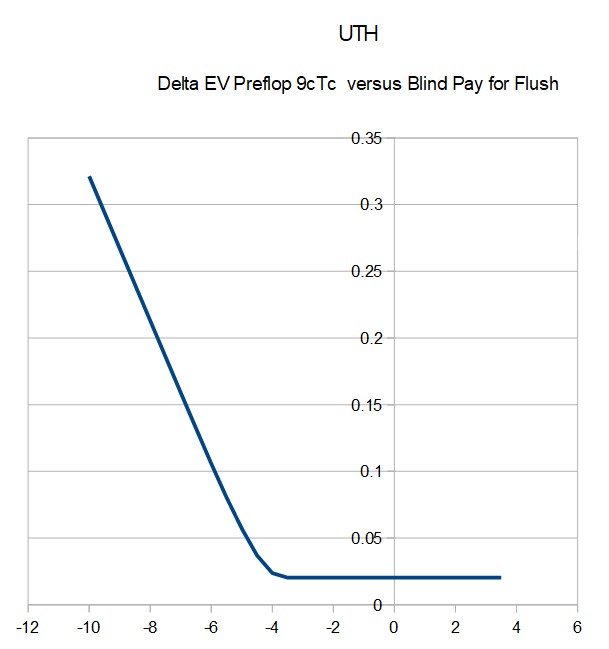
If the Blind pays 2:1 for the Flush (.9% HE), what's the element of risk?
Is it the same ratio as Flush pays 3:2?
Ie: HE is 2.19, then EoR is .53%
If so then If HE is .9%, EoR is .22?
(So you shouldn't play Trips ever because even the best Trips payout listed on WoO has HE of about 1%?)
Quote: acesideThe original element of risk is 2.185%/4.152252 = 0.526%, so the revised EoR will be 0.9%/4.152252=0.217%. This number does not indicate nothing though.
link to original post
To me it does.
It tells me it's EoR is better than Blackjack (EoR .38%) even though it's HE is higher than BJ (.9% vs .43%).
I just created a thread about that:
https://wizardofvegas.com/forum/gambling/tables/42577-he-and-eor-same-result-in-the-end-but/#post987043
Quote: acesideAnother related problem in UTH is the Blind payout of 10:1 for a player quads. The current payout of 10:1 is too small; I believe it should be 20:1. With this change of payout, the strategy will change too and the EV gain will be calculated differently, I speculate. This is because player may raise 1x or fold some of their quads.
link to original post
The only time you fold quads is if it is board quads and the board kicker and both your kickers are low ranks. The payoff for quads does not affect this decision for any reasonable payoff. Quads paying 20 changes nothing about the strategy.
You would never fold quads that was not board quads unless the blind bet paid -4 units.
2s, 2c, 2d; 2h, 3s,
and the player holds these two cards,
3c, 6s,
Player should fold if the quads payout is 10:1, but raise1x if 20:1. I guess this part but haven’t tested it myself.
Quote: acesideLet me show you an example strategy change. If the five community cards on the board are
2s, 2c, 2d; 2h, 3s,
and the player holds these two cards,
3c, 6s,
Player should fold if the quads payout is 10:1, but raise1x if 20:1. I guess this part but haven’t tested it myself.
link to original post
I wrote some code to check for all hands where doubling the quads payout would change the decision assuming the player holds 3c6s. It turns out that there are 33 board quads where you fold if the blind bet on quads pay 10, but you raise if quads pay 20. The highest rank of board quads is 5555 and the highest board kicker is a five. Many of these hands are equivalent.
...5............5............5..........3.5.........
...5............5............5.........2..5.........
...5............5...........45............5.........
...5............5..........3.5............5.........
...5............5.........2..5............5.........
...5...........45............5............5.........
...5..........3.5............5............5.........
...5.........2..5............5............5.........
..4............4............4............45.........
..4............4............4...........34..........
..4............4............4..........2.4..........
..4............4............45...........4..........
..4............4...........34............4..........
..4............4..........2.4............4..........
..4............45...........4............4..........
..4...........34............4............4..........
..4..........2.4............4............4..........
..45............5............5............5.........
..45...........4............4............4..........
2............2............2............2..5.........
2............2............2............2.4..........
2............2............2............23...........
2............2............2..5.........2............
2............2............2.4..........2............
2............2............23...........2............
2............2..5.........2............2............
2............2.4..........2............2............
2............23...........2............2............
2..5............5............5............5.........
2..5.........2............2............2............
2.4............4............4............4..........
2.4..........2............2............2............
This is only 0.00001557514 of all possible boards and the difference in EV is small. An actual doubling of the quads payoff is huge, and yet there are very few strategy changes. It seems you only need to raise the quads payoff to 15 to enable strategy changes -- 14 is not sufficient.
While we are making wishes about paytables, maybe they can add a blind bet payoff for trips. That would help the player a lot more.


