


The End of Pennsylvania Skill Games?

Introduction
Recently, the Pennsylvania Supreme Court has ruled that Skill Games are a form of gambling; given that the form of gambling is not one that is state-sanctioned/regulated, the only logical conclusion to draw is that Skill Games machines constitute illegal gambling devices.
What will this mean for any number of businesses in the state? Are the skill games going to go anywhere? Do we expect the state Supreme Court’s ruling to be enforced?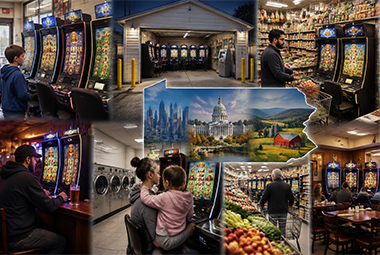
SKILL GAMES IN THE STATE
As everyone is likely aware, I’m of a fairly laissez-faire mindset when it comes to gambling-legal and regulated, or otherwise. It’s no secret that the Skill Games are not regulated by the state and, aside from claims made by their manufacturers, we don’t really have any strong information on the payout percentages and nor is any minimum payout necessary. Caveat Emptor.
In the most commented article on Wizard of Vegas, I discussed Pace-O-Matic machines; I was familiar with these devices from Ohio from when I lived there. Generally speaking, the State of Ohio turned a blind eye towards these sorts of games; however, that changed when the state determined that it was going to legalize and regulate casinos and racinos.
Pennsylvania is an interesting case in that it’s the opposite; I don’t recall seeing too many of these Skill Games in the state (if any) prior to the legalization of land casinos; in fact, these devices really seemed to gain some popularity during the Covid-19 pandemic; I suspect that this surging popularity was due to the casinos being closed.
One aspect of the above article that I should clarify is that some Pace-O-Matic machines have five relatively new games on them, an example of which is Black Belt Bacon; on those games, it actually is sometimes possible to pick a winning line, but have it be sub-optimal. I have no idea why Pace-O-Matic decided to do that, but on the older games, it’s not possible to choose one lesser winner in favor of a result that would have paid better. That said, where bells pay less than cherries (just as an example), a configuration like this is somewhat possible:
| Bell | Apple | Cherry |
|---|---|---|
| Free Games | Blueberry | 7 |
| Bell | Bonus | Cherry |
In the above configuration, it is not possible to choose both Bells and Cherries (on the older games, in order for both options to be present, it would have to be possible to pick both simultaneously), so if cherries pay more than bells, then placing the WILD in the middle-right of this grid would be the optimal play. The above-linked article was written in 2020 and I believe the new games have only been out for a year or thereabouts.
In a different article, I spoke with the developers of Banilla Games wherein we discussed the fact that some of those games arguably had no Skill Element whatsoever. Even if a few of their games could arguably involve an element of skill (such as moving a symbol up or down on the payline), there are many games now out there that have no possible element of skill, short of somehow knowing what the repeating spin pool consists of and where one is at in that spin pool, but that would be nearly impossible (and very expensive!) to figure out-it also wouldn’t necessarily cross over from one device to another.
AS A NOTE: I’d also like to reiterate that I appreciate Banilla Games taking some time out of their day to talk to me and I found them pleasant and straight-forward. I was also supposed to have an interview with a representative from a similar company, but they started ignoring my calls, I believe, when they gathered that this is a gambling site as it is one of the companies that wants to avoid any connotation with gambling like the plague.
In any event, I think the Banilla Games guys were right that those (and similar) machines are preferred by players compared to Pace-O-Matic. Granted, I’m not aware of how many manufacturers there are (probably fewer than a dozen) and couldn’t even hazard a guess as to how many distributors there are, but in terms of market share, I’d suggest that Pace-O-Matic is getting beaten at least four-to-one in the Pittsburgh area. In fact, some locations that once housed Pace-O-Matics have gotten rid of those in favor of other Skill Games.
HAVE THE SKILL GAMES BECOME PERVASIVE?
In a word, yes.
As stated above, I usually have a laissez-faire attitude towards matters related to gambling, but the sheer quantity (and placement) of PA Skill Games has become a bit ridiculous. For one thing, having them in convenience stores that children can freely access was already a bit questionable, even to me, but now, it’s not impossible to find a completely unstaffed location that consists of Skill Games, a cash out machine and an ATM. Granted, those tend to be few and far between because, as you might suspect, such locations are somewhat susceptible to burglary.
In fact, I was aware of one such location that formerly housed Pace-O-Matics; evidently, the owners closed it (it was in a separate garage building of an auto repair and detailing company) because it got hit on two occasions in as many months; on one occasion, the cash out machine was broken into; on the second occasion, the ATM got hit.
Unfortunately, while it’s something of a rare sight, it’s not completely unheard of to see someone pounding away at one of these devices with a child in their lap, or alternatively, loitering about nearby. I suppose what I’m saying is that there might be such a thing as too accessible.
In terms of where you might expect to find these machines, I would suggest that any Asian/Indian market type place yields better than a 90% probability. Other locations, in order of frequency/probability, would include convenience stores (such as 7-11’s), fraternal clubs/orders, smoke shops, gas stations, beer distributors, bars/lounges, proper grocery stores (believe it or not!) restaurants (not typical) and, on occasion, even laundromats.
And, again, I tend to be extremely laissez-faire and tend not to be a huge fan of government overreach, especially when the victim, if there can even be said to be one, is a victim of their own decision-making…but, man, I’d be lying if I said I’m not being tested on this one.
In terms of the returns, only the operators (maybe), distributors and manufacturer would be aware of the returns of any particular unit; that said, some places have left stray print out reports lying around and I’ve seen as low as 73%; however, that 73% has to be taken with a grain of salt because, were the top prize to hit on the very next spin, then that percentage would immediately have been pushed up into the low-80’s.
I’ve also been present when a few Pace-O-Matics were being worked on and have seen some of those return percentages (at least based on the number of spins in the pool that had been played thus far) and, best of my recollection, it tended to hover in the mid-80’s to low-90’s, but that’s based on a very small sample size of return screens that I’ve seen. Actually, it’s not much of an anecdote, but I actually showed a tech what the different reports and numbers meant, on one occasion.
However, given the fact that it’s totally the Wild West out here, and the machines are absolutely everywhere, including areas easily accessible to children, it comes as no surprise to me that the Pennsylvania Supreme Court finally found itself compelled to step in. Further, I think it’s possible that all of the signage proclaiming the legality of the machines (as if this was true in the entire state) might have spurred them to act.
WATER IS WET
With that, the Pennsylvania Supreme Court came in and issued a ruling that declares the Pennsylvania Skill Games are gambling devices. In related rulings, the Supreme Court has officially declared that water is wet and Pittsburgh has a lot of bridges.
It’s time to examine the ruling itself for anything of particular note, or surprise.
Of course, prior to this ruling, one of the articles linked above mentions how the Beaver County Court of Common Pleas determined Pace-O-Matics (specifically) to be, ‘Presumptively Legal,’ having decided there was nothing in state law that would render them illegal. Other jurisdictions have created ordinances surrounding Skill Games, such as an employee having to be present in a location offering them; still other jurisdictions imposed an annual tax per device.
Given that the machines have now been declared illegal by the Supreme Court, one must assume that any laws/codes put in place by lower jurisdictions would effectively be rendered null and void; however, it’s somewhat likely that operators would continue to comply with these (now void) codes in the hopes that local jurisdictions won’t enforce (i.e. police) based upon the Supreme Court’s ruling. After all, laws can certainly exist on paper, but they only functionally exist to the extent to which they are being enforced.
Relevantly, from the Supreme Court’s decision:
The Commonwealth Court’s decisions in POM and Three Devices are the central pillars upon which rests the current state of affairs in this Commonwealth, in which “skill game” devices have been held to fall into a legal gray area outside of the reach of both the Gaming Act and the Crimes Code. Thriving therein, the devices now may be found not only in taverns, restaurants, and social clubs, but also in mini-marts, gas stations, grocery stores, laundromats, pizza parlors, and various other establishments throughout Pennsylvania—even some dedicated solely to the purpose. However, the Commonwealth Court’s interpretation of the governing statutes, upon which the legal status quo wholly depends, is deeply flawed. The Commonwealth Court was incorrecton both points. Under a plain reading of the law, “skill game” devices are subject to both the Gaming Act and the Crimes Code. We accordingly reverse the orders of the Commonwealth Court in both POM and Three Devices.
We recognize, as we have in the past, that many throughout Pennsylvania have placed reasonable reliance upon the Commonwealth Court’s decisions on the lawfulness of the subject devices. We are further mindful of the potential disturbance that our correction of the prevailing case law may cause to business owners and other good-faith participants in the industry. We thus stay our order for a period of 120 days. During this 120-day period of safe harbor, no law enforcement agency is to take adverse action against owners or operators of “skill game” devices in reliance upon this opinion.
Essentially, in addition to this ruling not being enforced by any Executive Arm, at any level, until October of next year, this also gives the two Legislative (state-level) bodies to actually put in place something by way of state-level regulations that would keep the Skill Games in the state legally. Imagine that- Pace-O-Matic’s claim that their devices are legal might actually become true!
Shortly after the above, the Supreme Court’s decision would go on to call the Beaver County Common Pleas ruling (though not by name) categorically wrong; readers would do well to recall that it was Beaver’s, ‘Presumptively Legal,’ ruling that would lead to Pace-O-Matic/distributors/operators advertising with signage that declared these to be, “Legal Skill Games,”; of course, you’ll find similar signage at locations housing machines that don’t have any of the elements that Beaver County’s decision used to qualify something as a ‘Skill Game.’
Relevantly:
As discussed at length below, our General Assembly already has spoken clearly on this subject, particularly through a 2017 enactment that added new terms to the Gaming Act’s definition of a “slot machine,” i.e., “skill slot machine” and “hybrid slot machine,” which make abundantly clear that the “skill” element of the subject devices is not legally significant.5 That is to say, as it concerns their unregulated operation in unlicensed facilities throughout Pennsylvania, it is not this Court that declares “skill games” to be unlawful. Rather, it is the General Assembly that did so nearly a decade ago. If interested parties find the application of the General Assembly’s laws to be undesirable, the proper remedy lies with the same legislative body that wrote those laws. The solution is not for courts to adopt strained and untenable readings of statutes to avoid their application.
Personally, I think this ruling is remarkably well-written; that’s coming from someone who doesn’t necessarily want to see all of the Skill Games be removed from the state (mostly owing to the fact that I financially benefit from playing some of them skillfully!), but what we see here is a Supreme Court that is interpreting the law that the Legislature has already created, rather than trying to create their own laws. It’s a shining example of how, in the United States, the separation of powers is supposed to function.
In any event, the Supreme Court has unambiguously determined that these unregulated devices constitute a form of slot machine, and thereby, are a gambling device.
As I’ve stated in earlier articles, particularly with respect to Pace-O-Matic (and machines with the, ‘Prize Viewer’ feature), the optimal way to play is to simply never play losing puzzles; alternatively, an individual could also play the Simon Says game on PoM’s perfectly (or well enough to be net profitable), so I would argue that you don’t actually have to gamble on these devices; however, it remains undeniable that the majority of players play them as if they were traditional slot machines and that it is unequivocally PoM’s goal that they be played in such a fashion.
Of course, I’d be remiss not to highlight some of the functional aspects that the Supreme Court’s decision gets wrong, for example:
A “pay table” is displayed next to the reels, which informs the player of the potential payouts connected to each winning combination of symbols. A player inserts cash into the device, which is converted into points equal to one cent, i.e., one dollar equals 100 points. The player can decide how many points to wager on a given spin, ranging from real-dollar amounts of $0.08 to $4.00 per play. The device, however, only pays out in whole dollar amounts, rounding down to the nearest whole dollar. The device allows the player to preview the upcoming spin before deciding how much to wager, but the player cannot change the outcome of the next spin, i.e., it either will allow a winning combination of symbols or it will not, and the player has no control over that result.
The statement that the machine rounds down to the nearest whole dollar is not always true; while I have never seen a machine that pays out any amounts under a dollar, I have seen PoM machines that will only cash out in multiples of five dollars, increments of ten dollars and, on one occasion, required a minimum balance of $20 to cash out and would only cash in multiples of $20. It should come as no surprise that those same machines, however, would accept $1 bills; while it has never been a personal concern of mine, I do think it’s a bit predatory to the extent that, if $1 is good enough to be put into the machine, then $1 should be good enough to cash out of the machine. In any event, on some units (and, I assume this is configurable in the settings) a player might not be able to cash out as little as $1 and the breakage can, on occasion, be more than $1.
Furthermore, with respect to the Legislature, it’s interesting to see the proposed Legislation as it would describe Pace-O-Matic games almost to the T to the exclusion of many other Skill Games; though, as I have previously mentioned, some ‘Skill Games’ have no identifiable skill element whatsoever. The only thing that prevents them from strictly being pure chance is the fact that they operate on a repeating spin order.
The next aspect of the machines that the Supreme Court takes on is the need for the player to correctly position the WILD to, when possible, create a winning combination:
The main gameplay contains an interactive component, but this is not the “skill” element of arguable legal significance. The “primary game” or “base game” is what POM describes as a “‘Tic-Tac-Toe’ style puzzle,” because winning combinations of three symbols may be arranged vertically, horizontally, or diagonally, as in Tic-Tac-Toe.31 After the player presses the “play” button and the virtual reels spin, the player can change one symbol to a “wild” symbol to create a set of three matching symbols. Thus, for instance, if a row has two matching symbols, the player can turn the third, non-matching symbol “wild” to produce a winning combination. Although the placement of the “wild” symbol creates the impression that the player is controlling the outcome, this is not the “skill” element from which the device takes its name. As the trial court in Three Devices found: “The puzzle portion of the game is predominately reliant on chance. Although a player has the opportunity to interact with the game to place a wild symbol, there is nothing that a player can do to ensure that the reels show a puzzle that can be correctly solved.”32That is, each play in the base game either will allow a winning combination or it will not, and that outcome is preordained by chance.
In my opinion, which has nothing to do with the legality (the Supreme Court would know better than I would!) I’d argue that there is a skill component to this, but that the Supreme Court is correct in the predominating element being one of chance, rather than skill.
As discussed in other articles and touched upon here, with respect to PoM’s, players have the option of seeing what the next puzzle will be and can choose not to play a losing puzzle; however, most players do not play this way and, even when they do, will often continue to play despite knowing that the next puzzle can only produce a losing result. Essentially, they are playing for the spin after that one, which is not only unknown, but is also determined predominantly by chance in that the machine will either select a winning result from the spin pool, or alternatively, will select a losing one.
Of course, there is a bit of a skill element present in that it’s possible to pick the wrong spot and thereby lose where one would have otherwise had a winning puzzle (and I’ve certainly seen that happen!), but I think the decision is correct in saying that doesn’t predominate. Honestly, given that the player has thirty seconds to make their decision, it’s not really reasonable that anyone who is both taking their time, and has at least a room temperature IQ, would ever miss.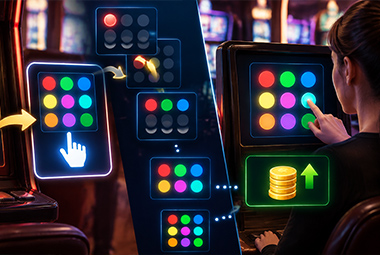
Next, we will examine the Supreme Court’s analysis of the, ‘Follow Me,’ feature:
The legally relevant skill element comes into play whenever a spin in the base game produces a loss, or the player “wins” an amount less than the wager, specifically less than 105% of the amount wagered on a given spin. The player then is given the opportunity to use an additional feature called “Follow Me.” “Follow Me” is a memory test reminiscent of the game “Simon.”34 The player is presented with a three-by-three grid of colored dots, which flash in a random sequence that the player must recall and reproduce. The entire exercise consists of twenty-five rounds, with each round adding another step that the player must remember.35 By the end of “Follow Me,” the player must correctly reproduce a sequence of twenty-five steps. Upon successful completion of this task, the player receives 105% of the amount wagered in the base game. Thus, using the “Follow Me” feature, a successful player can avoid realizing a loss on any given play of the base game.
The parties to the Three Devices appeal differ, to say the least, as to how “Follow Me” should be characterized. The Commonwealth contends that the feature is designed to be ignored, as “Follow Me” is not mentioned or explained in the device’s general instructions, and the feature can be accessed only by clicking a cryptic and unexplained prompt—“Touch Here to Follow Me”—which appears for only a few seconds after a losing spin, and only after the option to play the base game returns.36 “No one walks up to these things to play ‘Follow Me,’” the Commonwealth asserts, “because no one walking up even knows there is a ‘Follow Me.’”37 The Commonwealth further asserts that the device discourages the use of the feature because “Follow Me” is tedious and unreasonably difficult; deliberately slows gameplay by imposing multiple “intermissions” between rounds where nothing happens for approximately fourteen seconds; takes approximately twelve minutes to complete in total, compared to mere seconds to play the base game;and awards only a few cents in excess of the player’s lost wager (at most twenty cents, on a maximum bet of four dollars).38 Thus, the Commonwealth contends, “Follow Me” is “an obvious fig leaf, included to cloak the game’s primary purpose as a gambling device. Most pithily, the Commonwealth suggests that “‘Follow Me’ isn’t there for the players; it’s there for the lawyers.”40 That is, “Follow Me” exists to provide a legal hook for the application of the predominant factor test, to allow a conclusion that skill can control the outcome and that the device is, therefore, not a “gambling device” under Section 5513 of the Crimes Code.
Granted, I haven’t even bothered with the, ‘Follow Me,’ feature in quite some time, but any machine I played consisted of twenty rounds, rather than twenty-five; it is possible that PoM changed that or that it might vary by device and/or game. I will definitely agree with the decision that suggests that the feature is designed to be ignored and, at least on the base game screen, is a bit (intentionally) cryptic.
I would disagree with the characterization that, ‘Nobody,’ walks up to the machines with the intention of playing, ‘Follow Me,’ because some people have and do in order to play profitably, but that they are an extreme minority of the player base is indisputable. I’d certainly grant that the feature is tedious; however, I’d also argue that the feature isn’t difficult at all if one uses the telephone keypad method and simply writes down the order of the symbols, much less is the feature unreasonably difficult—it’s just boring and, in my estimation, not worth doing.
Overall, not that it matters, but I actually disagree with the earlier ruling on this one. I would argue, that if indeed someone walked up to the machine with the intention of playing, ‘Follow Me,’ for any non-profitable result, that skill would then become the predominant feature of the machines and the only relevance that chance would have is how much the player wins and how long it takes the player to win that amount. The obvious goal of playing follow me is not to win $4.20 ($0.20 profit) on a $4.00 bet, but rather, to not lose anything on losing puzzles and then to make your profits on winning puzzles. To wit, someone winning a breakeven prize, even if they would normally play, ‘Follow Me,’ on a total loss, almost certainly would just move on to the next puzzle without playing the feature. Naturally, a $0.20 profit for a twelve minute time spend isn’t the best rate.
On the other hand, if the Supreme Court is considering how most people play the devices, then most people do not play Follow Me, and consequently, chance again becomes the defining aspect.
It would seem that the guys at Banilla Games were right that the courts would not make a distinction based either on that feature, choosing a spot, or the look-ahead “Next Puzzle” feature.
The Supreme Court then goes into an explanation of how the Legislative Branch defines a slot machine; it points out that the Legislative Branch amended its definitions to include, ‘Skill Slot Machines,’ and, ‘Hybrid Slot Machines’ (referring to both chance and skill being factors). Ultimately, the Supreme Court comes around to state that, pursuant to these definitions, the POM Skill Games are, undeniably, slot machines: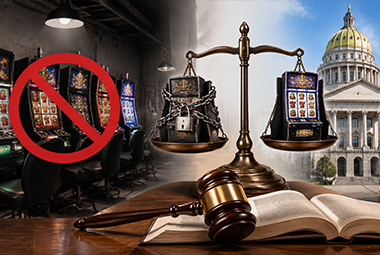
Arguably, any distinction between skill and chance has been irrelevant to the definition of a “slot machine” from the beginning, given that the language—“whether by reason of skill or application of the element of chance or both”—has been present in the general definition of “slot machine” since the original passage of the Gaming Act in 2004.Nonetheless, it is particularly telling that, once courts began finding that the “skill game” devices at issue are lawful to operate in unlicensed facilities under the predominant factor test, the General Assembly specifically added the definitions of “skill slot machine” and “hybrid slot machine” to the definition of a “slot machine,” using language that can be understood as nothing other than an incorporation of the predominant factor test.
With that, given that the devices are not regulated by the state, as well as the fact that they are operated by establishments that are not licensed to possess slot machines (because they are not casinos), they become illegal slot machines. Again, this is an excellent example of the Supreme Court doing what it's supposed to do, which is interpreting the laws that have already been written by the Legislative Branch.
The Supreme Court would then go on to discuss how, at that point (this amended wording was introduced in 2017) POM would then pivot to argue that their machines were not slot devices whatsoever and they exist in a realm wholly ungoverned by the Gambling Act. Of course, they are correct that the machines exist outside of the Gambling Act…which is to say, particularly given the Supreme Court’s recent ruling, that they are unregulated and illegal.
The next several pages of the decision make reference to the case being appealed (read them if you want to; they are really boring!), wherein there is a discussion as to whether or not the Gaming Act would even extend to unregulated devices in the first place. The lower court ultimately held that it does not and only applies to regulated machines in licensed locations, which has nothing to do with POM or any locations in which POM’s might be found. Essentially, that’s tantamount to saying that, because they aren’t regulated, the laws don’t apply to them.
Naturally, the decision that they can’t be illegal because they aren’t regulated in the first place is, on its face, a bit absurd; after all, were they regulated, and operated in a way that comported to the regulations, then (as with casino slot machines) they would be, unambiguously, legal. It’s patently nonsensical to essentially determine that something cannot be illegal because, in order for it to be so, it would have to be regulated/legal in the first place.
Also, let's apply some common sense here: Suppose that an entity got ahold of some Game King machines that would otherwise be regulated, placed them in some location and offered consideration (actually paid out) when players won, but then tried to defend itself by saying that, because they are an unlicensed facility, their operation of the Game Kings cannot possibly be illegal…the only difference in the case of the Skill Games is the fact that they consist of machines that aren’t regulated (at least, not in Pennsylvania) in the first place.
Beginning on Page 39, while I won’t quote it, the Supreme Court enters into a discussion about how a device cannot simultaneously be a slot machine and not be a slot machine; such a notion is patently absurd-it’s either a slot machine or it isn’t. Furthermore, the Supreme Court goes on to point out that the Gaming Act, in conjunction with the Crimes Code, doesn’t make anything outside of the Gaming Act legal outside of licensed locations; rather, it describes the only forms of gambling that are legal, and therefore, exemptions to the Crimes Code.
In other words, in order for a slot machine to be legal (exempted from the Crimes Code) it must exist in a licensed location and it must be a licensed machine manufactured and distributed by a licensed operator. Essentially, the Gaming Act describes every slot machine that is legal and any slot machine existing outside of the Gaming Act is not, ‘Presumptively Legal,’ but rather, is unambiguously illegal.
Okay, the Supreme Court does have one paragraph that’s snarky as Hell, so I have to quote it:
Assuming, arguendo, that the Commonwealth Court was correct about the scope of the Gaming Act, its suggestion leads to a uniquely peculiar outcome. It is true, in a general sense, that the Gaming Act concerns licensing for an activity that otherwise is unlawful (specifically, activity that is unlawful under Section 5513 of the Crimes Code, as we have seen). Indeed, such is the very purpose of a “license,” i.e., to obtain permission to do something that is otherwise impermissible.157 Yet, the POM court’s reasoning suggested that, precisely because the law governing licensing is addressed to the licensed activity, one need not be concerned with that law so long as one does not obtain a license. Thus, one is free to do the licensed activity without a license. But this, as should be obvious, subverts the entire purpose of a license.
Never let it be said that the Pennsylvania Supreme Court is humorless!
Of course, that goes to what I said above, prior to even reading this section: It doesn’t make sense that something would have to first be legal/regulated in order for it to be illegal. It’s kind of curious that the lower court could even come to $uch a conclusion; I wonder how that po$$ibly could have tran$pired.
And, let’s compare this to any other unlicensed activity: If I were to buy a bunch of liquor, set up a bar in my condo, and just start selling it to people (even assuming they’re of legal age), can my bar exist outside of the law because it’s not a licensed establishment? If that were so, then it would make sense for no bars, or casinos, for that matter, to ever get licensed because-why would you ever want to pay the license fees, the taxes or deal with the pain in the ass of regulations? If an entity that is otherwise supposed to be licensed could legally operate in an unregulated fashion, then why wouldn’t they just do that to save time, money and frustration?
The Supreme Court goes on to opine that, at least in terms of manufacturing, POM’s Skill Games, provided they could be categorized as slot machines (which, in the eyes of the State of Pennsylvania, has been unambiguously true since 2017), are incontrovertibly illegal because no person may manufacture unlicensed slot machines:
Perhaps most plainly illustrative of the Commonwealth Court’s error is Section 1317.1 of the Gaming Act, which addresses the requirements for obtaining a license to manufacture slot machines. Section 1317.1(e)(1) provides: “No person may manufacture slot machines . . . or associated equipment for use within this Commonwealth unless the person has been issued the appropriate manufacturer license under this section.”162 On its face, this provision demonstrates a far greater breadth to the Gaming Act than the Commonwealth Court allowed. “No person” is much broader than “licensed entity.” This provision also is not limited to a “licensed facility”; rather, its reach extends to “use within this Commonwealth.” This language demonstrates that the Commonwealth Court patently erred in its insistence that the Gaming Act “only applies to licensed slot machines in licensed entities/facilities.”
In other words, the only leg POM would have to stand on to characterize the devices as being legal is if the devices could be argued not to be slot machines. At the time of Beaver County’s ruling, in 2014, declaring POM’s to be, ‘Presumptively Legal,’ it could theoretically be defended that POM’s were not, in fact, slot machines; however, as we discussed earlier, the Gaming Code was changed, in 2017, to create definitions for, ‘Skill Slot Machines,’ and, ‘Hybrid Slot Machines.’ As a consequence of those definitions, POMs become slot machines no matter how you cut it.
The Court then goes on to state that the Gaming Code makes the use of the devices themselves illegal, unless they are licensed devices, which we’re all quite aware that the POMs are not. Of course, POM would go on to argue that its devices are not slot machines because they are not approved by the Pennsylvania Gaming Control Board:
The Appellees’ arguments to the contrary are unavailing. In its best argument against the application of the Gaming Act, POM contends that its device does not constitute a “slot machine” due to limiting language in the Gaming Act’s definition of that term: “approved by the Pennsylvania Gaming Control Board.” In relevant part, a “slot machine” is defined as including “[a]ny mechanical, electrical or computerized contrivance, terminal, machine or other device approved by the Pennsylvania Gaming Control Board which, upon insertion of a coin, bill, ticket, token or similar object therein or upon payment of any consideration whatsoever,” allows a person to operate it and, whether by chance or skill, may entitle the person to a reward, and which may or may not exhibit certain other features.190 On POM’s reading of this definition, a device does not become a “slot machine” until it is “approved” by the Board. The Department contends that it is unreasonable to conclude that the “Board’s blessing” is what transforms a device into a “slot machine,” but POM argues that “the ‘Board’s blessing’ is precisely what is required to turn a game into a ‘slot machine.’”
Naturally, this ridiculous argument is what the Supreme Court refers to as POM’s ‘best’ argument. We can debunk it fairly quickly. Let’s suppose that there is a manufacturer of slot machines that is licensed outside of Pennsylvania, but not in Pennsylvania, that manufacturer produces a slot machine that then makes its way into Pennsylvania-does it cease to be a slot machine, when it crosses state lines, because it isn’t approved by the Pennsylvania Gaming Control Board? I’d think not; otherwise, you could operate any slot machine that you want to, for profit, and it would not be illegal because it wasn’t approved by the Gaming Control Board, as such, to begin with.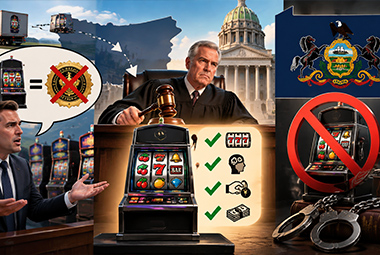
Essentially, all of the arguments in the lower court’s ruling rely on POM (and other Skill Games) somehow existing outside of all applicable laws; it also relies on them simultaneously being, and not being, slot machines. The government is as slow as a tortoise, but after no fewer than twelve years, we have an official legal conclusion that Pace-O-Matic devices are slot machines; we also know that they are not licensed, and because of that, are illegal.
So, is it a slot machine? From the Supreme Court’s conclusion:
Is the POM device a slot machine? Several times over. First, the device meets the general definition of a “slot machine” in the Gaming Act, and it always has.228 Second,especiallyafter Act 42 of 2017 added two new terms to the definition of “slot machine” that specifically address the “skill” aspect of the device, the POM device—which for its entire legal existence depends upon its minor “skill” component—is also plainly either a “skill slot machine” or a “hybrid slot machine.”229 Take your pick. These conclusions are necessitated by the unambiguous language of the Gaming Act, and not any judicial interpretation of otherwise undefined terms. But even setting aside the plain language of the statutes and resorting instead to a judicial gloss, the POM device is a “slot machine” for a yet a third reason—it meets the Commonwealth Court’s common-meaning, ordinary-English definition: “a coin-operated gambling machine that pays off according to the matching of symbols on wheels spun by a handle,” or an electronic version of such a device.230 This definition describes the POM device with precision.
Whether or not skill is a factor, or the predominant factor, POM’s are indubitably slot machines; reading the Crimes Code and Gaming Act together; POM’s become illegal slot machines in that they are both unregulated and unlicensed. That’s to say nothing of the several other ‘Skill Games’ out there that are even less predominant on skill, do not rely on skill whatsoever or have no mechanism such that a win is guaranteed for a skillful player…which I’d argue (not that the Supreme Court would care) that Pace-O-Matics do.
With that, legally (as the representatives at Banilla Games predicted) it doesn’t matter. In my estimation, Pace-O-Matics are the most commonly found Pennsylvania ‘Skill Game’ where skill, actually predominates for the following reasons:
- You can know, ahead of time, whether you’re going to win or lose and simply not take losing puzzles.
- You do have to place the WILD in the correct position, where winning is possible, in order to win or get the best outcome, and:
- You do have the opportunity to have a winning result, even on an otherwise losing base game spin. The only area where I’d disagree with the Supreme Court is, while tedious, it’s not actually at all difficult…which is what makes it tedious. Granted, without using the keypad method (or similar), then I would argue that it’s almost impossible, but as long as that method is not in some way prevented, the game is actually very easy.
But, even with all of that, the game with, arguably, the greatest number of actual skill components is, in the eyes of the State of Pennsylvania, an illegal slot machine.
WHAT’S GOING TO HAPPEN TO THE SKILL GAMES?
Ironically, I think the most likely outcome is that, if Skill Games are going to be removed at all, it’ll be from the locations wherein their existence is the most defensible.
For example, in the rare enforcement actions taken against the Skill Games, it was usually in bars; the state would threaten liquor licenses, on occasion, if bars did not get the illegal games out of there. Even then, there are many bars that still have the games (again, actual enforcement actions were few and far between), but establishments with a license to actually threaten (also true of beer and lottery distributors) are the most likely targets for state-level enforcement.
Of course, when it comes to establishments with a lottery license, but not with a beer distribution or liquor license, they’d probably just keep the skill games, given the choice. For example, in Pennsylvania, total lottery commissions are about 5.79 percent (see the top of page three), but that figure includes certain sales incentives and is closer to 5.24% without those incentives.
In raw numbers, before considering the incentives, the average lottery retailer makes a little over $25,000 (mean average) in commissions from the lottery; however, that doesn’t account for the time employees spend dealing with lottery-related transactions. When we factor in the expenses the business incurs, on direct, as a result of offering lottery products, some lottery retailers are making an absolute pittance. Given the choice between lottery games and Skill Games, if I could only have one or the other, I know which one I’d keep.
That said, Philadelphia already declared Skill Games illegal, within city limits. With that, there was some broader enforcement action in that city.
Ironically, at least until October, the claims on POM’s signage are finally true-given the 120-day stay on the court’s decision, Pennsylvania Skill Games are functionally (albeit, temporarily) legal. You can go and play legal PA Skill Games!
Naturally, concerned businesses are hoping for the State Legislature to take action that would legalize the machines before the October 13th stay on the Supreme Court’s order arrives. There are two different versions of legislation, with one seeking to cap the number of Skill Games at 50,000 (statewide) and have a monthly tax of $500 per terminal.
I would be surprised if any Legislation is based prior to this deadline, but I suppose anything is possible. Of course, it also took no fewer than fourteen years for the state to officially declare these devices to be slot machines, so the law is going to need to move much faster than its usual speed.
Or…maybe it won’t matter.
As I said earlier, the Supreme Court can determine whatever it wants to; the Legislature can either pass a law that would make the machines legal (although, I could see such a law being challenged on the grounds that, if the state sees Skill Games as slot machines, then they should be regulated and taxed the same way as slot machines…which certainly isn’t a $500 per unit monthly fee) or not pass such a law; ultimately, the question is whether or not the various levels of the Executive Branch will actually enforce the law.
Dauphin County indicates that they are ready to mobilize local police, as well as get the state police involved, in order to enforce the anti-gambling laws. That’s just one county, however, and no individual county is strictly required to enforce laws against illegal gambling; I imagine there are quite a few counties who either won’t enforce it at all or for whom they may enforce it, but consider it an extremely low priority.
The most defensible location for Skill Games is bars and fraternal organizations; however, given that bars require state licensing, I think that’s where state-level enforcement may be the most targeted. In perhaps a bit of irony, places where children can go in and out freely, with or without accompaniment, might be largely left alone on this one.
It should also be remembered that, while the Skill Games will become illegal slot machines after the court’s stay lapses, the Legislature can still legalize/regulate them at any point after that, so some lower jurisdictions might not see a purpose in getting rid of the Skill Games if they’re eventually going to be made legal anyway. Others still might decide that it’s not really worth enforcing if it will be detrimental to small businesses.
Even in localities so inclined to enforce the Supreme Court’s decision, quite frankly, I think it’s going to be time-consuming to find all of the Skill Games. It’s not as if there is some comprehensive list of every place that has them, so unless the police want to scour every single business establishment in a given jurisdiction, sometimes even including backrooms, then they’re simply not going to find them all.
WHAT SHOULD HAVE HAPPENED
Quite frankly, all of this is fairly stupid and the Skill Games only proliferated due to the state, in all three branches of Government, being too slow to act. At present, Skill Games outnumber legal slot machines by (potentially) as many as three to one, so it’s certainly gotten a bit out of hand and is truly, as the Supreme Court itself described it, “The Wild West.”
Another aspect of this that is stupid is that all the State of Pennsylvania had to do was enact a Limited Video Lottery, similar to bordering West Virginia, and none of this would even be a consideration as the Skill Games, in all likelihood, wouldn’t have meaningfully proliferated in the first place. Pennsylvania wouldn’t even need as liberal a model as West Virginia has (which is to say that WV has any number of business establishments whose only meaningful source of revenue is limited video lottery), instead, the Keystone State could have restricted Limited Video Lottery to bars and fraternal organizations-again, places where such devices are the most defensible as kids wouldn’t have access to them.
CONCLUSION
Instead, Skill Games face an uncertain future. Personally, I find them to be diminishing returns as, in addition to Pace-O-Matics not being as popular (in terms of number of locations) as they once were and other ‘Skill Games,’ often replacing them, even the places with Pace-O-Matics have players more inclined to check their, ‘Next Puzzle,’ before leaving, or casual players who check through all of the games before beginning, ‘Normal play.’
All of that said, I really don’t care what happens to them. The businesses who allow them to be in there were fully aware that they might not last forever, so they made the money while the money was there to make…but if your business is going to live or die on whether or not you offer Skill Games, then maybe you shouldn’t be in business at all. Beyond that, I’ll certainly admit that these devices being where kids are allowed has certainly tested my laissez-faire tolerance; seeing people playing these things with their kids’ in their lap was certainly harrowing.
If they do get regulated, then I’d just as soon see them restricted to bars and any other premises that do not allow those under the age of eighteen inside. I really don’t see how they can be taxed under a different regulatory framework than slot machines if the state legally (which it does) considers them to be slot machines; on that note, I think that a tax of 52% (the tax rate on slot machines) could potentially reduce the profits on Skill Games such that they aren’t even worth having; that becomes especially true if, in addition to that tax, there is a state or local per unit fee associated with the devices.
My best guess is that they’ll be out of any jurisdictions in which law enforcement is motivated to get them out and, aside from bars, will largely be left alone everywhere else.
Comments
No comments for this articleRelated Articles:
-

Pennsylvania (No)Skill Games
Sep 03, 2020 -
The (Theoretical) Spread of Skill-Based Games
Mar 06, 2016 -
Skill Games-The Last Word
Oct 26, 2020 -
Skill Games Semi-Definitively
Jun 22, 2022 -
Online Casino Rankings/Reviews for Pennsylvania
Feb 28, 2022