


One Zero or Two? What Changes Between European and American Roulette

Introduction
A second green pocket sounds like a tiny change, but roulette is a game where one extra outcome reaches into every bet on the table. The payouts may look the same, yet the numbers underneath them are different. That makes 0 versus 00 worth noticing before the wheel starts turning.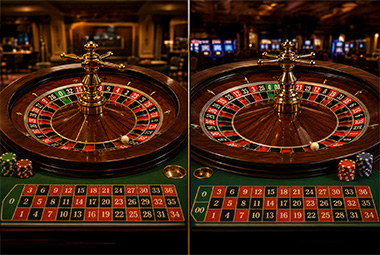
A roulette table does not give you much warning that you are playing a different version of the game. The layout still has red and black numbers, the dealer still sends the ball around the wheel and the usual bets are sitting in front of you. Then you spot the green pockets. European roulette has one zero; American roulette adds a double zero, and that small change alters the maths behind every spin.
One Extra Pocket Changes the Numbers
European roulette uses 37 pockets. You get numbers 1 through 36, plus a single green zero. American roulette uses 38 because it adds 00 beside the standard zero. Everything else can look remarkably similar when you first sit down, but that extra possible result changes the probability behind every bet.
The clearest example is a straight-up wager on one number. Both versions normally pay 35:1, yet your chance of hitting that number is 1 in 37 on a European wheel and 1 in 38 on an American one. The standard house edge works out at about 2.70% for single-zero roulette and 5.26% for the double-zero version.
That distinction is relevant when choosing a roulette table online as well as in a casino. VoltRush carries live roulette within its casino section, including European and American variants, so the number of green pockets is part of the actual game choice rather than a bit of roulette trivia. Lightning Roulette is also available in its live-game selection, giving the roulette section several formats rather than one standard table.
Same Bet, Different Probability
The betting grid changes very little between the two versions, which is why the difference can be easy to overlook. Red still means red, odd still means odd and a straight-up number still carries the same advertised payout. The important change sits underneath those bets because the American wheel has one extra possible result.
| Feature | European Roulette | American Roulette |
|---|---|---|
| Total pockets | 37 | 38 |
| Green pockets | 1 | 2 |
| Straight-up payout | 35:1 | 35:1 |
| Chance of one chosen number | 2.70% | 2.63% |
| Chance of red | 48.65% | 47.37% |
| Standard house edge | 2.70% | 5.26% |
A red bet covers 18 numbers on either wheel. On the European version, that means 18 winning results from 37 possibilities, or 48.65%. American roulette still gives you 18 red pockets, but there are now 38 possible results, cutting the probability to 47.37%.
Probability specialists have been modelling random outcomes for decades. Peter Dizikes of the MIT News Office explained that Monte Carlo simulations use repeated random inputs to model probabilistic systems, with the process repeated thousands or millions of times to build up a useful picture of possible outcomes. Roulette gives you the same basic idea in a much simpler setting: change the number of possible outcomes and the percentages change with it.
Real Physics Under the Digital Display
Roulette looks simple because the visible part of the game is simple. A wheel turns, a ball travels around the rim and eventually drops into a numbered pocket. Underneath that sequence is a physical system involving speed, deceleration and the point where the ball leaves the outer track.
Anna Salleh reported for ABC Science in 2012 on work by Professor Michael Small of the University of Western Australia and Dr Chi Kong Tse of Hong Kong Polytechnic University. Their research modelled roulette using the ball’s initial position together with its velocity and acceleration, showing that the physical movement can be studied mathematically before the ball starts bouncing among the deflectors.
Online roulette adds a digital layer without removing that basic game. Live tables can still use a dealer and physical wheel, with the action streamed to the player through an interface that handles betting and results. VoltRush makes its live casino available through web browsers and mobile apps for iOS and Android, so its roulette tables sit inside the same kind of screen-based experience used for other live dealer games.
Previous Spins Do Not Rewrite the Wheel
Roulette players have always watched what happened on the last spin. Electronic tables make that even easier because previous numbers can sit on the screen beside the betting area, giving you an instant record of recent reds, blacks and zeros.
The key point is that the wheel has no memory. Casino mathematician Michael Shackleford states the obvious: “In games of independent events like roulette, the past does not matter, period”.
Five black results in succession do not remove any red pockets from the wheel, and they do not add any either. The next spin still starts with the same 37 possible outcomes on a European wheel or 38 on an American one.
That is useful context when you see hot-number displays or recent-result panels on an electronic game. Those screens tell you what has already happened. They do not alter the probability built into the next spin.
What Actually Changes and What Stays Put
Once you strip away the table graphics, the distinction between the two games comes down to a small number of mechanical and mathematical differences.
What changes:
- The wheel moves from 37 possible outcomes to 38.
- Even-money bets have a slightly lower probability because 00 adds another green result.
- The standard house edge moves from about 2.70% to 5.26%.
- A straight-up number moves from a 1-in-37 chance to 1 in 38.
- What stays broadly the same:
- Numbers 1 through 36 remain on both wheels.
- Straight-up wins still normally pay 35:1.
- Each new spin remains independent from the result before it.
- The main inside and outside betting areas remain recognisable between versions.
Game selection becomes useful here because roulette now sits inside much larger casino catalogues. VoltRush says its library contains 7,000+ titles, with filters for provider or category and further filters for volatility and theme. Its roulette games sit within the live casino section, so choosing between wheel formats happens alongside the normal process of choosing a table and dealer format.
That wider catalogue does not change the maths of roulette, but it does make the variant label worth checking before you start. “European” and “American” are doing real work in the game title because they tell you whether the wheel contains one green pocket or two.
Green Pocket Does More Work Than It Looks
From a few feet away, European and American roulette can look almost interchangeable. The ball still travels around the same kind of wheel, the same numbered bets remain available and a straight-up win still pays 35:1. The second green pocket is the part that changes the underlying calculation.
VoltRush keeps both European and American roulette within its live casino selection, alongside other roulette formats, so that distinction appears directly in the games available rather than being buried in theory. Once you know what 0 and 00 represent, the labels become easy to read.
One zero gives you 37 possible outcomes. Two zeros give you 38. That is the whole mechanical difference, but every probability on the table starts from that number.
Gambling is for entertainment purposes only and carries financial risk. Adults should gamble responsibly and only use money they can afford to lose.
Comments
No comments for this articleRelated Articles:
-

Advanced Basic Strategy
Apr 05, 2021 -
Vegas Crest Casino Promotions
Aug 29, 2015 -
Fewer Numbers, More Winning
Aug 15, 2016 -
The Worst Software Ever?
May 08, 2017 -
High Noon Casino Loss Rebate
Jun 13, 2015