


I simulated 100 roulette systems (10,000 players each) and ranked them against Bold Play


Fully agree with the forum description, so I set out to prove it properly. I got tired of YouTube roulette channels claiming their system "never loses", so I built a simulator and rebuilt about 100 systems bet by bet: Martingale, Fibonacci, D'Alembert, Labouchère, plus a lot of the YouTube favourites (Holy Grail, Double Up Dozens, Moving Corners etc).
Each system gets 10,000 simulated players on a single-zero wheel, with its own bankroll and goals of +$50, +$100 and +$200.
No surprises on the big picture: every system has a negative average result, and the house edge shows up exactly where you'd expect.
What I found more interesting is the ranking. Raw win rate is misleading, because a bigger bankroll always buys a higher hit rate. So I compare each system with Bold Play for the same bankroll and goal (Dubins & Savage) and rank by the gap. Some results:
- Martingale on red ($2,550 bankroll, +$50 goal): 97.8%, essentially at the Bold Play ceiling, as theory predicts.
- Most YouTube "high coverage" systems land 2 to 6 points below the ceiling.
- Several "never lose" systems lose the whole bankroll in roughly 1 session out of 10.
- A few lose badly because half their "wins" are really pushes or partial losses (e.g. 1-18 + Even together).
The full ranking is here if anyone wants to pick it apart (free)
roulette-analyzer.com/best-roulette-systems.php
I'd genuinely like feedback on the method, especially whether ranking by distance to the Bold Play ceiling is the fairest way to compare systems with different bankrolls.

The Six Line Quattro looks more my speed with a $9 average loss, but I'd play it different and it wouldn't be a Martingale. I'd press on a win by two units starting at 10 units per double street and see if I can double or triple my buy-in of $100 with a Six Line Quinto.
https://roulette-analyzer.com/system/six-line-quattro
https://roulette-analyzer.com/best-roulette-systems.php
And the double-zero machines really are cursed, mathematically speaking: 5.26% edge vs 2.70%. I ran every system on both wheels. On the same Martingale, the bust rate at +$200 roughly doubles on 00 wheels.
Out of curiosity: have you ever seen En Prison or La Partage tables in the US, or is it strictly a European/high-limit thing?


Quote: SystemAnalyzerHi all,
Fully agree with the forum description, so I set out to prove it properly. I got tired of YouTube roulette channels claiming their system "never loses", so I built a simulator and rebuilt about 100 systems bet by bet: Martingale, Fibonacci, D'Alembert, Labouchère, plus a lot of the YouTube favourites (Holy Grail, Double Up Dozens, Moving Corners etc).
Each system gets 10,000 simulated players on a single-zero wheel, with its own bankroll and goals of +$50, +$100 and +$200.
No surprises on the big picture: every system has a negative average result, and the house edge shows up exactly where you'd expect.
What I found more interesting is the ranking. Raw win rate is misleading, because a bigger bankroll always buys a higher hit rate. So I compare each system with Bold Play for the same bankroll and goal (Dubins & Savage) and rank by the gap. Some results:
- Martingale on red ($2,550 bankroll, +$50 goal): 97.8%, essentially at the Bold Play ceiling, as theory predicts.
- Most YouTube "high coverage" systems land 2 to 6 points below the ceiling.
- Several "never lose" systems lose the whole bankroll in roughly 1 session out of 10.
- A few lose badly because half their "wins" are really pushes or partial losses (e.g. 1-18 + Even together).
The full ranking is here if anyone wants to pick it apart (free)
roulette-analyzer.com/best-roulette-systems.php
I'd genuinely like feedback on the method, especially whether ranking by distance to the Bold Play ceiling is the fairest way to compare systems with different bankrolls.
link to original post
Welcome. The math may interest you, but the title of your thesis may as well be ‘Different ways to lose at roulette’. I see little value in doing work to show which bad system is worse than another bad system.
You're right that for anyone here it's old news. But this forum isn't really who it's for. It's for the people watching YouTube channels where a system "won $900 in 15 minutes" and "never loses". They're going to play those systems anyway, and telling them "all systems lose" doesn't land, because they just watched one win.
What does seem to land is specifics: "this exact system busts your whole $2,000 about 1 night in 10" or "these 12 numbers that look like wins are really pushes". So the ranking is less "which bad system is best" and more "here's what the video didn't show you".
If it nudges a few people toward smaller bankrolls, stop-wins, or just not believing the next "never lose" video, I'll call it worth the work.
Single-zero wheel
- Double to $200: 35.8% (Bold Play ceiling: 48.6%)
- Triple to $300: 20.4% (ceiling: 31.5%)
Double-zero wheel
- Double: 29.3%
- Triple: 14.9%
Sessions are short, about 8–10 spins on average. The nice thing about pressing on wins instead of Martingaling is that you can never lose more than the $100 buy-in. The catch is you need a run of 30-number hits in a row, and one miss resets everything, so it lands well below the ceiling.
If you want the closest thing to "double my $100", it's still Bold Play: one $100 bet on red does it 48.6% of the time. Boring, but unbeatable.
Quote: ChumpChangeI've lost interest in roulette unless I hit a high limit room and the HA is 1.35% with the En Prison rule for outside bets. I don't know where those tables exist and I doubt I'll ever find one IRL. I might play a machine with a double zero to pass some time and get a few rewards points, but I find I'm just cursed on those machines.
The Six Line Quattro looks more my speed with a $9 average loss, but I'd play it different and it wouldn't be a Martingale. I'd press on a win by two units starting at 10 units per double street and see if I can double or triple my buy-in of $100 with a Six Line Quinto.
/system/six-line-quattro
p
link to original post
Glad you had a look! I ran your Six Line Quinto just now: $100 buy-in, five double streets at $10, press +$2 per line after every win, back to $10 after a loss. 50,000 players:
Single-zero wheel
- Double to $200: 35.8% (Bold Play ceiling: 48.6%)
- Triple to $300: 20.4% (ceiling: 31.5%)
Double-zero wheel
- Double: 29.3%
- Triple: 14.9%
Sessions are short, about 8–10 spins on average. The nice thing about pressing on wins instead of Martingaling is that you can never lose more than the $100 buy-in. The catch is you need a run of 30-number hits in a row, and one miss resets everything, so it lands well below the ceiling.
If you want the closest thing to "double my $100", it's still Bold Play: one $100 bet on red does it 48.6% of the time. Boring, but unbeatable.

Quote: SystemAnalyzerHi all,
Fully agree with the forum description, so I set out to prove it properly. I got tired of YouTube roulette channels claiming their system "never loses", so I built a simulator and rebuilt about 100 systems bet by bet: Martingale, Fibonacci, D'Alembert, Labouchère, plus a lot of the YouTube favourites (Holy Grail, Double Up Dozens, Moving Corners etc).
Each system gets 10,000 simulated players on a single-zero wheel, with its own bankroll and goals of +$50, +$100 and +$200.
No surprises on the big picture: every system has a negative average result, and the house edge shows up exactly where you'd expect.
What I found more interesting is the ranking. Raw win rate is misleading, because a bigger bankroll always buys a higher hit rate. So I compare each system with Bold Play for the same bankroll and goal (Dubins & Savage) and rank by the gap. Some results:
- Martingale on red ($2,550 bankroll, +$50 goal): 97.8%, essentially at the Bold Play ceiling, as theory predicts.
- Most YouTube "high coverage" systems land 2 to 6 points below the ceiling.
- Several "never lose" systems lose the whole bankroll in roughly 1 session out of 10.
- A few lose badly because half their "wins" are really pushes or partial losses (e.g. 1-18 + Even together).
The full ranking is here if anyone wants to pick it apart (free)
roulette-analyzer.com/best-roulette-systems.php
I'd genuinely like feedback on the method, especially whether ranking by distance to the Bold Play ceiling is the fairest way to compare systems with different bankrolls.
link to original post
Did you try the Great Universal Theory?
Over 15 million bets:
- average numbers covered per bet: 4.6
- hit rate: 12.37% (coverage alone predicts 12.38%)
- return: −2.8% per $1 staked, i.e. the house edge plus noise
Same thing I found with hot numbers, cold numbers and sector tracking. Every selection method hits at exactly its coverage rate, because the counts describe the past and the wheel doesn't read them. The Law of the Third is a fine description of what 37 spins tend to look like (about 2/3 of the numbers show up). It just doesn't tell you which ones come next.
And agreed on baccarat. The outcomes aren't equally likely, and a tie is roughly 9.5% with 8 decks, not 1/19, so the premise breaks even before the maths does.

Can you add my strategy?
The rule:
Always bet 1 unit. When you lose, repeat or climb to a higher-odds bet so a win still leaves you ahead. When you win, reset.
Each loss adds 1 to your deficit. Within a tier, each repeat drops the net win by 1 (3, then 2, then 1). When the next repeat would net 0, move up a tier.
When the straight-up tier (35:1) would net 0, a win is pushed back to the top of the ladder. It starts again at even money, then dozen, six line, and so on down to straight up, where if you would net 0 again another push would follow and so on.
The ladder (bet, odds, net if win):
Even money, 1:1, net +1
Dozen, 2:1, net +1
Six line, 5:1, repeat up to 3 times: net +3, then +2, then +1
Corner, 8:1, repeat up to 3 times: net +3, then +2, then +1
Street, 11:1, repeat up to 3 times: net +3, then +2, then +1
Split, 17:1, repeat up to 6 times: net +6 down to +1
Straight up, 35:1, repeat up to 18 times: net +18 down to +1
Straight up pushed to even money, 71:1, repeat up to 36 times: net +36 down to +1
… , … , … : …
Your ladder is now live: /system/odds-ladder
94.7% reach +$50 on a single-zero wheel ($10 units, $2,000 bankroll). That’s a gap of −2.5 to the Bold Play ceiling, which puts it among the best systems in the catalog. On a double-zero wheel it’s 94.1%.
What I like about it: almost every popular system fights a losing streak by raising the stake, and that’s exactly what blows up the bankroll. Yours keeps the stake at one unit and raises the odds instead, so a bad run costs you one unit at a time rather than one huge bet. It’s a really clever way to get close to Bold Play without ever making a big bet.
The honest catch, as always: the house edge doesn’t go away. About 1 cycle in 20 reaches the let-it-ride stage, where two legs roughly double the edge, and that’s where most of the losses come from. The average result over 10,000 players is still slightly negative – just much smoother than most.
You can play it spin by spin on the site and see every level of the ladder. Let me know if you’d like it listed under a different name or with your username as the source – happy to credit you properly.

Quote: SystemAnalyzer
Your ladder is now live: /system/odds-ladder
link to original post
https://roulette-analyzer.com/system/odds-ladder
We'll keep fixing the links until the spam filter acquiesces, I think.

Quote: LiwetI think random betting should be your control. Random betting numbers, random betting red/black, random betting various 2:1 bets, and/or random betting green spots.
link to original post
Good point – that would make a useful second baseline. Bold Play is the ceiling: the best any strategy can do for a given bankroll and goal. A random flat bettor is closer to a “no strategy” control, so every system could be shown somewhere between the two.
One thing I’d expect: on a short goal like +$50 with a big bankroll, flat random betting will look surprisingly decent, because the bankroll is large compared to the bet and the edge needs time to show. The difference should appear at larger goals and in how much is lost on average when it fails.
I’ll run random red/black, random 2:1, random straight-ups and a random mix as controls and post the numbers here. Thanks for the idea.
Random red/black: +$50 76.2% (gap −21.0), +$100 58.6%, +$200 34.3%
Random 2:1 bets: +$50 86.1% (gap −11.1), +$100 75.7%, +$200 57.0%
Random straight-ups: +$50 88.6% (gap −8.6), +$100 88.2%, +$200 84.2%
Random mix of all of them: +$50 88.0% (gap −9.2), +$100 86.0%, +$200 82.7%
The surprise for me: flat red/black is the worst control, not the best. With small even-money bets the edge gets hundreds of spins to grind you down before you reach the goal. Straight-ups are high variance, so they reach the goal faster – the same logic that makes Bold Play optimal.
So for a +$50 goal the scale looks roughly like this: random betting −9 to −21, typical progression systems −3 to −6, the best ones (like the Odds Ladder at −2.5) within a few points of the Bold Play ceiling.
Good suggestion – I’ll probably add the random mix as a reference line on the site.
Your suggestions have already made the site better: the Odds Ladder is now in the catalog, and the random-betting control gives every system a second yardstick next to Bold Play. That’s exactly the kind of feedback I was hoping for.
If you have a system you’d like tested, or you think something in the method looks off, just post it here. I’m happy to run it and share the numbers – good or bad.
Odds Ladder sounds like a great name, and I'm pleasantly surprised at how well it holds up.
If you don't mind, here is another, much simpler system. I personally call the system 17, because that is all it does: bet on 17.
The rule:
Always bet 1 unit. When you lose — repeat or push one time so a win still leaves you ahead. When you win, reset.
We start with a bet on 17 (straight up) and repeat until the net profit drops to one, after which point we would push a win to another bet on 17 (straight up). That's it, no more pushes after that.
I doubt any push after the first has even has a chance of landing for any bank roll smaller than 4000 unit
Single zero: +$50 64.6% (gap −32.5), +$100 62.3%, +$200 56.7%
Double zero: +$50 63.2% (gap −33.5)
So this one is a lot weaker than the Odds Ladder, and the reason is interesting. You get 35 tries on 17 before the net drops to zero, and missing all 35 happens about 38% of the time. From there the 17→17 push only hits 1 time in 1,369, so the rest of the bankroll drains away.
The surprise: the push is what hurts it. Just flat betting a single number with the same bankroll reaches +$50 about 89% of the time in my random-betting control. In the Odds Ladder the push only kicks in after all the cheaper tiers have absorbed most losing runs – here it comes far too early.
Happy to add it to the catalog anyway as a “what the push does” example, if you’d like. Thanks for sending it!
Quote: SystemAnalyzerThanks – glad you like the name! I ran “17” the same way ($10 units, $2,000 bankroll, 40,000 players):
Single zero: +$50 64.6% (gap −32.5), +$100 62.3%, +$200 56.7%
Double zero: +$50 63.2% (gap −33.5)
So this one is a lot weaker than the Odds Ladder, and the reason is interesting. You get 35 tries on 17 before the net drops to zero, and missing all 35 happens about 38% of the time. From there the 17→17 push only hits 1 time in 1,369, so the rest of the bankroll drains away.
The surprise: the push is what hurts it. Just flat betting a single number with the same bankroll reaches +$50 about 89% of the time in my random-betting control. In the Odds Ladder the push only kicks in after all the cheaper tiers have absorbed most losing runs – here it comes far too early.
Happy to add it to the catalog anyway as a “what the push does” example, if you’d like. Thanks for sending it!
link to original post
Does it work better on 22?
(I said 22!)
Quote: SystemAnalyzerHa – I ran it on 22 just to be sure. Same 64.6% at +$50, to the decimal, because the wheel doesn’t know which number you picked. 😄 Though I’ll admit “22” has a nicer ring when you say it twice.
link to original post
I didn't expect otherwise. Without luck on your side, this is what you get. If luck is on your side, the math hardly matters.
(ᵕ—ᴗ—)
Yes, “22” has a nice ring to it, and I am now assured that 22 is not worse than 17. I am considering a name change—could I do that? Also, as you mentioned, I think adding it as an example to show what the push does is a good idea.
roulette-analyzer dot com /system/22
Same as always though: the house edge hasn’t gone anywhere. A good run of 27 days is still just one path – over 10,000 players the average result is slightly negative, and the long run that drains the bankroll can come on any day. It’s a remarkably resilient system, not a winning on
Also @Dieter, thanks for the video — it just fits perfectly.
Quote: 61984263Yes, "22", same rules, but not the same number. Call me superstitious, but if the system is called 22, we can't be betting 17; we have to bet on 22 and then push it to 22. There is just no way around it.
Also @Dieter, thanks for the video — it just fits perfectly.
link to original post
And I tend to agree - "22" is different. You bet everything you have (on 22), twice, and leave. In "17", you flat bet a sensible amount, a variable number of times, until a certain win/loss threshold is met.
Edit: 41%, got it wrong before, changed it, point still stands.
//I was partially joking, if it's not obvious. Yes, it is better than I expected, and it probably still does better than most other systems, but 41% to 48.6% is a huge difference in terms of house edge. My advice is always to play timid for the session, then play bold at the end.
Quote: 61984263Yes, "22", same rules, but not the same number. Call me superstitious, but if the system is called 22, we can't be betting 17; we have to bet on 22 and then push it to 22. There is just no way around it.
Also @Dieter, thanks for the video — it just fits perfectly.
link to original post
Superstition respected! 😄 It now bets on 22 and pushes to 22 – no 17 in sight. The numbers stay the same, since the wheel doesn’t play favourites, but the name and the bets finally match.
Quote: 61984263I could not find “quitte ou double” under the strategies listed. Very simple strategy: bet your entire bankroll on a single even money bet. Obviously it is not optimal for the target, but for completion's sake I think it should be listed.
link to original post
Good call – added for completeness: Quitte ou Double, the whole $1,000 on one even-money bet.
48.7% reach +$50 on a single-zero wheel (gap −45.9 to the Bold Play ceiling), and it’s the same 48.6% whatever the goal, since one spin decides it all. So it sits at the very bottom for small goals, because it bets twenty times more than a +$50 goal needs.
The nice twist: when the goal is to double the bankroll, Quitte ou Double is Bold Play – one bet of everything is then the mathematically optimal play. It’s the perfect bookend for the ranking.
roulette-analyzer dot com /system/quitte-ou-double
Quote: 61984263I could not find “quitte ou double” under the strategies listed. Very simple strategy: bet your entire bankroll on a single even money bet. Obviously it is not optimal for the target, but for completion's sake I think it should be listed.
link to original post
Define "optimal for the target."
In a "target or bust" scenario, you would think that would be the best play, as it exposes the smallest amount to the house edge.
Of course, if your bankroll is larger than the target, then the optimal strategy might be something closer to Martingale - bet the smaller of (a) what you need to reach the bankroll and (b) the maximum allowed. (It is "martingale" in that, if, say, the target is $100, then your first bet is $100, your second is $200, your third is $400, and so on.)
Quote: ThatDonGuyQuote: 61984263
Define "optimal for the target."
In a "target or bust" scenario, you would think that would be the best play, as it exposes the smallest amount to the house edge.
Of course, if your bankroll is larger than the target, then the optimal strategy might be something closer to Martingale - bet the smaller of (a) what you need to reach the bankroll and (b) the maximum allowed. (It is "martingale" in that, if, say, the target is $100, then your first bet is $100, your second is $200, your third is $400, and so on.)
link to original post
Optimal means having the highest likelihood of achieving the target. The target here is $2050 to $2200 with a $2000 bank. The optimal strategy is always bold play, as established by Dubins and Savage in 1965. So it serves as the ceiling against which any other strategy can be measured.
Quote: 61984263Honestly, what I find most astounding is how efficient Martingale is. I thought it might break down as we increase the target, but even at a 200-unit start to a 400-unit target, the chances of that are about 41%, which is closer to bold play's 48.6% than I expected. For most goals one could have, it is not a bad choice. At this point I don't even get the hate on Martingale. Just play Martingale.
Edit: 41%, got it wrong before, changed it, point still stands.
//I was partially joking, if it's not obvious. Yes, it is better than I expected, and it probably still does better than most other systems, but 41% to 48.6% is a huge difference in terms of house edge. My advice is always to play timid for the session, then play bold at the end.
link to original post
Ha, I’ll admit Martingale surprised me too. For small goals it sits right at the ceiling, and even doubling the bankroll it holds up far better than its reputation.
The 41% vs 48.6% gap comes down to how much money passes over the table. Bold Play makes the fewest, biggest bets it can, so the house edge only gets one or two chances to bite. Martingale reaches a 200-unit target one unit at a time, which means a couple of hundred cycles and a lot of total action, and every one of those cycles carries its small chance of the long losing streak. Each one is cheap on its own; together they cost about 7 points.
I think the hate comes from three things: the rare loss is brutal and memorable, table limits cut the progression short in a real casino, and you need a big bankroll to chase a small win. As a pure maths exercise without limits, it’s one of the most efficient systems there is – just not one that changes the house edge.
Quote: 61984263Good point. So have "17" as its own system and add "22" as in the clip as an additional system?
link to original post
Agreed – “17” stays as its own system, exactly as you described it.
I tried adding Casablanca’s “22, twice” too, but it doesn’t fit the simulator: everyone stops at the goal, and one hit on 22 with your whole bankroll already blows past any goal, so the second spin never happens. The only way to force it is a one-chip bankroll, and then it would land near the top of the ranking for all the wrong reasons.
So here’s the Casablanca maths instead: everything on 22, twice, is 1 in 1,369 and pays 1,295 to 1. Rick knew what he was doing – it only works when the croupier is on your side. 😄
Quote: 61984263It would be interesting to see how the strategies perform with bigger targets. The biggest we have is $200, which is 10% of our bankroll, but I think the most common goal is 50% of the bankroll in profit. That is the usual recommendation for where one should call quits. Also, doubling the bankroll is a common target for some. So I propose adding $500, $1000, and $2000 to possible targets.
link to original post
Great suggestion, and I agree the current goals are on the small side. One tweak: since every system uses its own bankroll (from $250 to $2,550), a fixed $500 or $2,000 would mean very different things from one system to the next. So I’m planning to add relative goals instead: +50% of the bankroll and doubling it – exactly the two you mention, but fair across systems. The Bold Play ceiling and the gap work the same way there.
I expect the big goals to separate the systems much more than +$200 does. I’ll post the ranking once it’s done. In the meantime, the Pro tools on each system page already let you set any goal you like.
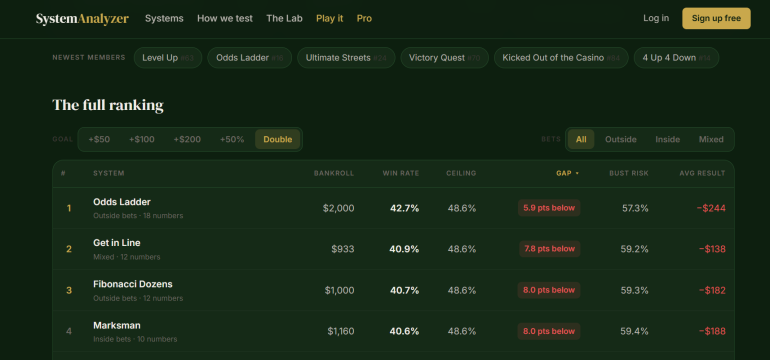 Done – the bigger goals are live. Following your suggestion, every system is now also tested at +50% of its own bankroll and at doubling it, on both wheels. You’ll find them as “+50%” and “Double” in the 100 Club, and in a “Bigger goals” box on every system page.
You were right that it changes the picture. A typical system sits about 5 points below the Bold Play ceiling at +$50 – but about 16 points below at +50% and 19 at doubling. And the ranking gets turned upside down:
Martingale: #1 at +$50 → #37 at doubling
Oscar’s Grind: #6 → #71
Labouchère: #14 → #41
Odds Ladder: #13 → #3
Quitte ou Double: last → #1 (for doubling it simply is Bold Play)
So your ladder really comes into its own with bigger goals – the flat one-unit stake is exactly what holds up over a long session. Thanks for the idea, it’s one of the most useful additions so far.
roulette-analyzer dot com /best-roulette-systems.php
But I did not expect Martingale to perform that poorly. Did you include a Hail Mary bet? Most betting systems that increase the bet size on a loss benefit from a Hail Mary bet. When you are at the point where you would need to scale up your bet but can't cover it with what you have left, you would make a Hail Mary bet where you put whatever you have left on the odds that would just cover the next escalation of bet increase.
For example, you have 150 units and fail the Martingale as you lose 7 times in a row, you would be left with 23 units but the next escalation requires 128 units. So you put all you have left on a six-line bet (5:1), which if you lose you are truly bust and if you win you get 138, just enough to cover the next escalation. If you win the Hail Mary but lose again, another Hail Mary would follow. This time, with 10 units, to get to 128 ones again (note: the target of the last Martingale step does not increase, if we are repeating Hail Marry bets), you would need to put everything on a split bet (17:1) to cover it.
We repeat this process until we either win on the Martingale or fail our Hail Mary.
If we can't make it with one Hail Mary bet, we need to stack them, starting with a straight-up bet.
For example, we have 256 units and we failed 8 times in a row, the next bet would be 256 units but we only have 1 unit left, we would make a straight-up bet to go to 36, then make a corner bet (8:1) to get to 324 so we can cover again.
Essentially, what this achieves is that we make complete use of our funds, which betting systems with increasing wagers struggle with. I can imagine this should boost Martingale by 5 percent in the double bankroll category.
Edit: added note
Simple list of odds you would be taking with a Hail Marry:
1:1 Even Money
2:1 Dozen / Column
5:1 Six Line
8:1 Corner
11:1 Line
17:1 Split
35:1 Straight Up
Results over 200,000 players on a European wheel, with the goal of doubling the bankroll:
100 units: 39.9% → 41.9%
150 units: 38.9% → 42.2%
255 units: 37.8% → 40.2%
So you’re right that it helps, about +2 to +3 percentage points, a bit short of 5. It works for the reason you gave: the leftover money gets used instead of sitting idle.
One fun comparison: putting your whole bankroll on red once doubles you 48.6% of the time. Every progression system lands below that, because each extra spin pays the house edge again. The Hail Mary moves Martingale a bit closer to that ceiling.
And good call on making it a separate system. “Martingale + Hail Mary” will go in next to the classic Martingale so people can compare them directly. Small naming note: the 11:1 bet is usually called a street (3 numbers).
I’d like to credit you on the system page. What name should I use?
Quote: 61984263For testing porpoises you could just introduce „Martingale with Hail Marry“ as a separate system.
Simple list of odds you would be taking with a Hail Marry:
1:1 Even Money
2:1 Dozen / Column
5:1 Six Line
8:1 Corner
11:1 Line
17:1 Split
35:1 Straight Up
link to original post
Dolphins?
Marry?
You need better spell check…
I am not disputing any of the analysis/math you guys are doing. I just don’t get the why!
Fair question. The “why” is mostly educational. Every week someone on YouTube presents a new system that “can’t lose”, and lots of people believe it. Saying “the house edge always wins” rarely convinces anyone, but showing it with 10,000 simulated players often does.
Ranking against bold play adds one more useful point. No system beats the house, but some lose your money a lot faster than others. If someone is going to play a system anyway, it’s better they know which ones are the worst.
And honestly, it’s fun to test ideas like the Hail Mary and see exactly how much (or how little) they move the numbers.
The K-series is a family of sequences where each term is the sum of the previous term and the term K steps back: a(n) = a(n−1) + a(n−K), starting with K ones. The choice of K controls how fast the bet grows after a loss. Two well-known special cases fall out of this family:
* K = 1 gives the doubling sequence 1, 2, 4, 8, … — exactly the Martingale progression when bet on even money.
* K = 2 gives the Fibonacci sequence 1, 1, 2, 3, 5, 8, … — exactly the Fibonacci Dozens progression when bet on a dozen.
This raised the question: given a bankroll and a target, what is the optimal betting strategy within this group? Right now this is still trial and error, so I chose 200 units as my bankroll and doubling it as my target. Here are the results for the best K-series for each odds, and the success rate I found:
Start: 200 units — Target: 400 units
Even money — K = 1 — 41.9% (Martingale)
Dozen — K = 2 — 44.1% (Fibonacci Dozens)
Six line — K = 6 — 45.0%
Corner — K = 15 — 45.0%
Street — K = 19 — 45.5%
Split — K = 30 — 44.0%
Straight up — K = 127 — 40.9%
First of all, the winner is the street bet with a K = 19 progression, resulting in a 45.5% success rate. This beats the established Fibonacci Dozens strategy by about 1.4 percentage points.
A few notes on the process:
1. These numbers were confirmed with 100,000 trials. When I ran only 10,000 trials, the street bet at K = 19 once appeared as high as 46.7% — pure noise, so I did not list it. The 100,000-trial confirmation is what makes these figures reliable.
2. For a fair comparison, every strategy here used the same "Hail Mary" salvage bet — a bet placed when the remaining bankroll can no longer cover the next wager increase. In that situation, the entire remaining bankroll is bet at the lowest odds that can still cover the needed amount, giving the best chance to recover.
3. These results are strictly optimized for a 200-unit bankroll with the goal of doubling it. The optimal strategy is bankroll-dependent. For example, using 50 units with the goal of doubling gives a different picture:
Start: 50 units — Target: 100 units
Even money — K = 1 — 43.9%
Dozen — K = 2 — 45.0%
Six line — K = 9 — 45.4%
Corner — K = 13 — 44.9%
Street — K = 27 — 43.6%
Split — K = 56 — 43.6%
Straight up — K = 127 — 43.4%
At 50 units, the six line (K = 9) takes the top spot at 45.4%, while street falls to 43.6%. My guess is that a smaller bankroll cannot survive the long droughts of the higher-odds bets, so a higher hit rate (six line, 16.2%) becomes more valuable than a higher payout per hit (street, 12×). With a 200-unit bankroll, there is enough runway to survive those droughts, so the higher payout of street becomes worth it.
When you compare the two tables, you also see that K changes — mostly upwards — when we lower the bankroll. Again, I suspect because of the droughts: the lower the K, the more a drought cuts into our bankroll, so we see that K increases as our starting bankroll gets shorter.
The optimal strategy within the K-series family depends on both the bet's odds, and the size of your bankroll, and your target. For a 200-unit bankroll aiming to double, street with K = 19 (45.5%) is the best of the group, narrowly edging out the classic Fibonacci Dozens.
One benchmark that might help: for doubling, the mathematical ceiling is known. It’s Bold Play (Dubins & Savage, 1965): bet as much as you need, or everything you have, on even money. To double, that’s simply one spin on red: 18/37 = 48.6%, whatever the bankroll. So your street K = 19 at 45.5% is about 3 points below the ceiling. That’s very good for a progression, most systems we’ve tested land much further below it. It also explains what you noticed: inside the K family the best choice depends on the bankroll, but the ceiling for doubling doesn’t.
And a quick follow-up on your Odds Ladder. We ran it through the same 10,000-player test as every other system in our catalog. It reaches +$50 about 95% of the time, and the average loss per session is tiny: at a +$100 goal it’s around $10, the second smallest of the 121 systems we’ve tested. The stake never grows, only the odds do, so the house edge has very little money to work on. We also let 112 systems play +$50 a day for a full month on the same spins, and the Odds Ladder finished second.
It doesn’t beat the house edge, nothing does, but it’s one of the smartest ideas we’ve seen. Full credit to Mathias (61984263), it’s now listed in the catalog under his name. Thanks for sharing it here. If anyone else has a system they’d like tested, post it and we’ll run the numbers.

On the fairness question: ranking by distance to bold play is a fair test of how efficiently a system spends its bankroll on one goal. The catch is the goal. At +$50 from $2,550 you're asking for 2% of the bankroll, so any deep martingale sits within a point of the ceiling, and the ranking mostly measures how deep the progression goes. The doubling-the-bankroll goal you added is where the systems actually separate, because there bold play's 48.6% on a single bet is hard to approach with anything timid.


