


https://wizardofvegas.com/forum/gambling/dice-setting/35372-dont-you-just-love-it/2/#post787041
>>>
I want to check some assumptions that I am not sure are correct, and my math could be wrong too
the question does come up, how much would a shooter have to deviate from random in order to have an advantage? So I go to the Wizard's pages, see first link, and find that the ratio that is used is called rolls to sevens, and the first increment seems to be a ration of 6.04 versus 6 for random. It strikes me right away as odd, since the change is noted in the denominator, ie 1/6 versus 1/6.04 ............ This is one thing I'm trying to check, can someone confirm that I am interpreting that right?
However if we try to put such a small change in the numerator, I can see why this is done. We get 0.99337748344/6 ........... yeah, that's awkward.
In the meantime it must be noted that the chart in the link shows player advantage at 6.04. For one thousand rolls, 166.667 [1000/6]would be random and 6.04 [1000/6.04] gets you 165.5629 per thousand, or about 1 roll of seven less, per thousand rolls! That's not much for sure.
So I am trying to see if I am interpreting it all correctly, or not.
https://wizardofodds.com/games/craps/appendix/4/
>>>
I'm at the point of being satisfied that my assumptions have been correct, rereading the link about rolls to sevens and also noting 1 divided by 6.04 and 0.99337748344 divided by 6 both equal 0.1655629139, so that has to be right. I also have to say the bit about 166.667 versus 165.5629 per thousand rolls is right, can't see how it would be wrong.
I'm still befuddled a bit by 'skill factor', not so much the idea but the ability to apply the math, so ... Well, anyway, one thing I note in the Wizard's pages on this is that somehow there is no mention of the 'flying V' dice set. If you can stay on axis with that set it rules out a roll of 7 using 5+2 or 6+1. If staying on axis, a big 'if' ha ha, the only possible rolls [will have] 2 sevens out of 16, or 1 out of 8 versus random's 1 out of 6. You can check this out yourself with a pair of dice. I wish we had a chart, then, with the effect of using even a random roll in the comeout and then following up with the flying V after a number is marked to be resolved. This has been my practice, but the Wizard's chart uses hardways sets for some reason.
Craps dot com image for the flying V
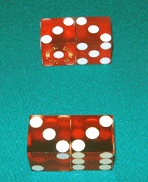
Actually any dice that are set as identical pairs, but then have one die turned 180 degrees like that, might produce the 'less 7s' effect, as far as I can tell; it can certainly be flying 2s instead of flying 3s.
>>>
I was thrown for a bit by realizing you can get different sets of numbers, 'depending'. It is easy to intend to start one die rotating and the next thing you know you've got the other one rotating and get lost.
OK, so with a die with 2 and 5 as the axis, giving the axis a right and left side by facing the 6, say, the 2 is on the left and the 5 is on the right, call it the 2-5 die. For the other die with 6 and 1 as the axis, arbitrarily facing the 5, the 6 is on the left and the 1 is on the right. The 6-1 die call it.
With the 2-5 die unchanged after throw, the four numbers we get with the spin of the 6-1 die are 8, 7, 5, 6, the last through double-pitch.
2-5 die making a rotation on axis that 6 comes up, making the four possibles 11, 10, 8, 9 same way.
2-5 die making another rotation the 4 comes, and the four possilbes are 9, 8, 2, 7 ...
2-5 die making last rotation, the 1 comes up and the four we get are 6, 5, 3, 4
we encountered two 7s out of 16
However, there can be a 5-2 die if we choose to face the 1 on the die, that is, 5 on the left, 2 on the right.
Going through the same way with the 6-1 die, 8, 7, 5, 6.... 6,5,3,4... 9,8,6,7... 11,10,8,9............. two 7s
There can be a 1-6 axis die if you choose to face the 2. Against a 2-5 die that does the rotation on axis:
1-6 die unchanged, 9,7,4,6
1-6 die has the 2 come up, 8,6,3,5
1-6 die has the 4 come up, 10,8,5,7
1-6 die has the 5 come up, 11,9,6,8.................... process also has two 7s
1-6 die now needs the numbers from a 5-2 die. Somebody may tell me these are not the only possibles but I hope this is it......................4,7,9,6... 3,6,8,5... 5,8,10,7... 6,9,11,8 ....................... two 7s
So there are 16 possibilities, but only for each of four scenarios, making 64, which has nearly killed me. Note that a player does not need to decide anything but to have the flying V, or even flying 2s, all of which is quickly set.
>>>
I'm still going with this.
I wanted to see just how many less 7s a player needs to roll before it's +EV in rightside Craps. So, I came up with this, and maybe you'll tell me it can't be done this way, but it seems to offer an insight unless I am very much mistaken. So I took the following,
the familiar figures for each number that can be rolled:
2....1/36 rolled and loses 1 unit
3.....2/36 rolled and loses 1
4.....3/36 rolled and wins 3/9 of the time
10.....3/36 rolled and wins 3/9 of the time
5...4/36 rolled and wins 4/10 of the time
9...4/36 rolled and wins 4/10 of the time
6...5/36 rolled and wins 5/11 of the time
8...5/36 rolled and wins 5/11 of the time
7 6/36 wins 1
11 2/36 wins 1
12 1/36 loses 1
I put it in a calculator as
[1/12*1/3]+[1/12*1/3]+[1/9*2/5]+[1/9*2/5]+[5/36*5/11]+[5/36*5/11]+[1/6]+[1/18]
for the winning combinations, in order those are 4,10,5,9,6,8, when winning, then 7,11 in come out
for the losing combinations,
-[1/12*2/3]-[1/12*2/3]-[1/9*3/5]-[1/9*3/5]-[5/36*6/11]-[5/36*6/11]-[1/36]-[1/36]-[1/18]
which is 4,10,5,9,6,8 when losing, then 2,12, 3 in come out
the sum of the winners is +0.4929292929292929
the sum of the losers is -0.5070707070707071
and the sum of both is the familiar -0.0141414141414142 house edge
So after pondering this quite a bit, decided what it would look like if the shooter rolled one less 7 in about one thousand rolls, and chose 972 rolls, a multiple of 36. I then postulated that if the shooter rolled one less 7, it would be when he set the dice for that in numbers to be resolved, while rolling without setting dice in the come outs. So in the equation, only the chances when resolving did I want to alter. To make the shooter slightly more unlucky, what is rolled instead of 7-out will be deemed to be a roll that does not resolve, so only the part of the equation that gives the wins is unchanged while the chances of a loss do indeed decrease slightly for each.
So when rolling to resolve, instead of the ratio 162 per 972 rolls [1/6] such shooter enjoys a mere 161, while the chances, say, for rolling an 8 stay at 5/36 or 135 per 972 rolls. This makes 161 ways to lose and 135 ways to win, 296 total ways, and 161/296, the chances of losing, now to be 0.5439189189189189 instead of the 6/11 that comes with random results, or 0.5454545454545455, a difference of 0.0015356265356266 which seems to fit. So in the losing equation above, the same process for each takes place and I get:
for the 5s and 9s, 4/36, or 108/972, 161 ways to lose vs 108, total of 269, 161/269 checks as 0.5985130111524164 chances instead of the 0.6 of random's 3/5
for the 4s and 10s, 3/36 = 81/972, and 161+81 = 242 total ways, 161/242 = 0.6652892561983471 which is mighty close to 2/3 and 67%
-[1/12*161/242]-[1/12*161/242]-[1/9*161/269]-[1/9*161/269]-[5/36*161/296]-[5/36*161/296]-[1/36]-[1/36]-[1/18] = -0.5060841337666279
that is reduced from -0.5070707070707071 however,
+0.4929292929292929-0.5060841337666279 = -0.013154840837335
I get a house edge of -1.31% for the 6.04 shooter versus -1.41% and that is definitely progress but the shooter has to be better it seems.
Now I do realize that this process is a little wonky, but to me it does not seem totally flawed. Or can somebody tell me that it is? If not totally flawed I am going to continue with it.
>>>
Trial and error continues, to see at what point rolling less 7s in an unknown way gets a player to +EV. The next level of skill noted by the Wizard is a 6.08 rolls to sevens shooter which indeed means we go to about two missing 7s after 1000 in theory if continuing with the assumption this means one 7 per 6.08 rolls, 1/6.08 instead of 1/6. I'll continue with the above stipulations, that the come-out rolls are without setting the dice and random results, and that rolling less 7s helps avoid 7-outs but does not increase the number of wins. That latter stipulation will have to change when we go to higher rolls to sevens, and that is going to give me a headache it looks like. I'm not expecting much change but let's see.
Sticking to the admittedly deviating 972 rolls, again instead of the ratio 162 per 972 rolls [1/6] such shooter enjoys a mere 160, while the chances for rolling a 6 or 8 stay at 5/36 or 135 per 972 rolls, total of 295 possibles for resolving.
for the 5s and 9s, 4/36, or 108/972, 160 ways to lose vs 108, total of 268 possibles.
for the 4s and 10s, 3/36 = 81/972, and 160+81 = 241 total ways.
-[1/12*160/241]-[1/12*160/241]-[1/9*160/268]-[1/9*160/268]-[5/36*160/295]-[5/36*160/295]-[1/36]-[1/36]-[1/18] = -0.5050902973936376
-0.5050902973936376+0.4929292929292929 = -0.0121610044643447
-1.22% ; so we are getting somewhere but not to +EV
How do I solve the need to adjust the winning side of the equation if I go to, say, 6 less rolls than random of seven, per 972? Help accepted!