


Easy physics puzzles
Poll
| No votes (0%) | |||
 | 2 votes (22.22%) | ||
| | 2 votes (22.22%) | ||
| | 2 votes (22.22%) | ||
| No votes (0%) | |||
| | 1 vote (11.11%) | ||
| No votes (0%) | |||
| No votes (0%) | |||
| | 2 votes (22.22%) | ||
| No votes (0%) |
9 members have voted

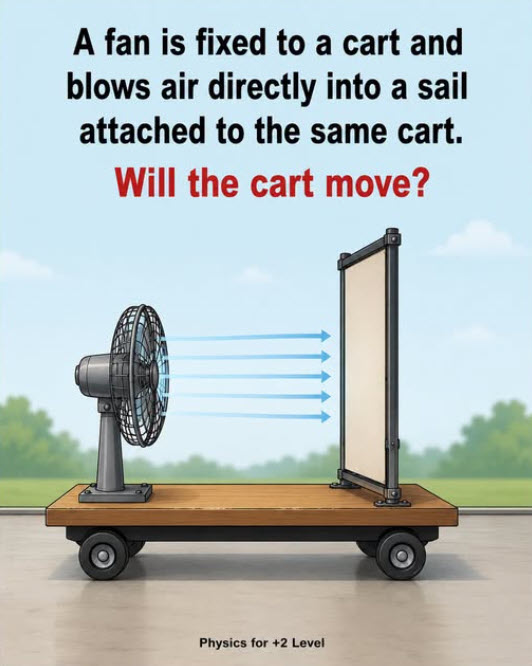
I saw this on my Facebook feed, which links to this page. Fair warning I don't know the answer, but have an opinion.
The question for the poll is who is your favorite member of the Manhattan Project?

Quote: Wizard
I saw this on my Facebook feed, which links to this page. Fair warning I don't know the answer, but have an opinion.
The question for the poll is who is your favorite member of the Manhattan Project?
link to original post
Well, my first answer was No, the cart will not move. The action of the fan blades dragging on the air produces a net force backward which offsets the force of the air being driven into the "sail."
But I am a bit unsure. There must be an onboard power source - say, an electric battery that is powering the fan and putting energy into the system but that is not shown in illustration. So external energy is being applied to the cart and thus it is plausible that the cart is permitted to have net momentum.
Secondly, considering the air as a fluid, the action of the rotating fan is essentially causing a reduced air density at the point of the fan This creates a wake in the air to the left of the fan which will actually cause air movement - a slight breeze - going from left to right. Think of it this way: As the fan pushes air forward, a vacuum would occur around the fan unless air was moving into the fan. Thus air is sucked into the fan and the flowing air will tend to act on the structure of the fan and cart and tend to move the entire cart forward. This is consistent with the observation that the cart is not a closed system; the 'closed system' is the cart plus the upstream and downstream air plus the on-board battery.
However, I must point out that the screen/sail is so close to the rotating fan that there will be backflow from the screen/sail into the fan, inevitably causing some turbulence and possible disruption of the idealized aerodynamics of the fan. It might even affect the mechanical rotation of the fan blades if the distance between the fan and screen is small enough.
So, it is complicated.


I think the cart will move to the left. Without the sail, there would be a recoil effect from the fan blowing right, as well as a vacuum, causing the cart to move left. This is partially mitigated by the sail. However, there will be some loss of air movement between the fan and the sail, for the same reason a hand held fan won't do much good if it is held six feet from your head.

Quote: rainmanThe screen/sail are bolted to the cart the fan is bolted to the cart any force put into the sail is canceled out by the thrust created in the opposite direction.
link to original post
As I said in my spoiler box this would be true if the cart (or boat) were a closed system. But the cart/boat has a battery or combustion engine that is rotating the fan, so you are putting energy into the cart from the battery/engine and thus conservation of momentum need no longer apply.
The rotating fan sucks air into its rotating blades and actually creates a sustained wind or air flow that is not present when the fan is turned off. The entire 'closed system' includes the cart, the engine/battery and the air, not just the cart.
Quote: gordonm888Quote: rainmanThe screen/sail are bolted to the cart the fan is bolted to the cart any force put into the sail is canceled out by the thrust created in the opposite direction.
link to original post
As I said in my spoiler box this would be true if the cart (or boat) were a closed system. But the cart/boat has a battery or combustion engine that is rotating the fan, so you are putting energy into the cart from the battery/engine and thus conservation of momentum need no longer apply.
The rotating fan sucks air into its rotating blades and actually creates a sustained wind or air flow that is not present when the fan is turned off. The entire 'closed system' includes the cart, the engine/battery and the air, not just the cart.
link to original post
Took me awhile to get this got it now thanks.

Quote: Wizard
I think the cart will move to the left. Without the sail, there would be a recoil effect from the fan blowing right, as well as a vacuum, causing the cart to move left. This is partially mitigated by the sail. However, there will be some loss of air movement between the fan and the sail, for the same reason a hand held fan won't do much good if it is held six feet from your head.
link to original post
Yes, I think you have it!
To create a clearer mental picture of it:
1. What if... the screen was just a pencil?
2. What if everything was the same size as pictured, except the cart was a mile long?
3. If the cart was a mile long, would it make any difference if the screen was a mile wide, was a pencil, or was as pictured?
Putting those 3 things together, you'll see why the assembly moving left, albeit not very efficiently, is likely.
Quote: charliepatrickSpoiler : Mythbusters tried this and you can see the result at https://www.youtube.com/watch?v=vVlsKdQ-o3I . It's so funny but I won't reveal their result!
link to original post


Quote: acesideI’d say that the above is not a physics problem, if the system is in an air environment. It’s a fluid dynamics problem. However, it’s a good physics problem, if it is in a vacuum environment. How will the system move in vacuum?
link to original post
aceside,
In a vacuum the fan is useless, so the cart remains stationary.
Dog Hand

Least Favorite: Donald William Kerst, because he gave me an F in a physics course even though I aced all of the exams for that semester because my lab writeups were quite superficial.
An interesting related topic: https://en.wikipedia.org/wiki/Blackbird_(wind-powered_vehicle)
Quote: DogHandQuote: acesideI’d say that the above is not a physics problem, if the system is in an air environment. It’s a fluid dynamics problem. However, it’s a good physics problem, if it is in a vacuum environment. How will the system move in vacuum?
link to original post
aceside,
In a vacuum the fan is useless, so the cart remains stationary.
Dog Hand
link to original post
No, probably not right. The fan has a mass and a spin and thus an angular momentum. The base has a mass and thus applies a torque on the spin; therefore, there is a movement for this system in vacuum.
A MIT professor demonstrated this using a bicycle wheel that was attached to a vertical rope at one wheel axis. You can just search the video to find the motion.
Quote: acesideQuote: DogHandQuote: acesideI’d say that the above is not a physics problem, if the system is in an air environment. It’s a fluid dynamics problem. However, it’s a good physics problem, if it is in a vacuum environment. How will the system move in vacuum?
link to original post
aceside,
In a vacuum the fan is useless, so the cart remains stationary.
Dog Hand
link to original post
No, probably not right. The fan has a mass and a spin and thus an angular momentum. The base has a mass and thus applies a torque on the spin; therefore, there is a movement for this system in vacuum.
link to original post
Perhaps a movement, but not a linear translation. What would cause a linear translation in a vacuum? The lunar rovers worked just fine, but we used the motor to drive wheels in that case. The wheels themselves were not in vacuum; they were pressed against matter, the surface of the moon. If the rover was floating in space the wheels wouldn't do anything there.
Quote: acesideQuote: DogHandQuote: acesideI’d say that the above is not a physics problem, if the system is in an air environment. It’s a fluid dynamics problem. However, it’s a good physics problem, if it is in a vacuum environment. How will the system move in vacuum?
link to original post
aceside,
In a vacuum the fan is useless, so the cart remains stationary.
Dog Hand
link to original post
No, probably not right. The fan has a mass and a spin and thus an angular momentum. The base has a mass and thus applies a torque on the spin; therefore, there is a movement for this system in vacuum.
A MIT professor demonstrated this using a bicycle wheel that was attached to a vertical rope at one wheel axis. You can just search the video to find the motion.
link to original post
No, there is no torque on a fan spinning in vacuum except the equal and opposite torques from the motor and friction which are parallel to the axis of rotation. Torques parallel to the angular momentum do not induce precession. So, in the case where the motor and frictional forces were not balanced, the effect would just be acceleration of the fan speed, not precession. At any rate, precession is rotational movement, not linear movement.
If the cart was drifting in the vacuum of space, the velocity of the center of mass of the cart would not change just because the fan was switched on or off. If a fan blade was flung off, the cart would move in the opposite direction.
See this YouTube video to see if you would agree with me or not “This video is a part of a lecture from MIT open courseware. The teacher is Prof. Walter Lewin.”
Quote: acesideI believe there is a torque applying on the spinning fan. The torque comes from the weight of the fan itself, in other words, it’s the gravity on the fan that twists the spinning fan. Therefore, the motion includes two parts, spin and precession.
See this YouTube video to see if you would agree with me or not “This video is a part of a lecture from MIT open courseware. The teacher is Prof. Walter Lewin.”
link to original post
Newton's First Law! It's a reliable one. Once the fan blade is accelerated to its maximum velocity there is no more torque on it. Now there was torque on it while it was accelerating, so if the whole thing was floating in space the fan blades would be spinning with an angular momentum, and the rest of the works on the other side of the fan axle would be spinning in the opposite direction with the same angular momentum.
Quote: AutomaticMonkeyQuote: acesideI believe there is a torque applying on the spinning fan. The torque comes from the weight of the fan itself, in other words, it’s the gravity on the fan that twists the spinning fan. Therefore, the motion includes two parts, spin and precession.
See this YouTube video to see if you would agree with me or not “This video is a part of a lecture from MIT open courseware. The teacher is Prof. Walter Lewin.”
link to original post
Newton's First Law! It's a reliable one. Once the fan blade is accelerated to its maximum velocity there is no more torque on it. Now there was torque on it while it was accelerating, so if the whole thing was floating in space the fan blades would be spinning with an angular momentum, and the rest of the works on the other side of the fan axle would be spinning in the opposite direction with the same angular momentum.
link to original post
in the video when they tried this experiment on a boat with a fan and a sail, they turned the fan on and the boat started spinning.
Quote: gordonm888Quote: AutomaticMonkeyQuote: acesideI believe there is a torque applying on the spinning fan. The torque comes from the weight of the fan itself, in other words, it’s the gravity on the fan that twists the spinning fan. Therefore, the motion includes two parts, spin and precession.
See this YouTube video to see if you would agree with me or not “This video is a part of a lecture from MIT open courseware. The teacher is Prof. Walter Lewin.”
link to original post
Newton's First Law! It's a reliable one. Once the fan blade is accelerated to its maximum velocity there is no more torque on it. Now there was torque on it while it was accelerating, so if the whole thing was floating in space the fan blades would be spinning with an angular momentum, and the rest of the works on the other side of the fan axle would be spinning in the opposite direction with the same angular momentum.
link to original post
in the video when they tried this experiment on a boat with a fan and a sail, they turned the fan on and the boat started spinning.
link to original post
Sure, but that's not from the rotation of the fan blade because sometimes the boat spins clockwise, other times counterclockwise. Same equipment.
Quote: acesideI believe there is a torque applying on the spinning fan. The torque comes from the weight of the fan itself, in other words, it’s the gravity on the fan that twists the spinning fan. Therefore, the motion includes two parts, spin and precession.
See this YouTube video to see if you would agree with me or not “This video is a part of a lecture from MIT open courseware. The teacher is Prof. Walter Lewin.”
link to original post
I cannot follow the link.
There is no net torque on the armature of the motor and fan blade. A top that is not spinning will fall over immediately due to gravitational torque. If the fan is not spinning, it will not fall over because there is no net torque acting on it to topple it. The torque that gravity applies is counteracted by the counter-torque the base via the mounts. Zero net torque.
If you see a demonstration of a bike wheel supported on ONE end of the axle, there is torque from gravity that is not counteracted. The wheel will precess in that case.
If the axle is supported on both ends, then there will be no net torque and no precession of the wheel.
The fan motor/blade assembly is supported by two bearings that will cancel out any torque on the assembly due to gravity.
You say "The base has a mass and thus applies a torque on the spin." In the actual problem, the mass of the base is not specified because it has no bearing on the problem. In free-fall in space, gravity exerts no torques on the system at all (unless you are near the event horizon of a black hole where the gradient of gravity comes into play).

You have two balls, each of radius 1m. One has a mass of 1 kg, and the other has a mass of 2 kg.
You drop both of them from near the top of the STRAT tower; note that the distance from the center of mass of each one to the center of mass of Earth is a constant. Also assume that the distance from each one to the ground is the same.
Which one hits the ground first?
Quote: ThatDonGuyHere's my problem - at least, I think I have this right:
You have two balls, each of radius 1m. One has a mass of 1 kg, and the other has a mass of 2 kg.
You drop both of them from near the top of the STRAT tower; note that the distance from the center of mass of each one to the center of mass of Earth is a constant. Also assume that the distance from each one to the ground is the same.
Which one hits the ground first?
link to original post
The two kilogram ball has twice the potential energy and the 1 kg ball. Since there is substantial air resistance and it is equal for the the two balls at equal speed, the heavier ball will lose a smaller fraction of its potential energy to air resistance as it falls. Therefore, it will accelerate faster than the lighter ball all the way to the ground.
The force of air resistance increases linearly with speed.
Quote: Mental
If the axle is supported on both ends, then there will be no net torque and no precession of the wheel.
I totally agree with you here! If the bicycle wheel is supported on Both ends of its axis, then the torque is zero and thus there is no precession at all. However, in this picture, the fan is supported on One end of its axis; therefore, there is a non-zero torque from gravity, just like Walter Lewin's YouTube demonstration.
Of course, the picture is more complicated than Walter Lewin's experiment, because I think the base of the electric fan is not pinned down at a fixed floor spot. So, I guess it is more complicated than that.
Direct: https://www.youtube.com/watch?v=vVlsKdQ-o3I
Quote: ThatDonGuyHere's my problem - at least, I think I have this right:
You have two balls, each of radius 1m. One has a mass of 1 kg, and the other has a mass of 2 kg.
You drop both of them from near the top of the STRAT tower; note that the distance from the center of mass of each one to the center of mass of Earth is a constant. Also assume that the distance from each one to the ground is the same.
Which one hits the ground first?
link to original post
ThatDonGuy,
Here's my answer:
The volume of each sphere is V = 4/3×π×R³, so for R = 1 meter, V = 4.1888... m³, or 4188.8... liters.
Assuming a pressure of 1 atm and a temperature of 25°C, and using the Ideal Gas Law, the mass of the air displaced by each sphere is given by m = MW*P*V/(R*T), where MW = 29 g/mol is the molecular weight of air, P= 1 atm is its pressure, T = 25°C = 298 K is its absolute temperature, and R = 0.082 liter*atm/(mol*K) is the IGL constant.
Inserting the variables gives
m = (29 g/mol)*(1 atm)*(4188.8 liters)/[(0.082 liter*atm/(mol*K))*(298 K)] = 4917 g, or 4.917 kg.
Thus, each sphere has a lower mass than the air it displaces, so each sphere will rise.
Dog Hand
The density of air at 25 degree Celsius at 1 atm is 1.184 kg/m^3, and the sphere volume is 4/3×π×R³=4.1888 m³.
Therefore, the mass of air inside of this sphere is
1.184x4.1888=4.96 kg.
Quote: ThatDonGuyHere's my problem - at least, I think I have this right:
You have two balls, each of radius 1m. One has a mass of 1 kg, and the other has a mass of 2 kg.
You drop both of them from near the top of the STRAT tower; note that the distance from the center of mass of each one to the center of mass of Earth is a constant. Also assume that the distance from each one to the ground is the same.
Which one hits the ground first?
link to original post
The problem is not defined clearly. If the balls are evacuated spheres, then they will both imploded within milliseconds and the pieces of the 2-kg ball will hit the ground before the lighter shards of the 1-kg ball.
If they are both whiffle balls, they will not implode, and the heavier one will hit the ground first. This assumes that the problem states the mass of the solid material in the ball and not the air inside the ball. If there is less than 1 kg of air and ball material, then the air pressure inside the ball will not counteract the 30 tons of force that the atmosphere is exerting on the surface of the ball.
I must assume that the problem as posed only states the weight of the solid material in the ball, otherwise the balls cannot be constructed with the specified masses using known materials.
You have two balls, each of radius 10cm. One has a mass of 5 kg, and the other has a mass of 10 kg.
You drop both of them from near the top of the STRAT tower; note that the distance from the center of mass of each one to the center of mass of Earth is a constant. Also assume that the distance from each one to the ground is the same.
Assume there is no air resistance, or any force on each ball other than the gravitational force between that ball and Earth.
Which one hits the ground first?
He figured this one out remember?
The force of gravity is stronger on the heavier. But it also has more inertia. These cancel out and they fail at the same rate
that the acceleration is the same is the result
Quote: WizardYou are in a canoe floating on a lake. You drop a large rock from the canoe into the water. Does the water level rise or fall relative to the shore?
link to original post
For floating objects, the volume of water displaced = the volume of water with the same mass as the object. For submerged onces, the volume of water displaced = the volume of the object. Since, for a rock, the first one is greater, less water is displaced when the rock is thrown into the water, so the level goes down.
the displacement of water by the boat while rock is in it is owing to weight. The displacement by the rock after being thrown is owing to volume assuming it is heavier than water. Seems to me these could be two different values?Quote: WizardYou are in a canoe floating on a lake. You drop a large rock from the canoe into the water. Does the water level rise or fall relative to the shore?
link to original post
There in an assembly where the bowl shaped one is concave side up and filled with a solution of borax in water. The other piece slides down a tube from the ceiling, where upon making contact it will displace the borated water and form a sphere with its mate.
What am I doing?
Quote: AutomaticMonkeyOn my kitchen table there are two metal objects defined in spherical dimensions. The first one is biconvex, with one side having a radius of curvature of +50 mm and the other side has a radius of +30 mm. For the second object, the one side also has a radius of +50 mm and the second side a radius of -30 mm, forming a meniscus, a bowl shaped object. Placed together they would form a solid sphere of 50 mm radius.
There in an assembly where the bowl shaped one is concave side up and filled with a solution of borax in water. The other piece slides down a tube from the ceiling, where upon making contact it will displace the borated water and form a sphere with its mate.
What am I doing?
link to original post
It depends on the metal, but I have a feeling it's

Quote: acesideAn air bubble is trapped in a water tank truck full of water. If the truck is accelerating forward, in which direction would the bubble move, forward or backward?
link to original post
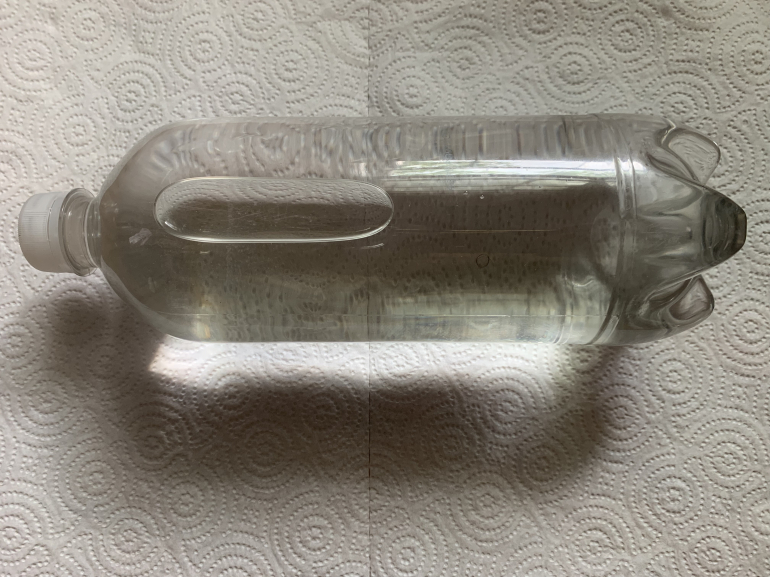
So it's like these devices?

Picture the acceleration vector from gravity, and what it does to the bubble and fluid in the level as the level is tilted. That acceleration can be drawn as two vectors, one parallel to and the other perpendicular to the surface of the level.
And your answer pops out of that!
Quote: acesideAn air bubble is trapped in a water tank truck full of water. If the truck is accelerating forward, in which direction would the bubble move, forward or backward?
link to original post
Forward.
Here is the answer I was thinking of:Quote: ThatDonGuyYou have two balls, each of radius 10cm. One has a mass of 5 kg, and the other has a mass of 10 kg.
You drop both of them from near the top of the STRAT tower; note that the distance from the center of mass of each one to the center of mass of Earth is a constant. Also assume that the distance from each one to the ground is the same.
Assume there is no air resistance, or any force on each ball other than the gravitational force between that ball and Earth.
Which one hits the ground first?
link to original post
Most people would remember Galileo's experiment at the Leaning Tower of Pisa, or perhaps one done on the Apollo 15 moon mission with a hammer and a feather, and say that they land at the same time.
That would be true, except for one detail that most people leave out.
The gravitational force that every object has on every other object = G m M / r^2, where:
G is "Newton's gravitational constant" (that's what I call it, anyway) of 6.6743 x 10⁻¹¹ m3 / (kg sec2)
m and M are the masses of the two objects
r is the distance between their centers of mass
Since force = mass x acceleration, the acceleration of an object falling towards Earth = (G m M / r^2) / m = G M / r^2, where M is the mass of Earth and r the distance from the center of mass of the falling object to the center of Earth. Notice that the mass of the object is irrelevant, so the two balls "should" fall at the same speed.
What was left out? Each ball exerts the same force on Earth that Earth exerts on the ball (Newton's Third Law of Motion?), so Earth is also being pulled toward the ball; the acceleration would be G m / r^2, where m is the mass of the ball.
If m = 5 kg and r = 6371 km, this is 8.2217 x 10⁻¹⁸ m / sec2.
If m = 10 kg and r = 6371 km, this is 1.6.443 x 10-17 m / sec2.
It's not by much (that's putting it mildly), but the heavier ball will reach the ground first.


