


Easy math puzzles
Poll
 | 25 votes (47.16%) | ||
| | 17 votes (32.07%) | ||
| | 7 votes (13.2%) | ||
| | 4 votes (7.54%) | ||
| | 12 votes (22.64%) | ||
| | 4 votes (7.54%) | ||
| | 6 votes (11.32%) | ||
| | 5 votes (9.43%) | ||
| | 12 votes (22.64%) | ||
| | 10 votes (18.86%) |
53 members have voted

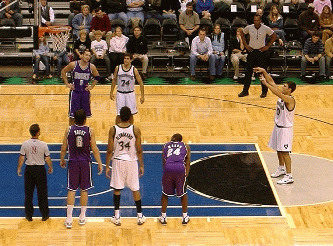
A basketball player’s free throw percentage describes how often they successfully throw the ball into the basket from the free throw line in official games.
If a player’s free throw percentage is initially below 75 percent and later above 75 percent, can it be said with certainty that it was exactly 75 percent at some point in between?

Quote: GialmereLet's shoot some hoops...
A basketball player’s free throw percentage describes how often they successfully throw the ball into the basket from the free throw line in official games.
If a player’s free throw percentage is initially below 75 percent and later above 75 percent, can it be said with certainty that it was exactly 75 percent at some point in between?
link to original post
Intuitively I thought ‘no’. But I can’t think of any scenario that does not include an exact 75%. So I’ll say ‘yes’.
SOOPOO hit 32 straight a few days ago. And had 104/105 earlier this year.

Quote: GialmereLet's shoot some hoops...
A basketball player’s free throw percentage describes how often they successfully throw the ball into the basket from the free throw line in official games.
If a player’s free throw percentage is initially below 75 percent and later above 75 percent, can it be said with certainty that it was exactly 75 percent at some point in between?
link to original post
No.
Proof:
Let the player have made a free throws in b attempts.
If the player went from < 75% to > 75% without ever being at exactly 75%, then it was done in one shot.
In order for this to happen, a / b < 3/4, and (a + 1) / (b + 1) > 3/4
a / b < 3/4 means 4a < 3b
(a + 1) / (b + 1) > 3/4 means 4 (a + 1) > 3 (b + 1), or 4a + 4 > 3b + 3, or 4a + 1 > 3b
4a < 3b < 4a + 1, but this is impossible if a and b are integers as 4a and 4a + 1 are consecutive integers, which means no integer is greater than one and less than the other.
Quote: SOOPOOIntuitively I thought ‘no’. But I can’t think of any scenario that does not include an exact 75%. So I’ll say ‘yes’.
Quote: ThatDonGuyNo.
Proof:
Let the player have made a free throws in b attempts.
If the player went from < 75% to > 75% without ever being at exactly 75%, then it was done in one shot.
In order for this to happen, a / b < 3/4, and (a + 1) / (b + 1) > 3/4
a / b < 3/4 means 4a < 3b
(a + 1) / (b + 1) > 3/4 means 4 (a + 1) > 3 (b + 1), or 4a + 4 > 3b + 3, or 4a + 1 > 3b
4a < 3b < 4a + 1, but this is impossible if a and b are integers as 4a and 4a + 1 are consecutive integers, which means no integer is greater than one and less than the other.
Correct!!
Well done. (ThatDonGuy obviously meant yes.)
--------------------
In Tetris, players try to efficiently pack a rectangular space with pieces that can have seven different shapes. As it happens, if you have exactly one of each of those seven possible pieces, then it is impossible to arrange them into a rectangle. But there is one piece you can discard that will allow you to make such an arrangement.
Which piece must be discarded?
Show the 2 rectangles that the 6 correct shapes can make. (Assuming you can think of a way to show it.)
Just as in Tetris, you may rotate pieces but not reflect them. In other words, if the pieces were cutouts on a table, then you could slide them and spin them but never lift them off the table.


Buuuuzzzzzzzzzzzzzz.............
No solves comrades? Stories were true. Western powers are weak and decadent. Launching nukes.
Each piece, no matter how it is placed, will cover exactly two white squares and two black squares of the rectangle’s checkerboard, except for the T-shaped piece, which will cover three of one shade and one of the other. Any rectangle built from Tetris pieces must contain an even number of squares total (four squares per piece). This means the rectangle will have an equal number of black squares and white squares. The T-shaped piece will create an imbalance that none of the other pieces can correct.
Discarding the T-shaped piece, we can create a 3 × 8 or a 4 × 6 rectangle from the other pieces like so:
:strip_icc()/pic9878744.gif)
Note that with two sets of pieces, the two T shapes could be offset to compensate for each other, thus allowing a rectangle to form.
---------------------

Melvin and Rachel have created new thermometer scales.
On the Melvin scale, water freezes at 5° M and boils at 45° M.
On the Rachel scale, water freezes at 50° R and boils at 110° R.
What temperature on the Melvin scale is 74° R?
Quote: GialmereSun is shinin' in the sky. There ain't a cloud in sight...
Melvin and Rachel have created new thermometer scales.
On the Melvin scale, water freezes at 5° M and boils at 45° M.
On the Rachel scale, water freezes at 50° R and boils at 110° R.
What temperature on the Melvin scale is 74° R?
link to original post
Quote: GialmereSun is shinin' in the sky. There ain't a cloud in sight...
Melvin and Rachel have created new thermometer scales.
On the Melvin scale, water freezes at 5° M and boils at 45° M.
On the Rachel scale, water freezes at 50° R and boils at 110° R.
What temperature on the Melvin scale is 74° R?
link to original post
74° R is 24/60, or 2/5, of the way from freezing to boiling
On the Melvin scale, this would be 5 + 2/5 x (45 - 5) = 21° M
Why do I have the feeling the answer to your next question is -85° ?

Quote: GialmereSun is shinin' in the sky. There ain't a cloud in sight...
Melvin and Rachel have created new thermometer scales.
On the Melvin scale, water freezes at 5° M and boils at 45° M.
On the Rachel scale, water freezes at 50° R and boils at 110° R.
What temperature on the Melvin scale is 74° R?
link to original post
Conventionally The letter R refers to the Rankine Temperature, so Rachel would not be able to use that nomenclature for her own temperature scale.
Quote: KevinAA
21
Quote: ThatDonGuy
74° R is 24/60, or 2/5, of the way from freezing to boiling
On the Melvin scale, this would be 5 + 2/5 x (45 - 5) = 21° M
Why do I have the feeling the answer to your next question is -85° ?
Correct!
Very good.
Consider ThatDonGuy's solve to be official.
--------------------
In American checkers rules, pieces only occupy the dark squares of an 8 x 8 checkerboard, and pieces can capture neighboring opposing pieces by jumping over them.
A regular piece can capture an opposing piece when it is diagonally adjacent to that piece and the square directly beyond the to-be-captured piece is vacant. If capturing a different piece from this new square is legal, then the piece continues capturing until no further capture is available.
Kings capture other pieces the same way but can also move backward, and kings can move forward and backward within the same turn.
When tallying captured pieces, kings count the same as unpromoted checkers—each only contributes one piece to the count.
What is the maximum number of pieces that can be captured in a single turn of American checkers?
You can tinker with a digital checkerboard by clicking “Set up position” here.,
This assumes that American rules prevent promoting a piece and then continuing the move, which I think is allowed in British draughts, although the answer might be the same anyway.
You cannot capture a piece on a board edge, and since a jump moves a piece two rows, the captured pieces must be on alternating rows, which leaves 9 spaces where pieces can be captured; there is definitely a way to capture 9.
Two players, and a pile of some integer N > 2 objects
The first player divides the pile into two (not necessarily equal) piles
Starting with the second player, the players alternate dividing any one pile that has two or more objects into two piles.
The last person to do so wins.
Who wins, and what is their strategy?
(There are different answers for different values of N)
Quote: ThatDonGuyI think it's 9
This assumes that American rules prevent promoting a piece and then continuing the move, which I think is allowed in British draughts, although the answer might be the same anyway.
You cannot capture a piece on a board edge, and since a jump moves a piece two rows, the captured pieces must be on alternating rows, which leaves 9 spaces where pieces can be captured; there is definitely a way to capture 9.
Correct!!
Very good!
:strip_icc()/pic9882196.gif)
To see why you can’t exceed nine captures, number the rows as above and observe that checkers in odd-numbered rows can only capture checkers in even-numbered rows, and vice versa. Furthermore, if a capturing piece begins in an odd-numbered row, then it also ends its capture in an odd-numbered row (and captures that begin in even-numbered rows end in even-numbered rows).
So the pieces captured on a single turn must all reside in odd rows or even rows. This cuts the 32 dark squares into only 16 possible slots for pieces captured on a single turn. Also, pieces on the very edge of the board can never be captured because no vacant square can lie beyond them. There are seven dark squares in odd-numbered rows on the edge of the board and seven in even-numbered rows. This lowers the 16 available squares from each parity down to nine.
Although nine sequential captures almost certainly would never occur in a real game, it is possible through legal (albeit bizarre) play.
....................
Quote: ThatDonGuyHere's an easy one - in fact, it's probably The World's Easiest Game Theory Problem:
Two players, and a pile of some integer N > 2 objects
The first player divides the pile into two (not necessarily equal) piles
Starting with the second player, the players alternate dividing any one pile that has two or more objects into two piles.
The last person to do so wins.
Who wins, and what is their strategy?
(There are different answers for different values of N)
link to original post
Quote: ThatDonGuyHere's an easy one - in fact, it's probably The World's Easiest Game Theory Problem:
Two players, and a pile of some integer N > 2 objects
The first player divides the pile into two (not necessarily equal) piles
Starting with the second player, the players alternate dividing any one pile that has two or more objects into two piles.
The last person to do so wins.
Who wins, and what is their strategy?
(There are different answers for different values of N)
link to original post
No takers? Here's the answer:
If N is even, the first player always wins, and if N is odd, the second player always wins, regardless of any "strategy."
The game begins with 1 pile. Each turn increases the number of piles by 1. The game ends when there are N piles, each with 1 object, so there will always be N-1 turns.
Find all integer-sided rectangles with equal area and perimeter.
Quote: GialmereHere's a simple Sunday one...
Find all integer-sided rectangles with equal area and perimeter.
link to original post
Well, since nobody else seems to want to answer this one...
Let a and be the lengths of the two sides; we are looking for 2a + 2b = ab, where and b are positive integers
2b = ab - 2a = a (b - 2)
a = 2b / (b - 2) = (2b - 4 + 4) / (b - 2) = 2 + 4 / (b - 2)
Since a is an integer, 4 / (b - 2) must also be an integer; since b is positive, b >= 3
b = 3 -> a = 2 + 4 / (3 - 2) = 6
b = 4 -> a = 2 + 4 / (4 - 2) = 4
b = 5 -> a = 2 + 4 / (5 - 2) = 10/3, which is not an integer
b = 6 -> a = 2 + 4 / (6 - 2) = 3
b > 6 -> 4 / (b - 2) is between 0 and 1, so a cannot be an integer
The only solutions are 3 x 6 and 4 x 4
Quote: ThatDonGuyQuote: GialmereHere's a simple Sunday one...
Find all integer-sided rectangles with equal area and perimeter.
link to original post
Well, since nobody else seems to want to answer this one...
Let a and be the lengths of the two sides; we are looking for 2a + 2b = ab, where and b are positive integers
2b = ab - 2a = a (b - 2)
a = 2b / (b - 2) = (2b - 4 + 4) / (b - 2) = 2 + 4 / (b - 2)
Since a is an integer, 4 / (b - 2) must also be an integer; since b is positive, b >= 3
b = 3 -> a = 2 + 4 / (3 - 2) = 6
b = 4 -> a = 2 + 4 / (4 - 2) = 4
b = 5 -> a = 2 + 4 / (5 - 2) = 10/3, which is not an integer
b = 6 -> a = 2 + 4 / (6 - 2) = 3
b > 6 -> 4 / (b - 2) is between 0 and 1, so a cannot be an integer
The only solutions are 3 x 6 and 4 x 4
link to original post
Correct!!
Excellent.
Consider ThatDonGuy's solve to be official.
--------------------
:strip_icc()/pic9884770.gif)
"Goblins and ghoulies from last Halloween, awaken the spirits with your tambourine!"
So says Madam Leota in the seance room at Disneyland's Haunted Mansion. The Ghost Host also points out...
"There are several prominent ghosts who have retired here from creepy old crypts all over the world. Actually, we have 999 happy haunts here..."
Of course, that was in 1969 when the attraction first opened. But, how many of the dearly departed now call the place tomb sweet tomb?
:strip_icc()/pic9884771.gif)
Replace the letters above with numbers that add up correctly.
There are 10 different letters, one for each of the digits 0 - 9.

Your cadaverous pallor betrays an aura of foreboding, almost as though you sense a disquieting metamorphosis. Is this haunted puzzle actually unsolvable? Or is it your imagination — hmm? And consider this dismaying observation: this post has no windows and no doors… which offers you this chilling challenge: to find a mathamatical way out! Ah ha ha ha ha ha...
:strip_icc()/pic9888778.gif)

Quote: GialmereWelcome foolish mortals...
"Goblins and ghoulies from last Halloween, awaken the spirits with your tambourine!"
So says Madam Leota in the seance room at Disneyland's Haunted Mansion. The Ghost Host also points out...
"There are several prominent ghosts who have retired here from creepy old crypts all over the world. Actually, we have 999 happy haunts here..."
Of course, that was in 1969 when the attraction first opened. But, how many of the dearly departed now call the place tomb sweet tomb?
Replace the letters above with numbers that add up correctly.
There are 10 different letters, one for each of the digits 0 - 9.
link to original post
526090+526830+5613740=6,666,660
Quote: aceside
526090+526830+5613740=6,666,660
link to original post
Correct!!
A spookey solve by aceside.
Oh, I didn’t mean to frighten you prematurely. The real chills come later this week. For now, beware of hitchhiking ghosts and...

--------------------
