

Oasis Poker

Simulations indicate that players should choose to switch all 5 cards in 6.7% of the rounds with cost equal to 1x ante.
The corresponding house edge is = - 0.60%+-.
I might have calculated it wrong. Can anyone verify this?
The combinatorial analysis would take about 25 hours, so I have no intention of doing it at this stage.

Below are the results of the combinatorial analysis (CA), which took about 29 hours to complete:
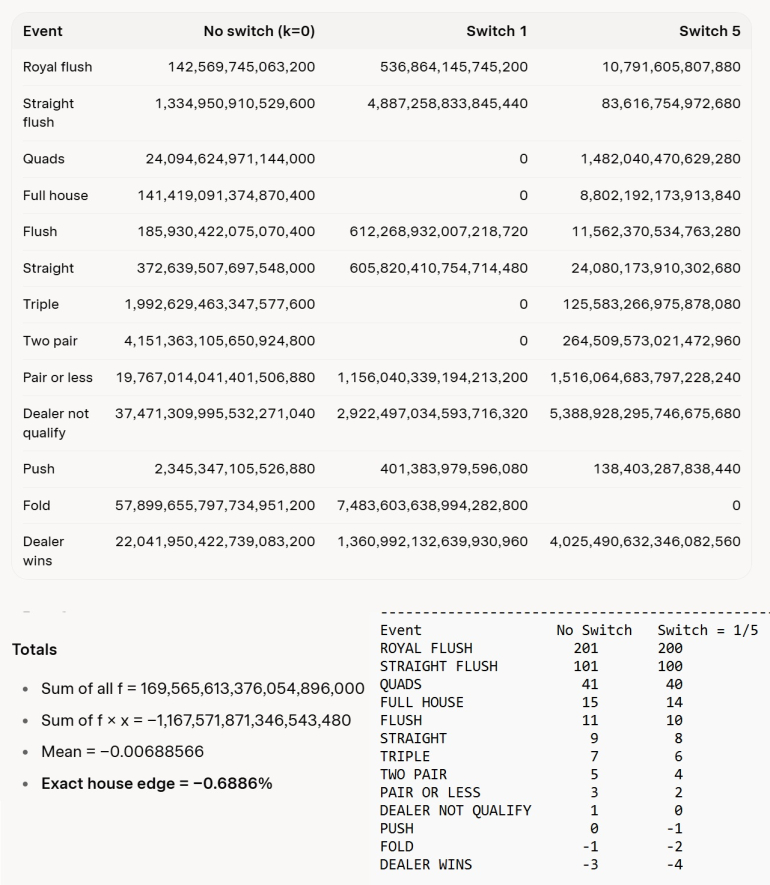
I welcome your thoughts.

At the risk of greatly upsetting you, may I ask this?: Did you happen to accumulate the above information as a function of the dealer's upcard? Certainly, dealer will always qualify and win more frequently when the upcard is Ace or KIng.
Any strategy tips vs upcard that you wish to share?
- When does player draw five cards- (certainly the dealer having a very low upcard is a given?)
- When does player switch one card with an inside straight?
- When does player switch one card with four to a flush and a pair?
Quote: gordonm888Masterfully done! Really sensational. Oasis Poker is one of the last frontiers - one of the last incompletely analyzed problems - of casino game analysis.
At the risk of greatly upsetting you, may I ask this?: Did you happen to accumulate the above information as a function of the dealer's upcard? Certainly, dealer will always qualify and win more frequently when the upcard is Ace or KIng.
Any strategy tips vs upcard that you wish to share?
- When does player draw five cards- (certainly the dealer having a very low upcard is a given?)
- When does player switch one card with an inside straight?
- When does player switch one card with four to a flush and a pair?
link to original post
Yes, I have calculated the ev(and the frequency of each event) for each dealer's up cards( 2 to ACE). BTW, I have discovered an error in the aforementioned CA results; the figures should be closer to approximately -0.60%. I will re-run the CA again.
1) Draw 5 cards when all three are true:
Dealer shows a 2.
You have no pair.
You have no four to a flush and no four to a straight.
When dealer show a 3, it is a coin flip.
2) and 3) is same as WIZARD strategy

First I made sure my program was doing the same thing the Wizard’s does. With only fold, raise and one-card switch allowed, it reproduces his return table exactly. All 28 combination counts match out of 837,195,681,722,400, and so do the 1.0372% edge, the 2.183772 average bet and the 8.4% switch rate.
Then I added the five-card switch. I get a house edge of 0.6895%, give or take about 0.001%, with the player switching all five on 6.66% of hands. That’s basically your 0.6886% and your 6.7%. I can’t see how it gets down to 0.60%, since that would be about 0.09% further, which is way outside the error on my figure. I’d have a look at what changed between your two runs before trusting the second one.
Your strategy is right against a 2, but it doesn’t stop there. Against a 2, about 40% of all hands should switch five, which is nearly every no-pair hand without a four-flush or four-straight (98.6% of them). Against a 3 it’s about 16% of hands, so yes, a coin flip on the trash hands depending on what’s already out. It still comes up against a 4 (13%), a 5 (12%) and a 6 (5%), occasionally against a 7, and never against 8 or higher. The ones against 4, 5 and 6 are mostly weak no-pair hands, some with an inside straight draw, and between them they’re worth about 0.08% of the total gain. A pair never switches five against anything.
By upcard, the gain over the Wizard’s strategy breaks down as roughly 0.172% from the 2, 0.091% from the 3, 0.056% from the 4, 0.024% from the 5 and 0.004% from the 6.
I also checked whether switching two, three or four cards is ever right. Over 4,000 test hands, weighted towards rubbish hands against low upcards, none came close; the nearest was still 0.12 units worse than the best play. So the Wizard is right about those.
On method: fold, raise and the one-card switch are a full enumeration. The five-card switch value comes from 16 million deals per upcard, conditioned on the player’s actual five cards, which is where the small margin of error comes from.

According to my own calculations, given the rules that allow exchanging 1 card for the cost of 1 ante, the player’s optimal expected value (EV) is -1.12% (+/- 0.05%).
Bet: 50.97%
Fold: 40.63%
Exchange: 8.38%
Exchanging 5 cards, or exchanging 2 or more cards for the cost of 2 or more antes, is not profitable (except in very rare situations); therefore, -1.12% can be considered the baseline.
Quote: DobrijI believe the Wizard’s calculations are correct.
According to my own calculations, given the rules that allow exchanging 1 card for the cost of 1 ante, the player’s optimal expected value (EV) is -1.12% (+/- 0.05%).
Bet: 50.97%
Fold: 40.63%
Exchange: 8.38%
Exchanging 5 cards, or exchanging 2 or more cards for the cost of 2 or more antes, is not profitable (except in very rare situations); therefore, -1.12% can be considered the baseline.
link to original post
If only one card is exchanged, my result matches the wizard's result. Please note that exchanging 5 cards only cost 1 unit( and must raise).
Quote: DobrijI believe the Wizard’s calculations are correct.
According to my own calculations, given the rules that allow exchanging 1 card for the cost of 1 ante, the player’s optimal expected value (EV) is -1.12% (+/- 0.05%).
Bet: 50.97%
Fold: 40.63%
Exchange: 8.38%
Exchanging 5 cards, or exchanging 2 or more cards for the cost of 2 or more antes, is not profitable (except in very rare situations); therefore, -1.12% can be considered the baseline.
link to original post
He reports that exchanging 5 cards is optimal on 6.7% of all hands. So it's certainly not negligible.
I have long wondered about Oasis Poker since I learned of it ten or so years ago. I've done some analysis years ago, I'll try to look up the files.
Quote: gordonm888
He reports that exchanging 5 cards is optimal on 6.7% of all hands. So it's certainly not negligible.
I have long wondered about Oasis Poker since I learned of it ten or so years ago. I've done some analysis years ago, I'll try to look up the files.
link to original post
That is highly questionable. 6.7% of all hands would mean roughly once every 15 hands. It is likely that his calculations actually show 0.67% rather than 6.7%; in that case, discarding and replacing all five cards would be the optimal move about once every 1500 hands.
Alternatively, if you provide some examples of a player's hand and the dealer's card where one should discard all five cards, we can calculate it together.
5d Ah 4h 7s 8c vs 5s
7s 4d 3d 8c Js vs 2d
5c 9d 7s 2h Tc vs 2d
Jd 8h 2c 6d 4s vs 2s
6c Ts 4d Ks 5d vs 5c
3h 7d 2h 8s 6s vs 2s
.
.
.
.
see the complete 1000 hands sim below(total 58 hands switch 5 cards) :-
https://limewire.com/d/n8kaV#Pgt2Evj7X9
Please help to check whether switch 5 cards is correct strategy for those hands.
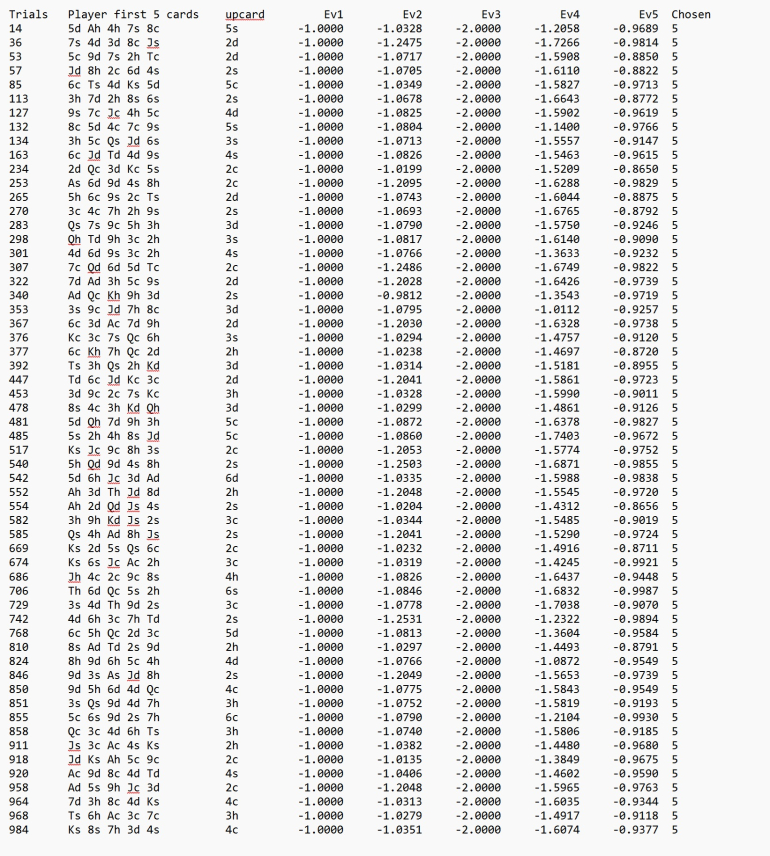
Based on the examples provided, the cost of replacing five cards came out to:
-0.944
-0.870
-0.846
-0.845
-0.943
-0.840
Quote: DobrijYes, I was mistaken; Was thinking in terms of stereotypes and was wrong. Interesting.
Based on the examples provided, the cost of replacing five cards came out to:
-0.944
-0.870
-0.846
-0.845
-0.943
-0.840
link to original post
But our expected value (EV) still doesn't match, have you considered whether exchanging five cards constitutes a situation where RAISE is mandatory?
Just estimating but it looks like the match card improves your EV by about +0.10
I have a question about your column marked: EV4. The documentation says: Ev4 = expected value when raise after switch 1 card. I believe this is an important column because the Oasis Poker rules are that you would first decide to Switch 1 Card and then make the Fold/Raise Decision.
1. When calculating the EV4 result, which card are you switching?
On this hand: "5d Ah 4h 7s 8c vs 5s" you would probably wish to switch the Ah and draw to the inside straight.
2. After switching 1 card, how do you decide whether to raise or fold? Or are you always raising as you do with a Switch 5 option?
On this hand: "5d Ah 4h 7s 8c vs 5s" if you discarded/switched the Ah card you would wish to raise if you drew a 4,5,6,7,8 and perhaps fold when drawing a 2, 3, 9-K. Not sure what you would if you drew an Ace.
3. So I am wondering if you have properly calculated the EV for the option "switching 1 card and then either raising or folding?"
This is an important question because some of your cases may have lower EV with Switch1 rather than Switch5.
Quote: gordonm888ssho88, first let me say that your work is very well formatted and documented - as usual. Very professional.
I have a question about your column marked: EV4. The documentation says: Ev4 = expected value when raise after switch 1 card. I believe this is an important column because the Oasis Poker rules are that you would first decide to Switch 1 Card and then make the Fold/Raise Decision.
1. When calculating the EV4 result, which card are you switching?
On this hand: "5d Ah 4h 7s 8c vs 5s" you would probably wish to switch the Ah and draw to the inside straight.
2. After switching 1 card, how do you decide whether to raise or fold? Or are you always raising as you do with a Switch 5 option?
On this hand: "5d Ah 4h 7s 8c vs 5s" if you discarded/switched the Ah card you would wish to raise if you drew a 4,5,6,7,8 and perhaps fold when drawing a 2, 3, 9-K. Not sure what you would if you drew an Ace.
3. So I am wondering if you have properly calculated the EV for the option "switching 1 card and then either raising or folding?"
This is an important question because some of your cases may have lower EV with Switch1 rather than Switch5.
link to original post
After you receive 5 cards and see 1 dealer's upcard :-
a) You FOLD, EVf = -1
b) Raise(without switch), and calculate the EVr(through combinatorial analysis.)
c) You switch card 1, raise and calculate the corresponding ev1. If ev1 < -2, then FOLD, ev1 = -2. If ev1 > -2, then RAISE, ev1 = ev1
Repeat above for card 2, card 3 , card4 and card 5 . . . until you get ev2, ev3, ev4 and ev5. Suppose ev3 is the highest , you switch card 3. So EVs = ev3. Please note that ev1, ev2, ..., ev5 are calculated through combinatorial analysis.
d) Exchange 5 cards, RAISE, calculate the ev6 through combinatorial analysis, EVa = ev6
Next, we compare EVa, EVs, EVr, and EVf: -
If EVa is max, then you SWITCH 5 card, RAISE.
If EVs is max, then you SWITCH 1 card, if EVs > -2, then you RAISE, otherwise you FOLD.
If EVr is max, then you RAISE without switch.
If EVf is max, then you FOLD without switch.
Your Switch1 analysis considers discarding each of the 5 cards and then for each of those 5 discards it draws each of the 46 remaining cards and makes individual "raise2x or fold" decisions for each of those 46 possible cards? Then sums the EV across all the possible 46 cards (some of which are raised, some of which are folded) to determine the EV for each of the 5 possible discards? and then, of course selects the discard withe the highest EV?
And that value for each hand is EV4 on your summary table? because you label implies that EV4 is SWitch1 and then raise for all drawn cards.
Quote: gordonm888So once you have dealt 5 cards and see the dealer's upcard:
Your Switch1 analysis considers discarding each of the 5 cards and then for each of those 5 discards it draws each of the 46 remaining cards and makes individual "raise2x or fold" decisions for each of those 46 possible cards? Then sums the EV across all the possible 46 cards (some of which are raised, some of which are folded) to determine the EV for each of the 5 possible discards? and then, of course selects the discard withe the highest EV?
And that value for each hand is EV4 on your summary table? because you label implies that EV4 is SWitch1 and then raise for all drawn cards.
link to original post
That's correct.
Firstly, focus on player's 1st card, switch this 1st card with a new card, RAISE 2X, calculate ev through combinations analysis(CA), then you can decide RAISE or FOLD, you get corresponding EV(1,1), E(1,1) may equal to ev from CA or equal to -2. Repeat this process another 45 times, you get EV(1, 2), EV(1,3), . . . EV(1, 46), then Average ev1 = (EV(1,1)+EV(1,2)+ . . +EV(1,46) )/46. Among these 46 EVs, some are the EVs of raising, while others are the EVs of folding( equal to -2)
Secondly, focus on player's 2nd card, repeat above process, you get EV(2,1), EV(2,2), EV(2,3) . . . EV(2,46), then get average ev2
Thirdly, focus on player's 3rd card, repeat above process, you get EV(3,1), EV(3,2), EV(3,3) . . . EV(3,46), then get average ev3
.
Lastly, you get average ev5.
Among these ev1 to ev5, suppose ev3 is the max values, then player's 3rd card is the best card to switch. This does not mean that player is going to switch 3rd card, player still have to compare this ev3 to ev of FOLD(-1, before switch) and ev of RAISE(ev0, before switch). Switch 3rd card of player if ev3 > -1 and ev3 > ev0. I’m not good at explaining things; please don’t take it amiss if something isn’t clear. Do you think this methodology/logic is correct ?
The above explanation does not include strategy for replacing all player's five cards.
Where did I ever label EV4 as SWitch1? EV4 in the summary is the best ev when player switch 4 of player's cards. As for which four cards to switch, you will need to repeat the steps above.
Here are the Combination Analysis(including strategy to exchange all 5 cards) vs Dealer's upcard : https://limewire.com/d/jpWRj#cF9fEyOGhw
Quote: ssho88
But our expected value (EV) still doesn't match, have you considered whether exchanging five cards constitutes a situation where RAISE is mandatory?
link to original post
I viewed it as a standard exchange. But is a raise mandatory specifically after the exchange?
Quote: DobrijQuote: ssho88
But our expected value (EV) still doesn't match, have you considered whether exchanging five cards constitutes a situation where RAISE is mandatory?
link to original post
I viewed it as a standard exchange. But is a raise mandatory specifically after the exchange?
link to original post
After replacing all 5 cards, a raise is mandatory, the rules explicitly state this.
Quote: ssho88
I viewed it as a standard exchange. But is a raise mandatory specifically after the exchange?
link to original post
After replacing all 5 cards, a raise is mandatory, the rules explicitly state this.
link to original post
I didn’t notice that such a condition existed.
Overall, the game holds no interest for an advantage player; however, if we are looking at it as a purely mathematical question:
Let’s assume a player gains an edge by making optimal decisions regarding the replacement of five cards—occurring in 6% of cases—which adds +0.5% to their overall return. But! The player will subsequently end up losing a significant portion of that advantage due to betting errors—specifically, failing to "pass" when they should—and those mistakes will cost them far more.
Quote: ssho88Quote: gordonm888So once you have dealt 5 cards and see the dealer's upcard:
Your Switch1 analysis considers discarding each of the 5 cards and then for each of those 5 discards it draws each of the 46 remaining cards and makes individual "raise2x or fold" decisions for each of those 46 possible cards? Then sums the EV across all the possible 46 cards (some of which are raised, some of which are folded) to determine the EV for each of the 5 possible discards? and then, of course selects the discard withe the highest EV?
And that value for each hand is EV4 on your summary table? because you label implies that EV4 is SWitch1 and then raise for all drawn cards.
link to original post
That's correct.
Firstly, focus on player's 1st card, switch this 1st card with a new card, RAISE 2X, calculate ev through combinations analysis(CA), then you can decide RAISE or FOLD, you get corresponding EV(1,1), E(1,1) may equal to ev from CA or equal to -2. Repeat this process another 45 times, you get EV(1, 2), EV(1,3), . . . EV(1, 46), then Average ev1 = (EV(1,1)+EV(1,2)+ . . +EV(1,46) )/46. Among these 46 EVs, some are the EVs of raising, while others are the EVs of folding( equal to -2)
Secondly, focus on player's 2nd card, repeat above process, you get EV(2,1), EV(2,2), EV(2,3) . . . EV(2,46), then get average ev2
Thirdly, focus on player's 3rd card, repeat above process, you get EV(3,1), EV(3,2), EV(3,3) . . . EV(3,46), then get average ev3
.
Lastly, you get average ev5.
Among these ev1 to ev5, suppose ev3 is the max values, then player's 3rd card is the best card to switch. This does not mean that player is going to switch 3rd card, player still have to compare this ev3 to ev of FOLD(-1, before switch) and ev of RAISE(ev0, before switch). Switch 3rd card of player if ev3 > -1 and ev3 > ev0. I’m not good at explaining things; please don’t take it amiss if something isn’t clear. Do you think this methodology/logic is correct ?
The above explanation does not include strategy for replacing all player's five cards.
Where did I ever label EV4 as SWitch1? EV4 in the summary is the best ev when player switch 4 of player's cards. As for which four cards to switch, you will need to repeat the steps above.
Here are the Combination Analysis(including strategy to exchange all 5 cards) vs Dealer's upcard : https://limewire.com/d/jpWRj#cF9fEyOGhw
link to original post
Thank you for the explanations of your analysis method for the Switch1 option. It certainly sounds as if you're doing it correctly.
I read the definition of EV4 provided in the output files you have been attaching. It says:
"Ev4 = expected value when raise after switch 1 card".
And thanks for the additional outputs for all option including 5 card switch sorted by dealer upcard. Very interesting stuff.
Join the discussion
Log in or create a free account to reply to this thread.