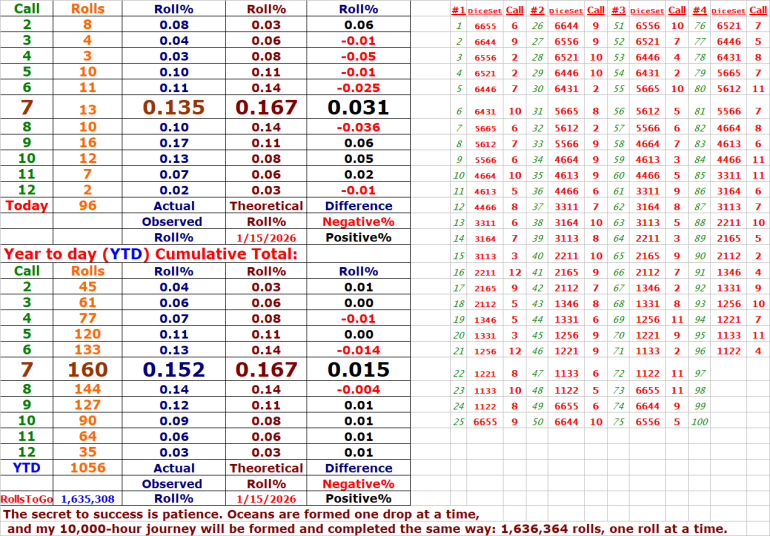


Some stats for the Make EM All bonus bet

December 27th, 2025 at 1:00:14 PM
permalink
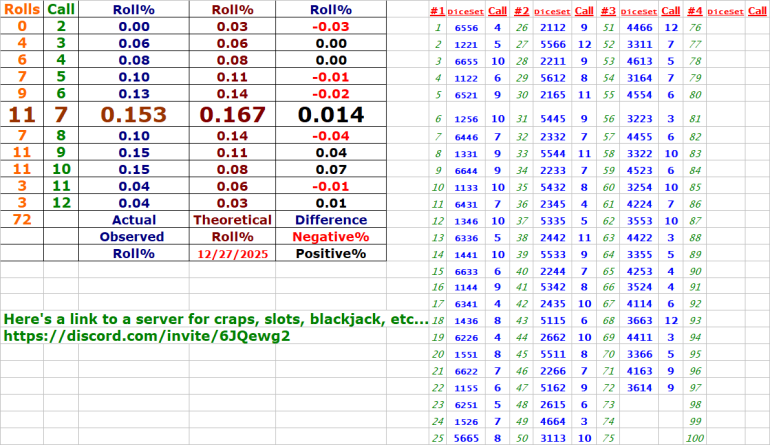
December 28th, 2025 at 5:15:06 PM
permalink
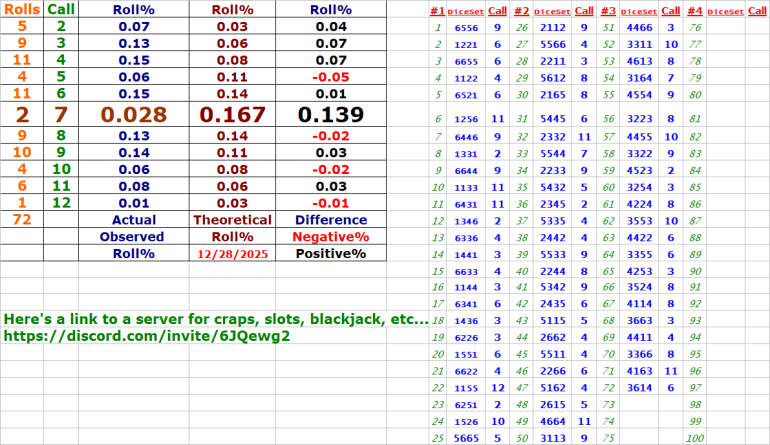
December 29th, 2025 at 9:44:40 AM
permalink
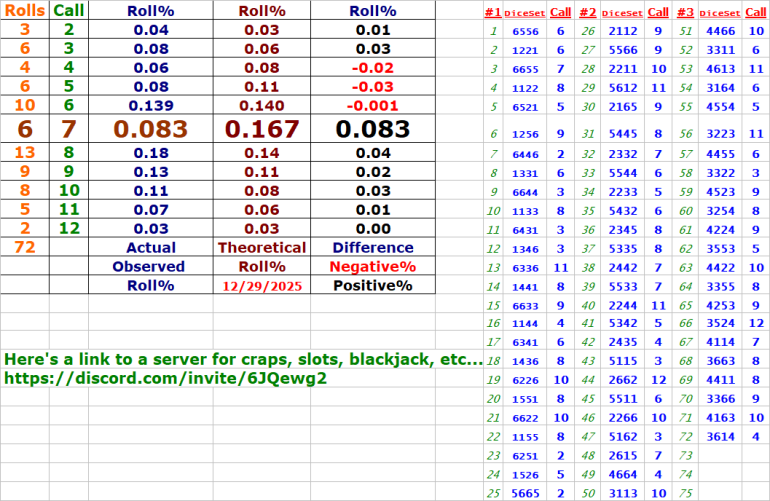
December 30th, 2025 at 12:37:01 PM
permalink
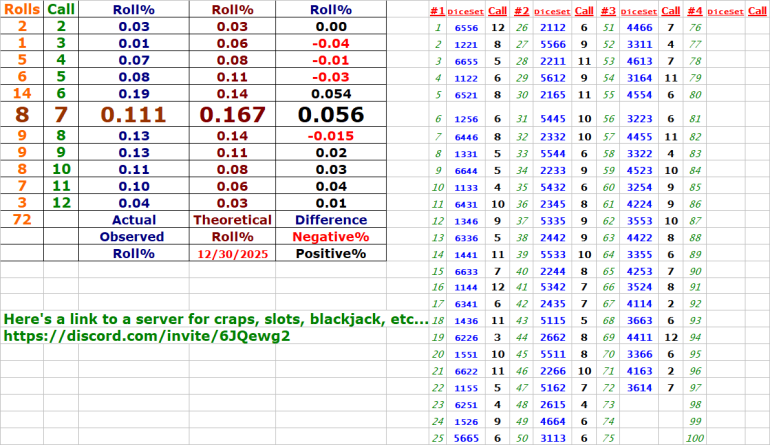
December 31st, 2025 at 1:04:34 PM
permalink
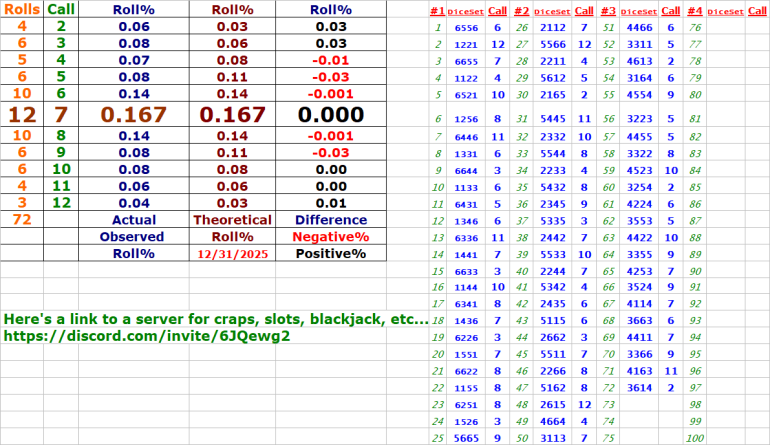
January 1st, 2026 at 12:14:06 PM
permalink
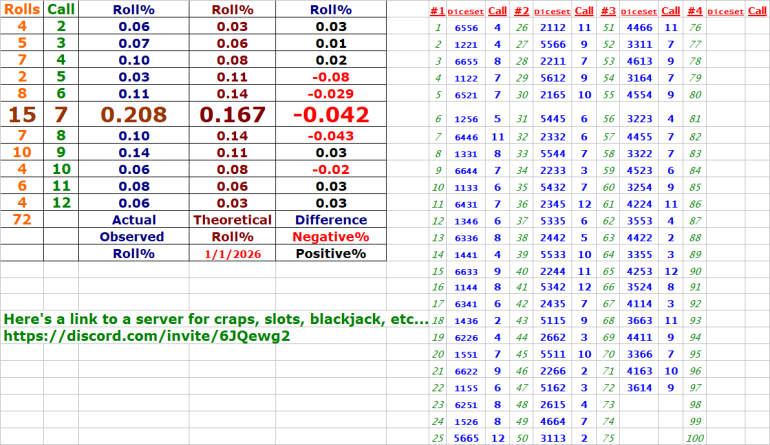
January 2nd, 2026 at 11:48:17 AM
permalink
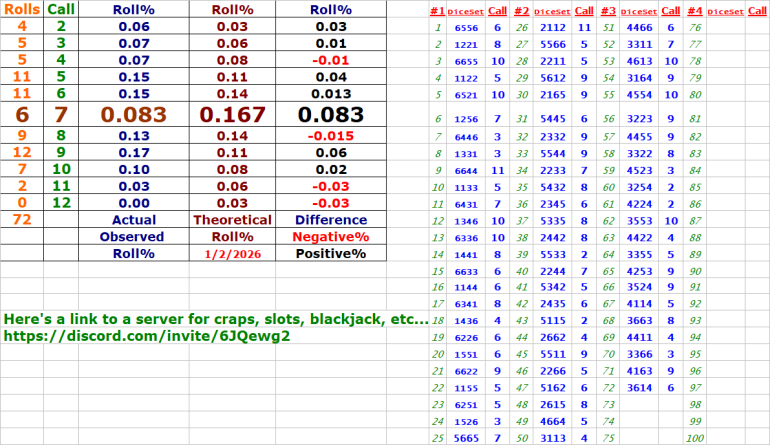
January 3rd, 2026 at 11:38:22 AM
permalink
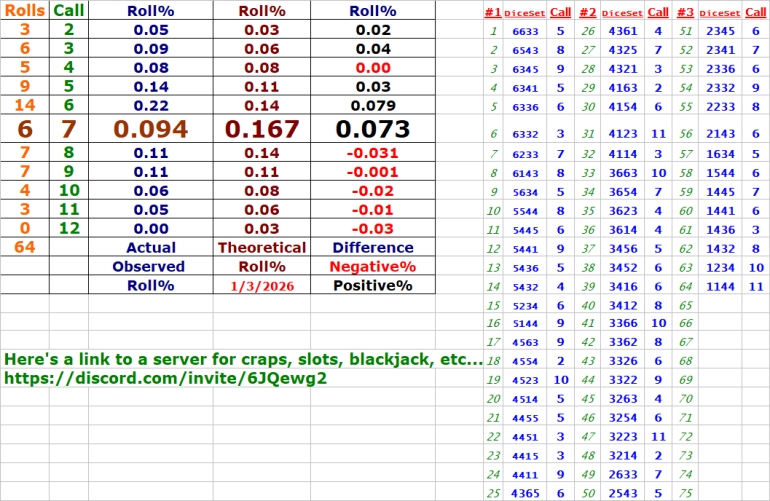
January 4th, 2026 at 8:16:20 PM
permalink
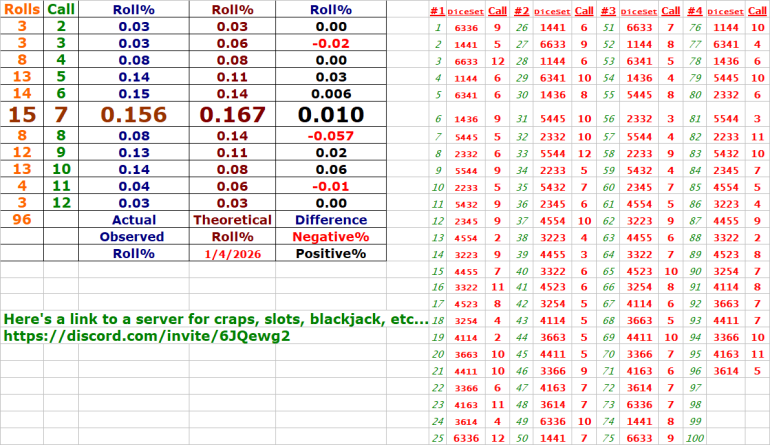
January 5th, 2026 at 3:41:13 PM
permalink
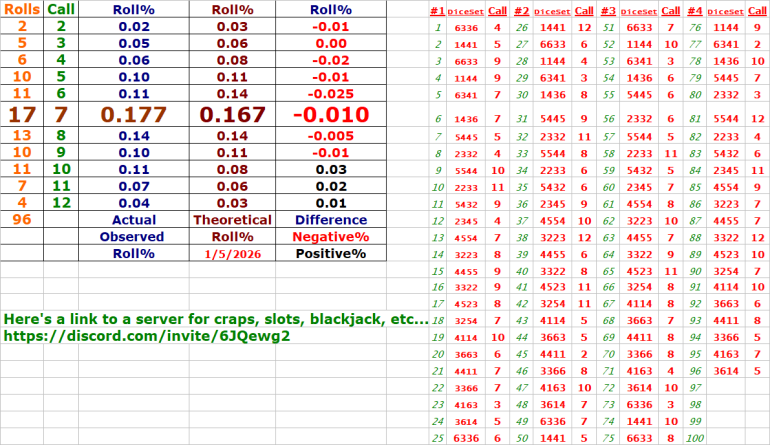

January 5th, 2026 at 7:52:21 PM
permalink
would it be possible for you to compile all of your results into a single document? I am more interested in your long-term results than your daily short-term results.
peace be upon you and happy new year
peace be upon you and happy new year
January 5th, 2026 at 8:24:47 PM
permalink
As you have previously estimated my journey will take 5 years to complete my 10,000 hour-practice.
I will post my practice result one day at a time.
Starting tomorrow I will include the cumulative total.

I will post my practice result one day at a time.
Starting tomorrow I will include the cumulative total.
January 5th, 2026 at 8:26:43 PM
permalink
It's a 5 year job if you are doing in eight hours a day :D It could definitely take decades otherwise :) I think 9,000 hours would be sufficient :D
January 5th, 2026 at 9:17:51 PM
permalink
I'm committed to roll seriously bones for 10,000 hours, NOT 9,000 hours, no short cut.
I did not dream of the 10,000 hour rule. Doctor Ericsson invented the rule.
Per Google:
"Here’s the clear, no-hype lowdown on Dr. Anders Ericsson’s “10,000-hour rule”, using Who / What / When / Where / Why / How.
Who
Dr. K. Anders Ericsson (1947–2020)
A Swedish psychologist and researcher who studied expert performance—how people become world-class in fields like music, sports, chess, and medicine.
Important note: Ericsson himself did not invent a “rule.” That label came later.
What
The so-called “10,000-hour rule” is the idea that roughly 10,000 hours of practice are needed to reach elite-level performance in complex skills.
But what Ericsson actually studied was deliberate practice, not just time spent.
Deliberate practice means:
Practice with clear goals
Focus on weaknesses
Immediate feedback
Mentally demanding (not automatic or “fun practice”)
Often guided by a coach or teacher
⛔ Simply repeating something for 10,000 hours does not guarantee mastery.
When
Ericsson’s key research began in the late 1980s
His most famous early study (violinists) was published in 1993
The idea became mainstream after 2008
Where
Ericsson worked mainly in Europe and the United States
His most famous studies were done with:
Why
Ericsson wanted to answer a big question:
Why are some people dramatically better than others?
He challenged the idea that greatness is mostly about talent or IQ.
His research showed that training quality matters far more than people think.
How (the rule was born & misunderstood)
1
2
3
4
Ericsson later criticized this simplification, saying:
The number varies widely
Some fields require more
Some people reach expertise with less
How you practice matters more than how long
Big misconceptions (important)
❌ It’s not a magic number
❌ It’s not guaranteed
❌ It’s not about mindless repetition
❌ It doesn’t ignore genetics—but genetics alone aren’t enough
The real takeaway
If you remember only one thing:
Greatness comes from years of focused, uncomfortable, feedback-rich practice—not just putting in time."
I did not dream of the 10,000 hour rule. Doctor Ericsson invented the rule.
Per Google:
"Here’s the clear, no-hype lowdown on Dr. Anders Ericsson’s “10,000-hour rule”, using Who / What / When / Where / Why / How.
Who
Dr. K. Anders Ericsson (1947–2020)
A Swedish psychologist and researcher who studied expert performance—how people become world-class in fields like music, sports, chess, and medicine.
Important note: Ericsson himself did not invent a “rule.” That label came later.
What
The so-called “10,000-hour rule” is the idea that roughly 10,000 hours of practice are needed to reach elite-level performance in complex skills.
But what Ericsson actually studied was deliberate practice, not just time spent.
Deliberate practice means:
Practice with clear goals
Focus on weaknesses
Immediate feedback
Mentally demanding (not automatic or “fun practice”)
Often guided by a coach or teacher
⛔ Simply repeating something for 10,000 hours does not guarantee mastery.
When
Ericsson’s key research began in the late 1980s
His most famous early study (violinists) was published in 1993
The idea became mainstream after 2008
Where
Ericsson worked mainly in Europe and the United States
His most famous studies were done with:
Why
Ericsson wanted to answer a big question:
Why are some people dramatically better than others?
He challenged the idea that greatness is mostly about talent or IQ.
His research showed that training quality matters far more than people think.
How (the rule was born & misunderstood)
1
2
3
4
Ericsson later criticized this simplification, saying:
The number varies widely
Some fields require more
Some people reach expertise with less
How you practice matters more than how long
Big misconceptions (important)
❌ It’s not a magic number
❌ It’s not guaranteed
❌ It’s not about mindless repetition
❌ It doesn’t ignore genetics—but genetics alone aren’t enough
The real takeaway
If you remember only one thing:
Greatness comes from years of focused, uncomfortable, feedback-rich practice—not just putting in time."
January 5th, 2026 at 9:23:11 PM
permalink
Did you read the AI summary? It's not a magic number nor guaranteed, I think nine thousand or even eight thousand five hundred would be sufficient.
January 6th, 2026 at 10:18:34 AM
permalink
I reread the explanation of the 10,000-hour rule , in particularly the summary:
"The real takeaway
If you remember only one thing:
Greatness comes from years of focused, uncomfortable, feedback-rich practice—not just putting in time."
We are in agreement 100%:
Your less than 10,000 hour practice will work because
"Greatness comes from years of focused, uncomfortable, feedback-rich practice—not just putting [10,000 hours] in time."
Then I noticed that some information had been accidentally cut off. Below is the corrected and complete version:
"Here’s the clear, no-hype lowdown on Dr. Anders Ericsson’s “10,000-hour rule”, using Who / What / When / Where / Why / How.
Who
Dr. K. Anders Ericsson (1947–2020)
A Swedish psychologist and researcher who studied expert performance—how people become world-class in fields like music, sports, chess, and medicine.
Important note: Ericsson himself did not invent a “rule.” That label came later.
What
The so-called “10,000-hour rule” is the idea that roughly 10,000 hours of practice are needed to reach elite-level performance in complex skills.
But what Ericsson actually studied was deliberate practice, not just time spent.
Deliberate practice means:
Practice with clear goals
Focus on weaknesses
Immediate feedback
Mentally demanding (not automatic or “fun practice”)
Often guided by a coach or teacher
⛔ Simply repeating something for 10,000 hours does not guarantee mastery.
When
Ericsson’s key research began in the late 1980s
His most famous early study (violinists) was published in 1993
The idea became mainstream after 2008
Where
Ericsson worked mainly in Europe and the United States
His most famous studies were done with:
Elite music academies
Chess players
Athletes
Medical professionals
Why
Ericsson wanted to answer a big question:
Why are some people dramatically better than others?
He challenged the idea that greatness is mostly about talent or IQ.
His research showed that training quality matters far more than people think.
How (the rule was born & misunderstood)
1) Ericsson found that top performers had accumulated ~10,000 hours of deliberate practice
2) Journalist Malcolm Gladwell popularized this in the book Outliers
3) Gladwell simplified it into a catchy phrase: “The 10,000-hour rule”
4) The public interpreted it as:
“Practice anything for 10,000 hours and you’ll be great”
Ericsson later criticized this simplification, saying:
The number varies widely
Some fields require more
Some people reach expertise with less
How you practice matters more than how long
Big misconceptions (important)
❌ It’s not a magic number
❌ It’s not guaranteed
❌ It’s not about mindless repetition
❌ It doesn’t ignore genetics—but genetics alone aren’t enough
The real takeaway
If you remember only one thing:
Greatness comes from years of focused, uncomfortable, feedback-rich practice—not just putting in time."
By Google
"The real takeaway
If you remember only one thing:
Greatness comes from years of focused, uncomfortable, feedback-rich practice—not just putting in time."
We are in agreement 100%:
Your less than 10,000 hour practice will work because
"Greatness comes from years of focused, uncomfortable, feedback-rich practice—not just putting [10,000 hours] in time."
Then I noticed that some information had been accidentally cut off. Below is the corrected and complete version:
"Here’s the clear, no-hype lowdown on Dr. Anders Ericsson’s “10,000-hour rule”, using Who / What / When / Where / Why / How.
Who
Dr. K. Anders Ericsson (1947–2020)
A Swedish psychologist and researcher who studied expert performance—how people become world-class in fields like music, sports, chess, and medicine.
Important note: Ericsson himself did not invent a “rule.” That label came later.
What
The so-called “10,000-hour rule” is the idea that roughly 10,000 hours of practice are needed to reach elite-level performance in complex skills.
But what Ericsson actually studied was deliberate practice, not just time spent.
Deliberate practice means:
Practice with clear goals
Focus on weaknesses
Immediate feedback
Mentally demanding (not automatic or “fun practice”)
Often guided by a coach or teacher
⛔ Simply repeating something for 10,000 hours does not guarantee mastery.
When
Ericsson’s key research began in the late 1980s
His most famous early study (violinists) was published in 1993
The idea became mainstream after 2008
Where
Ericsson worked mainly in Europe and the United States
His most famous studies were done with:
Elite music academies
Chess players
Athletes
Medical professionals
Why
Ericsson wanted to answer a big question:
Why are some people dramatically better than others?
He challenged the idea that greatness is mostly about talent or IQ.
His research showed that training quality matters far more than people think.
How (the rule was born & misunderstood)
1) Ericsson found that top performers had accumulated ~10,000 hours of deliberate practice
2) Journalist Malcolm Gladwell popularized this in the book Outliers
3) Gladwell simplified it into a catchy phrase: “The 10,000-hour rule”
4) The public interpreted it as:
“Practice anything for 10,000 hours and you’ll be great”
Ericsson later criticized this simplification, saying:
The number varies widely
Some fields require more
Some people reach expertise with less
How you practice matters more than how long
Big misconceptions (important)
❌ It’s not a magic number
❌ It’s not guaranteed
❌ It’s not about mindless repetition
❌ It doesn’t ignore genetics—but genetics alone aren’t enough
The real takeaway
If you remember only one thing:
Greatness comes from years of focused, uncomfortable, feedback-rich practice—not just putting in time."
By Google
January 6th, 2026 at 11:52:01 AM
permalink
This post has been intentionally left blank because it was duplicated in error, likely due to a system glitch.
Admin suggestion: A user-accessible Delete Post option (possibly time-limited or restricted) would help clean up duplicate posts created by system glitches.
Admin suggestion: A user-accessible Delete Post option (possibly time-limited or restricted) would help clean up duplicate posts created by system glitches.
Last edited by: Armagedden on Jan 6, 2026
January 6th, 2026 at 5:41:00 PM
permalink
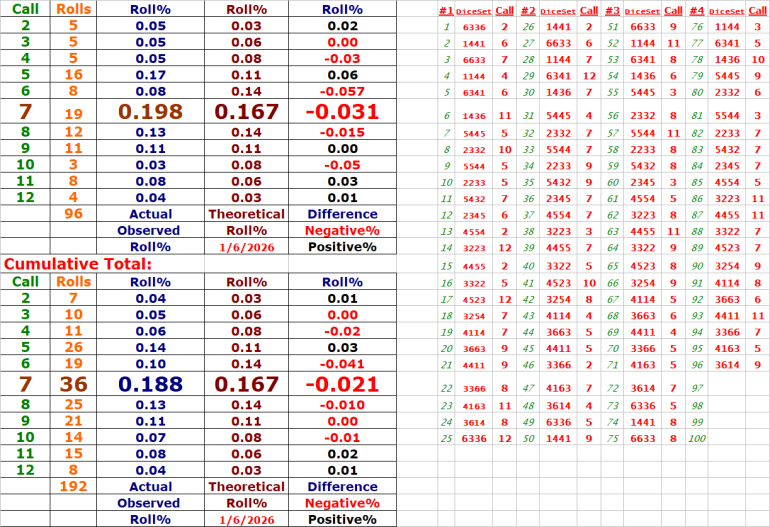
January 7th, 2026 at 10:28:28 AM
permalink
January 7th, 2026 at 5:53:20 PM
permalink
At a Mohegan property, the dice appeared “defective” in the shooter’s favor.
“Romeo” hit the All bonus, followed by another All bonus on the next shooter’s roll—back to back.


“Romeo” hit the All bonus, followed by another All bonus on the next shooter’s roll—back to back.
January 8th, 2026 at 7:45:32 AM
permalink
So, did you take advantage of the "defective" dice
January 8th, 2026 at 9:34:10 AM
permalink
Yep, I did.
The other shooter was yours truly.
The other shooter was yours truly.
January 8th, 2026 at 9:40:15 AM
permalink
While it is possible the dice were somehow defective, it could have also been really lucky.
Did you notice anything about the dice themselves? Were they chipped? Have you ever noticed dice that weren't the perfect cubes they are supposed to be?
Did you notice anything about the dice themselves? Were they chipped? Have you ever noticed dice that weren't the perfect cubes they are supposed to be?
January 8th, 2026 at 10:15:33 AM
permalink
The dice were not chipped
you’re absolutely right.
Luck often overrides any theoretical concerns, which is why shift managers allow so-called “lucky shooters.”
Patricia DeMauro’s 4-hour-and-18-minute roll is a perfect example.
If a pair of defective dice (aka hot dice) can favor a shooter, Patricia ( Romeo and I) certainly did.
you’re absolutely right.
Luck often overrides any theoretical concerns, which is why shift managers allow so-called “lucky shooters.”
Patricia DeMauro’s 4-hour-and-18-minute roll is a perfect example.
If a pair of defective dice (aka hot dice) can favor a shooter, Patricia ( Romeo and I) certainly did.
January 8th, 2026 at 12:56:46 PM
permalink
January 9th, 2026 at 11:29:30 AM
permalink
January 10th, 2026 at 12:36:04 PM
permalink
January 11th, 2026 at 12:00:18 PM
permalink
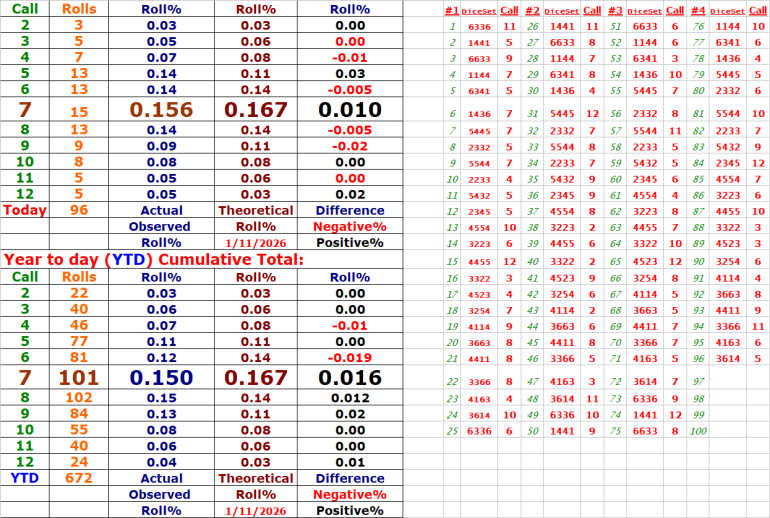
January 13th, 2026 at 10:35:46 AM
permalink
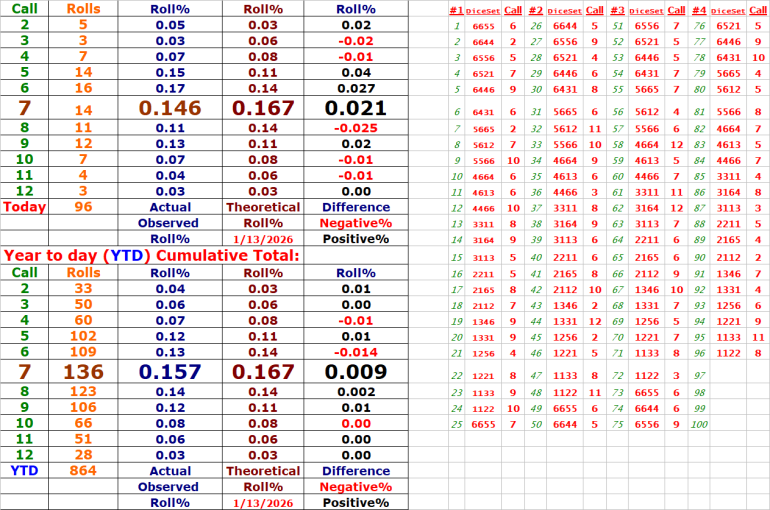
January 14th, 2026 at 11:43:59 AM
permalink
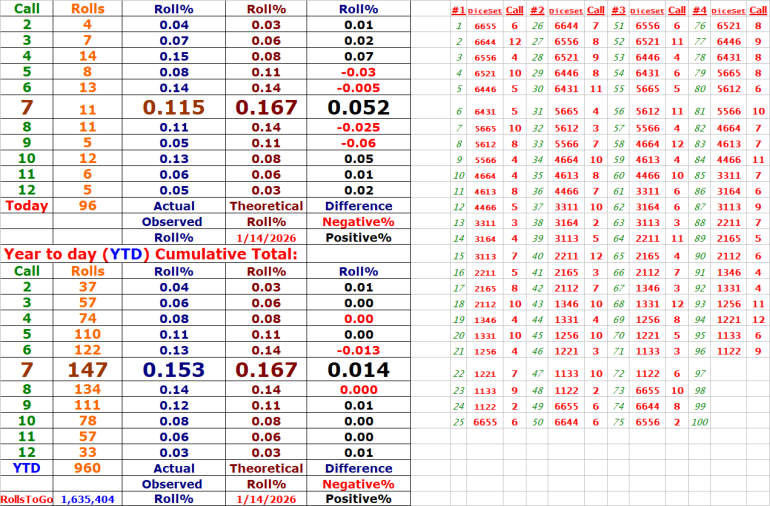
January 15th, 2026 at 10:57:24 AM
permalink