


KO with Table of Critical Running Counts

I always thought Automatic Monkey invented it.

Quote: Hunterhill“ Cacarulo invented the monkey count for Spanish 21”
I always thought Automatic Monkey invented it.
link to original post
I did. The simple version of it simply counts the ace as -2 to represent the very high EOR of the ace. There are also unpublished multiparameter versions of it.

Quote: AutomaticMonkeyQuote: Hunterhill“ Cacarulo invented the monkey count for Spanish 21”
I always thought Automatic Monkey invented it.
link to original post
I did. The simple version of it simply counts the ace as -2 to represent the very high EOR of the ace. There are also unpublished multiparameter versions of it.
link to original post
Sorry about that Automatic Monkey. Cacarulo just commented on my statement that the Monkey Count destroys playing strategy variations in Spanish 21 and he agreed. So I just assumed the was the author of Monkey Count..
I suggest using the Katarnia Walkers unbalanced HL (for Spanish 21 HL is unbalanced at 4 per deck just like KO is unbalanced at 4 per deck for blackjack) and use a 5mAc side count. Then use HL for playing strategy variations and brc = HL + 5mAc for betting. This is another reason to learn TCRC as a TCRC can be used for Spanish 21 HL. Walker used the same complicated formula to calculate HL true counts as Cacarulo did for TKO for KO true counts. Use a TCRC, much simpler and you get the same true counts .
This discussion is for KO with TCRC so I will not be covering Spanish 21 here other than to say what I mentioned above about Spanish 21.
Also for blackjack, KO is a much better primary count to add plus/minus side counts to than HL is. So another reason to learn KO with TCRC.
But I also did analysis on side counts to HL since I figure no matter what i say about KO with TCRC many readers will refuse to switch as they love HL.
So on BlackjackReview I published HL with 7m9c which can be used for both the shoe game and two deck game.
The Blackjack High-Low Count with 7m9c
October 13, 2024
[ Comments from Don Schlesinger ]
A very ambitious piece of work! Thank you for sending. Improvements in SCORE are impressive
So if you want to keep HL then add 7m9c as a side count.
.
Don S does not like me because he told me that he can guarantee that CC will not help at all with the SCORE. Gronbog then did around 20 siims of KO and HL with side counts and every time the weighted CC or betting CC increased the SCORE increased. So Don was upset that I showed that he was wrong and ever since then he says negative comments about me. .

For the hand 15vT Hard Hitting,
Card = {2 3 4 5 6 7 8 9 T A}
EoR = [0.1873 -0.3168 -0.7279 -1.7532 -2.2287 -0.537 0.0853 0.6642 1.1992 -1.1699].
Why do you flip the sign? Ultimately, I want you to figure out how these numbers are calculated. I haven’t read into this part yet.
For hard 15 v T, EoR in BJA was for hit - stand.
This can be seen, for example, in EoR if a six was removed is negative at -2.2287
So a six being removed make hitting hard 15 v T less desirable, thus the EV of hitting decreases if a six is removed.
What you want is stand - hit, for standing decision on hard 15 v T. Thus the signs are flipped.
The calculated HL indices using Excel spreadsheet and using EoR from BJA agree with published HL indices. The calculations are correct.
If I use Wizard online blackjack calculator to calculate, I get a different set of EoR numbers. Furthermore, the player hard 15 may have three different 2-card combinations: (10, 5), (9, 6), and (8, 7), while each combination gives a different set of EoR numbers.
More puzzling to me is this part. If using the optimal strategy, each set of EoR values do not add to zero. I hope you think about these things and help me understand.

Quote: aceside
If I use Wizard online blackjack calculator to calculate, I get a different set of EoR numbers. Furthermore, the player hard 15 may have three different 2-card combinations: (10, 5), (9, 6), and (8, 7), while each combination gives a different set of EoR numbers.
link to original post
I am not an expert on EoR. I think it some type of weight is used for each hard 15 v T configuration and I think I remember reading in BJA that some type of least squares technique was used in calculating the Eo
I am not the one to tell you how EoR were calculated but it seems to me to be quite complex. The only one I was personally able to calculate manually was insurance which is linear and simple. You will have to consult others on other EoR calculations which are not linear.
All I can tell you is that based on multiple Gronbog sims of KO and HL with side counts and based on Cacarulo's sims of TKO (which produces the same true counts as KO with TCRC) is that using EoR published in BJA works which is all that the vast majority of users care about. .
If you want to have a simple improvement to HL or KO then simply add 7m9c as a side count to HL (for HL users who do not want to switch to KO) or add 5m7c as a side count to KO both of which I discussed earlier.
Quote: BlackjackRebel
I am not the one to tell you how EoR were calculated but it seems to me to be quite complex. The only one I was personally able to calculate manually was insurance which is linear and simple. You will have to consult others on other EoR calculations which are not linear.
You are the author of more than 10 books, but you are telling the audience this? Even the calculation of your insurance CC is problematic for your true-counted KO count. Write out the equations and think about these.

Quote: BlackjackRebel
I am not an expert on EoR. I think it some type of weight is used for each hard 15 v T configuration and I think I remember reading in BJA that some type of least squares technique was used in calculating the Eo
I am not the one to tell you how EoR were calculated but it seems to me to be quite complex. The only one I was personally able to calculate manually was insurance which is linear and simple. You will have to consult others on other EoR calculations which are not linear.
EOR's are complex to calculate. For most effects of removal you need automation. I am not sure why any one is contesting that simple and obvious point.
The fact you can calculate them with an online calculator does not mean the process magically becomes simple, it just means a powerful tool has been made available to simplify a complex task.

Quote: acesideQuote: BlackjackRebel
You are the author of more than 10 books, but you are telling the audience this? Even the calculation of your insurance CC is problematic for your true-counted KO count. Write out the equations and think about these.
link to original post
I have exactly 10 books. Four with HL with side counts for those who do not want to give up the HL, four with KO with side counts and two Spanish 21 books with side counts. The books are only $10 each. You spend more for breakfast than buying these Kindle books. The derivations are covered in these books. If you have more derivation questions, break out your wallet and buy and read the books. I deliberately made the books very affordable.
I hesitate to include this as I think this lead to you asking more detailed questions on derivations which most readers do not care about. They just care if the system works and if it is easy to use.
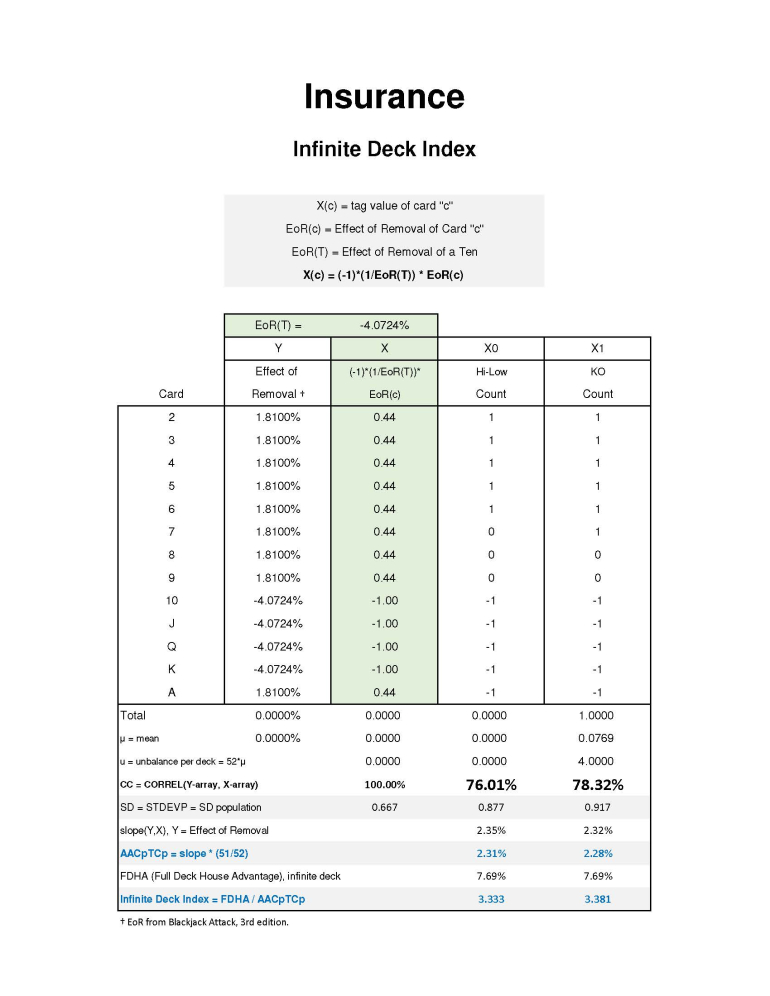
At any rate, attached is the calculation of the Infinite Deck insurance index for HL and KO. As the number or decks decrease the index decreases, For example, for two decks the HL index for insurance is around 2.5
And as you can see the KO CC for insurance is greater than the HL CC for insurance as the KO also counts the 7, a non-Ten value card, as +1
Below are the two free articles on Blackjack Review that I mentioned many times. Study and learn how to use the one you are interested in and learn to play it with minimal errors and that is where you will make your money.
Blackjack
The Blackjack High-Low Count with 7m9c
October 13, 2024
Blackjack
KO with Table of Critical Running Counts (Update)
September 14, 2025
If the strategy deviation index is TC=+3 for both Hi-Lo and your true-counted KL, which counting system is more powerful toward the insurance side bet alone?
Quote: acesideFor this hand of 15vT, I also compared the EoR numbers from a dealer peek game to a no-peek game and found them different from games. In my opinion, these values depend on how you define them.
link to original post
That's an interesting subject. It also depends on how you measure them.
There are 3 ways I know of, of determining EoR:
1. Combinatorial analysis, while removing one card of each rank at a time.
2. Repeated simulations, while removing one card of each rank at a time.
3. Shoe composition analysis. When you win, what were the cards left in the shoe when that hand began? When you lose, what were they? By comparing the cards in surplus for the hands where you win to the cards in surplus for the hands where you lose, you can also calculate the EoR of those cards.
And the interesting thing about that is they give you different results! Sometimes barely different, other times significantly different.
But there's good news- the closer the EoR values are to one another for the different methods, the more countable and valuable the game seems to be. An example of a game when they are all the same is the Insurance bet. You are betting on exactly one card being of exactly one value, and the effects of combinations of cards does not come into play.
Quote: acesideI’m interested in the math part. Here is a question for you:
If the strategy deviation index is TC=+3 for both Hi-Lo and your true-counted KL, which counting system is more powerful toward the insurance side bet alone?
link to original post
KO is stronger for insurance since the KO CC for insurance is greater than the HL CC for insurance, but the difference is very slight
This will gave practically no effect on your win rate since the difference is so small..
If you want to improve KO with TCRC then add 5m7c as a side count to KO.
So use either KO with 5m7c or if you want to keep HL count then use HL with 7m9c.
Also a few months ago, I compared the insurance EV values between HL and KO by simulation using the same trigger index of TC=+3 and the same red-to-black-chip bet spread and found that HL actually gives a higher insurance EV value.
Quote: acesideI’ve already posted here a few times: your calculation of your KO insurance correlation CC is wrong.
Also a few months ago, I compared the insurance EV values between HL and KO by simulation using the same trigger index of TC=+3 and the same red-to-black-chip bet spread and found that HL actually gives a higher insurance EV value.
link to original post
CC are calculated using Excel's CORREL function. The CC are calculated correctly. KO counts an additional non-Ten card, the 7, that HL ignores. So it also makes sense that insurance KO CC is larger than insurance HL CC.
With that being said the difference is very minimal and not even wroth discussing.
If you want to have a significant increase in SCORE and still keep things simple then I suggest, for simplicity, adding a simple level one plus/minus side count which counts only two ranks such as 7m9c for HL or 5m7c for KO.
So learn HL with 7m9c if you want to keep HL as the primary count or lean KO with 5m7c if you want to use KO as the primary count.
I used this equation: the correlation is the sum of the product of the point values and the effects of removal divided by the square root of the product of the sums of the squares of each set of numbers.
However, you used the Excel's CORREL function, which implies your earlier statement of "CC((X + constant),Y) = CC(X,Y) is a property of CC." However, this statement is invalid in my correlation equation.
Other than this, there is another problem. In the Hi-Lo system, the betting variable is the Running Count; however, in your true-counted KO, the betting variable is the floating Running Count = KO - 4 x (Deck Played). Do you see the problem?
Quote: aceside
Other than this, there is another problem. In the Hi-Lo system, the betting variable is the Running Count; however, in your true-counted KO, the betting variable is the floating Running Count = KO - 4 x (Deck Played). Do you see the problem?
link to original post
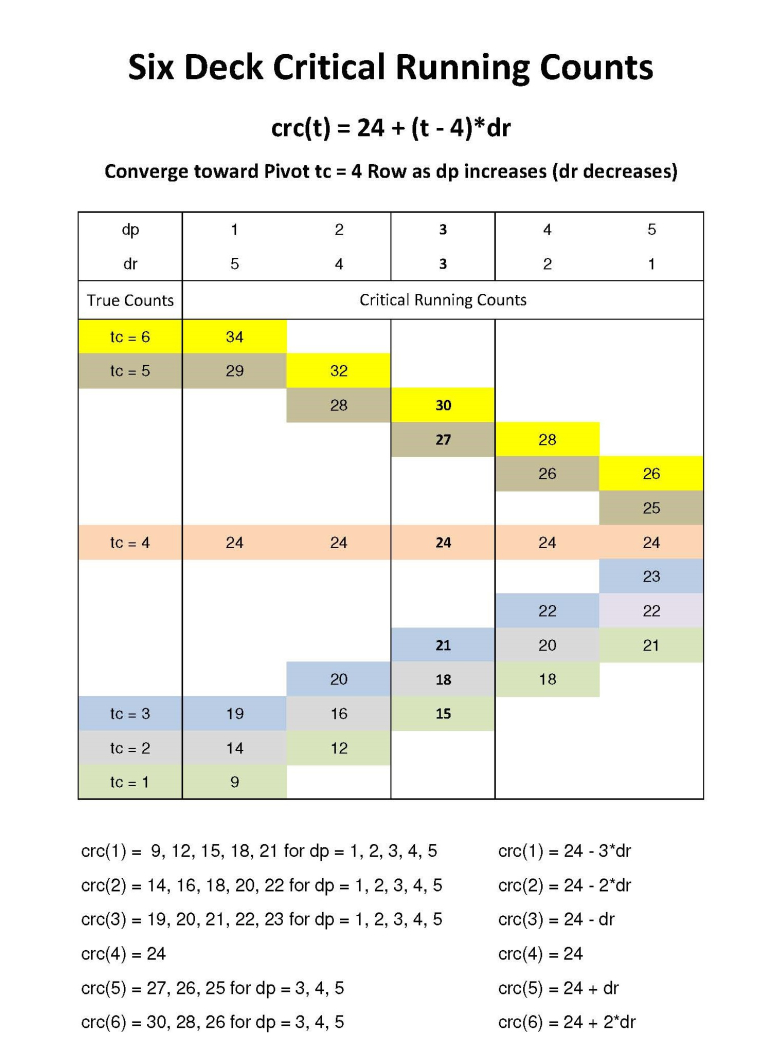
With KO you bet according to the KO true count just like with HL you bet according to the HL true count.
The KO true count is given in the TCRC,
Quote: acesideI’m glad that I’ve started to understand the equations you use for your books. I’m also glad that this website hasn’t banned us from posting. Good luck with your book selling and beat out all other book sellers too.
link to original post
Thanks. There is no reason to ban. We did not violate any rules.
As I suggested concentrate on winning more money and not these extreme technical details that you keep on bringing up.
If you want to keep HL then add 7m9c as a side count which is covered as HL with 7m9c in Blackjack Review for free or spend $10 and get the book HL with 7m9c on Amazon Kindle with more details.
If you switch to KO with TCRC then add 5m7c as a side count.which is covered in KO with 5m7c on Amazon Kindle tor $10.
If you want to play Spanish 21 then do not use the Monkey Count (which destroys playing strategy variations) but use Katarina Walkers HL but use TCRC and not her complicated and difficult true count formula which is hte same formula Cacarulo used for his TKO. So use Spanish 21 HL with TCRC and add 5mAc as a side count which is used for betting. HL is used for playing strategy variations and brc = betting running count = HL + 5mAc is used for betting. This is covered in Spanish 21 HL with 5mAc on Amazon Kindle for $10.
Good luck and I am glad I was able to answer your questions.
$10 at TC < +1:
$25 at +1 < = TC < +2;
$50 at +2 < = TC < +3;
$75 at +3 < = TC < +4;
$100 at +4 < = TC.
How much can a player make from the insurance side bet alone, per 100 hands, if using your KO as compared to the Hi-Lo?
Hi-Lo makes about $0.97 from insurance per 100 hands of playing;
KO makes about $0.90 from insurance per 100 hands of playing.
Therefore, KO is more inferior than Hi-Lo in this regard.
Quote: acesideRecently, I have investigated the math problem I raised above. Using the same trigger index of TC=+3, here are the results:
Hi-Lo makes about $0.97 from insurance per 100 hands of playing;
KO makes about $0.90 from insurance per 100 hands of playing.
Therefore, KO is more inferior than Hi-Lo in this regard.
link to original post
Say it ain't so!


