


Happy Pi Day

Quote: DRichI think this date next year will be the true pi day. 3/14/15 at 9:26:53 amQuote: Wizardp.s. Happy pi day!
I split this from the UTH video thread.
Pi day was celebrated in Austin during the SXSW music festival by 5 sky writing planes that circled the city. The 5 planes flew side by side and worked together to write text characters using short bursts of vapor in the style of a dot matrix printer. they wrote the message "Pi in the Sky" followed by the digits of PI. They continued to circle the city caring out the decimal representation of Pi to several hundred characters. It was magnificently geeky.

Quote: JimRockfordI split this from the UTH video thread.
Pi day was celebrated in Austin during the SXSW music festival by 5 sky writing planes that circled the city. The 5 planes flew side by side and worked together to write text characters using short bursts of vapor in the style of a dot matrix printer. they wrote the message "Pi in the Sky" followed by the digits of PI. They continued to circle the city caring out the decimal representation of Pi to several hundred characters. It was magnificently geeky.
I can remember is 8th grade one of my class rooms had pi written the entire way around the room as a border. IIRC it was my french class that used another teachers room for 1 period. Anyways, I was so horrible at language that I decided to study pi for the entire period for a year. That was nearly 20 years ago and I can still remember the following. I did not look it up, I promise.
3.1415926535897932384526433--832? brain stopped


Speedway gas stations seem to be offering their usual festive special - an entire pizza for half-tau dollars today and tomorrow.
I'm not around a Speedway, so... happy half-tau day (rounded down, a bit).

Quote: smoothgrhMay I have a large container of coffee?
link to original post
Their prices on the 3 quart to-go buckets never really impressed me.

Quote: DieterQuote: smoothgrhMay I have a large container of coffee?
link to original post
Their prices on the 3 quart to-go buckets never really impressed me.
link to original post
Are there drivers who consume three quarts of coffee between pit stops?
Quote: billryanQuote: DieterQuote: smoothgrhMay I have a large container of coffee?
link to original post
Their prices on the 3 quart to-go buckets never really impressed me.
link to original post
Are there drivers who consume three quarts of coffee between pit stops?
link to original post
Between pit stops? Maybe not.
The current trend is to no longer offer unlimited free beverage fills to the best fueling customers, and instead charge per fill. Many stores charge the same to fill a 20 ounce cup as a larger cup, so there is an indirect incentivization for larger containers.
I've never found my 2 quart thermal bottle to be too small.
Quote: smoothgrhMay I have a large container of coffee?
link to original post
May I have a large container of coffee?
3. 1 4 1 5 9 2 6
Quote: smoothgrhQuote: smoothgrhMay I have a large container of coffee?
link to original post
May I have a large container of coffee?
3. 1 4 1 5 9 2 6
link to original post
Man, I can't believe I missed that. I always used 355/113, and that's close enough for anything I'm building.

Quote: smoothgrhQuote: smoothgrhMay I have a large container of coffee?
link to original post
May I have a large container of coffee?
3. 1 4 1 5 9 2 6
link to original post
Why did you stop at seven digits right of the decimal? If you want to impress us, write the whole number out.

Quote: DRichQuote: smoothgrhQuote: smoothgrhMay I have a large container of coffee?
link to original post
May I have a large container of coffee?
3. 1 4 1 5 9 2 6
link to original post
Why did you stop at seven digits right of the decimal? If you want to impress us, write the whole number out.
link to original post
There's a math problem that bothers me about pi. If the digits of pi are indeed infinite and random, then all possible information should be encoded in it, and an infinite number of times. And you can find that information, if you knew what the starting digit was and its length in decimal digits. So why can't you use the starting digit as an abbreviation for a larger number.
For example, suppose you wanted an abbreviation for 415926. Your abbreviation would be (2,6) meaning you are starting at the 2nd digit to the right of the decimal point and using 6 digits.
I "know" that you can't really do that for generalized information, as the number you would need to express the position would be larger than the number you are trying to abbreviate. But I can't prove that. Has anyone proven that? Maybe the real mathematicians here might know.
Quote: AutomaticMonkeyQuote: DRichQuote: smoothgrhQuote: smoothgrhMay I have a large container of coffee?
link to original post
May I have a large container of coffee?
3. 1 4 1 5 9 2 6
link to original post
Why did you stop at seven digits right of the decimal? If you want to impress us, write the whole number out.
link to original post
There's a math problem that bothers me about pi. If the digits of pi are indeed infinite and random, then all possible information should be encoded in it, and an infinite number of times. And you can find that information, if you knew what the starting digit was and its length in decimal digits. So why can't you use the starting digit as an abbreviation for a larger number.
For example, suppose you wanted an abbreviation for 415926. Your abbreviation would be (2,6) meaning you are starting at the 2nd digit to the right of the decimal point and using 6 digits.
I "know" that you can't really do that for generalized information, as the number you would need to express the position would be larger than the number you are trying to abbreviate. But I can't prove that. Has anyone proven that? Maybe the real mathematicians here might know.
link to original post
Infinite. Not random. Not rational. Just forget about it and move on.
Quote: GenoDRPhQuote: AutomaticMonkeyQuote: DRichQuote: smoothgrhQuote: smoothgrhMay I have a large container of coffee?
link to original post
May I have a large container of coffee?
3. 1 4 1 5 9 2 6
link to original post
Why did you stop at seven digits right of the decimal? If you want to impress us, write the whole number out.
link to original post
There's a math problem that bothers me about pi. If the digits of pi are indeed infinite and random, then all possible information should be encoded in it, and an infinite number of times. And you can find that information, if you knew what the starting digit was and its length in decimal digits. So why can't you use the starting digit as an abbreviation for a larger number.
For example, suppose you wanted an abbreviation for 415926. Your abbreviation would be (2,6) meaning you are starting at the 2nd digit to the right of the decimal point and using 6 digits.
I "know" that you can't really do that for generalized information, as the number you would need to express the position would be larger than the number you are trying to abbreviate. But I can't prove that. Has anyone proven that? Maybe the real mathematicians here might know.
link to original post
Infinite. Not random. Not rational. Just forget about it and move on.
link to original post
It has not failed the statistical tests for randomness, i.e., all digits are equally represented, all 2-digit sequences are equally represented, all 3-digit sequences are equally represented, and so on. You cannot get any information about the next digit from the prior digits.
But that's an empirical test and I don't think the randomness of the sequence of digits has been proven either.

Quote: AutomaticMonkeyQuote: GenoDRPhQuote: AutomaticMonkeyQuote: DRichQuote: smoothgrhQuote: smoothgrhMay I have a large container of coffee?
link to original post
May I have a large container of coffee?
3. 1 4 1 5 9 2 6
link to original post
Why did you stop at seven digits right of the decimal? If you want to impress us, write the whole number out.
link to original post
There's a math problem that bothers me about pi. If the digits of pi are indeed infinite and random, then all possible information should be encoded in it, and an infinite number of times. And you can find that information, if you knew what the starting digit was and its length in decimal digits. So why can't you use the starting digit as an abbreviation for a larger number.
For example, suppose you wanted an abbreviation for 415926. Your abbreviation would be (2,6) meaning you are starting at the 2nd digit to the right of the decimal point and using 6 digits.
I "know" that you can't really do that for generalized information, as the number you would need to express the position would be larger than the number you are trying to abbreviate. But I can't prove that. Has anyone proven that? Maybe the real mathematicians here might know.
link to original post
Infinite. Not random. Not rational. Just forget about it and move on.
link to original post
It has not failed the statistical tests for randomness, i.e., all digits are equally represented, all 2-digit sequences are equally represented, all 3-digit sequences are equally represented, and so on. You cannot get any information about the next digit from the prior digits.
But that's an empirical test and I don't think the randomness of the sequence of digits has been proven either.
link to original post
I believe you've stated that correctly..
I've tried writing pi in radices other than 10 - such as base 9 etc. (and lots of other people have done the same thing.) Apparently, its irrationality and randomness characteristics are unaffected by what base your number system is.
If you wrote pi in base 26 and equated the numbers to letters (0=a, 1=b, . . . 25 =z) then it should contain every English word, every English phrase. Every first name and surname.
Quote: DRichQuote: smoothgrhQuote: smoothgrhMay I have a large container of coffee?
link to original post
May I have a large container of coffee?
3. 1 4 1 5 9 2 6
link to original post
Why did you stop at seven digits right of the decimal? If you want to impress us, write the whole number out.
link to original post
The mnemonic device only has eight words!
Quote: smoothgrhQuote: DRichQuote: smoothgrhQuote: smoothgrhMay I have a large container of coffee?
link to original post
May I have a large container of coffee?
3. 1 4 1 5 9 2 6
link to original post
Why did you stop at seven digits right of the decimal? If you want to impress us, write the whole number out.
link to original post
The mnemonic device only has eight words!
link to original post
May I have a large container of coffee, cream, and sugar?
(Punctuation is free.)

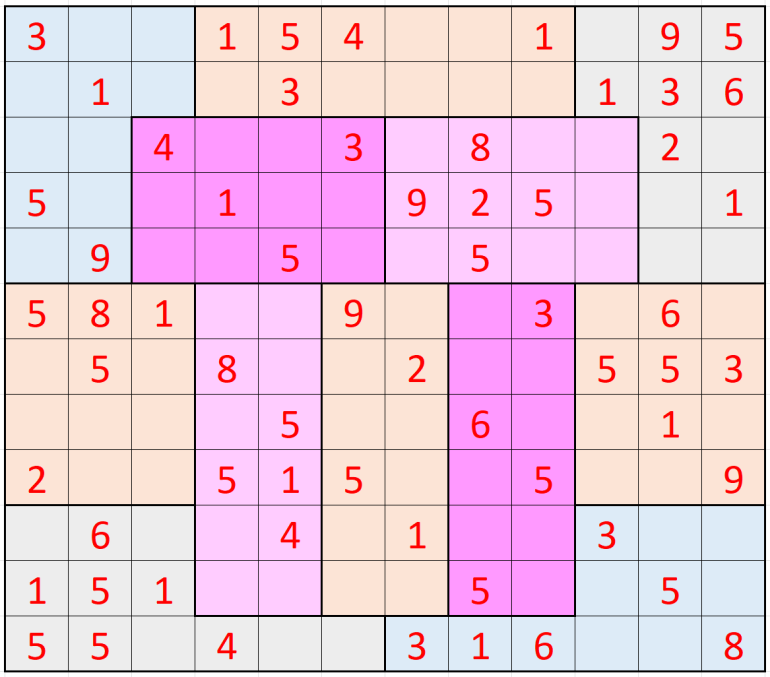
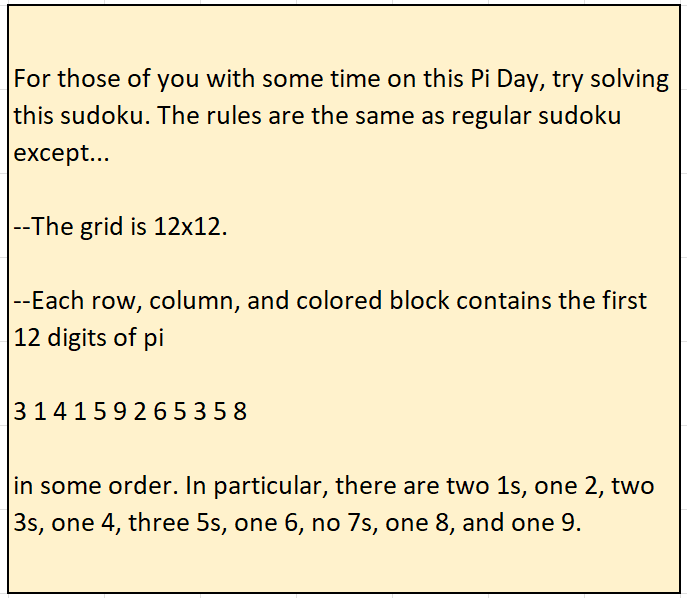
Enjoy!
Dog Hand
Quote: gordonm888Quote: AutomaticMonkeyQuote: GenoDRPhQuote: AutomaticMonkeyQuote: DRichQuote: smoothgrhQuote: smoothgrhMay I have a large container of coffee?
link to original post
May I have a large container of coffee?
3. 1 4 1 5 9 2 6
link to original post
Why did you stop at seven digits right of the decimal? If you want to impress us, write the whole number out.
link to original post
There's a math problem that bothers me about pi. If the digits of pi are indeed infinite and random, then all possible information should be encoded in it, and an infinite number of times. And you can find that information, if you knew what the starting digit was and its length in decimal digits. So why can't you use the starting digit as an abbreviation for a larger number.
For example, suppose you wanted an abbreviation for 415926. Your abbreviation would be (2,6) meaning you are starting at the 2nd digit to the right of the decimal point and using 6 digits.
I "know" that you can't really do that for generalized information, as the number you would need to express the position would be larger than the number you are trying to abbreviate. But I can't prove that. Has anyone proven that? Maybe the real mathematicians here might know.
link to original post
Infinite. Not random. Not rational. Just forget about it and move on.
link to original post
It has not failed the statistical tests for randomness, i.e., all digits are equally represented, all 2-digit sequences are equally represented, all 3-digit sequences are equally represented, and so on. You cannot get any information about the next digit from the prior digits.
But that's an empirical test and I don't think the randomness of the sequence of digits has been proven either.
link to original post
I believe you've stated that correctly..
I've tried writing pi in radices other than 10 - such as base 9 etc. (and lots of other people have done the same thing.) Apparently, its irrationality and randomness characteristics are unaffected by what base your number system is.
If you wrote pi in base 26 and equated the numbers to letters (0=a, 1=b, . . . 25 =z) then it should contain every English word, every English phrase. Every first name and surname.
link to original post
But pi is not random. It is a ratio. It may be irrational, it may be never ending, it may be quirky and "normal". But it isn't random.
Quote: GenoDRPhQuote: gordonm888Quote: AutomaticMonkeyQuote: GenoDRPhQuote: AutomaticMonkeyQuote: DRichQuote: smoothgrhQuote: smoothgrhMay I have a large container of coffee?
link to original post
May I have a large container of coffee?
3. 1 4 1 5 9 2 6
link to original post
Why did you stop at seven digits right of the decimal? If you want to impress us, write the whole number out.
link to original post
There's a math problem that bothers me about pi. If the digits of pi are indeed infinite and random, then all possible information should be encoded in it, and an infinite number of times. And you can find that information, if you knew what the starting digit was and its length in decimal digits. So why can't you use the starting digit as an abbreviation for a larger number.
For example, suppose you wanted an abbreviation for 415926. Your abbreviation would be (2,6) meaning you are starting at the 2nd digit to the right of the decimal point and using 6 digits.
I "know" that you can't really do that for generalized information, as the number you would need to express the position would be larger than the number you are trying to abbreviate. But I can't prove that. Has anyone proven that? Maybe the real mathematicians here might know.
link to original post
Infinite. Not random. Not rational. Just forget about it and move on.
link to original post
It has not failed the statistical tests for randomness, i.e., all digits are equally represented, all 2-digit sequences are equally represented, all 3-digit sequences are equally represented, and so on. You cannot get any information about the next digit from the prior digits.
But that's an empirical test and I don't think the randomness of the sequence of digits has been proven either.
link to original post
I believe you've stated that correctly..
I've tried writing pi in radices other than 10 - such as base 9 etc. (and lots of other people have done the same thing.) Apparently, its irrationality and randomness characteristics are unaffected by what base your number system is.
If you wrote pi in base 26 and equated the numbers to letters (0=a, 1=b, . . . 25 =z) then it should contain every English word, every English phrase. Every first name and surname.
link to original post
But pi is not random. It is a ratio. It may be irrational, it may be never ending, it may be quirky and "normal". But it isn't random.
link to original post
As a number it's not random, it represents a real thing, a real ratio. But as a series of digits, that's something else, it's no longer being used as a ratio but as just a series of digits.
I don't know what the terminology is. Quasi-random?

Quote: gordonm888Yes, we have been discussing pi as a series of integers ranging from 0 to 9, in which all the integers appear with the same average frequency (as evaluated over a very long string) and for which no one has ever found any discernable pattern. No matter how many of the preceding digits in the string you may have seen they contain no information to indicate what digit is coming next.
I don't know what the terminology is. Quasi-random?
link to original post
I'd call it random. For let's say I set up a true RNG. I have a radioactive sample, and I put 10 Geiger tubes in a circle around it, each one corresponding to an integer 0 through 9, and I derive my digits that way. Every time a tube fires I get that digit.
Even though it was derived from a real thing, specifically which direction a photon decided to go when an atom decayed, and there has never been full consensus on whether decay by the weak nuclear force is purely random (as that would require experiments we can't do) no one would deny that's a true RNG I have there and as long as I did my experiment right that's a true random number I have now. And even that random series of digits no matter how long, will be found somewhere in pi if our current mathematical understanding of pi is correct.
Quote: gordonm888Yes, we have been discussing pi as a series of integers ranging from 0 to 9, in which all the integers appear with the same average frequency (as evaluated over a very long string) and for which no one has ever found any discernable pattern. No matter how many of the preceding digits in the string you may have seen they contain no information to indicate what digit is coming next.
I don't know what the terminology is. Quasi-random?
link to original post
What you describe is called a normal number. https://en.wikipedia.org/wiki/Normal_number
As for predicting what digit comes next, that's easy. Just solve the mathematics operations to calculate pi. While there is no way of knowing from any preceding digits what comes next, there is a way of knowing. This differs from flipping a coin or rolling them bones on a craps table, from which there is no way of predicting or calculating which individual number comes next,
Quote: AutomaticMonkeyQuote: gordonm888Yes, we have been discussing pi as a series of integers ranging from 0 to 9, in which all the integers appear with the same average frequency (as evaluated over a very long string) and for which no one has ever found any discernable pattern. No matter how many of the preceding digits in the string you may have seen they contain no information to indicate what digit is coming next.
I don't know what the terminology is. Quasi-random?
link to original post
I'd call it random. For let's say I set up a true RNG. I have a radioactive sample, and I put 10 Geiger tubes in a circle around it, each one corresponding to an integer 0 through 9, and I derive my digits that way. Every time a tube fires I get that digit.
Even though it was derived from a real thing, specifically which direction a photon decided to go when an atom decayed, and there has never been full consensus on whether decay by the weak nuclear force is purely random (as that would require experiments we can't do) no one would deny that's a true RNG I have there and as long as I did my experiment right that's a true random number I have now. And even that random series of digits no matter how long, will be found somewhere in pi if our current mathematical understanding of pi is correct.
link to original post
If you called pi random on a test, quiz or homework, you'd get the answer wrong. You'd call it random. The rest of the world knows better.
Quote: GenoDRPhQuote: AutomaticMonkeyQuote: gordonm888Yes, we have been discussing pi as a series of integers ranging from 0 to 9, in which all the integers appear with the same average frequency (as evaluated over a very long string) and for which no one has ever found any discernable pattern. No matter how many of the preceding digits in the string you may have seen they contain no information to indicate what digit is coming next.
I don't know what the terminology is. Quasi-random?
link to original post
I'd call it random. For let's say I set up a true RNG. I have a radioactive sample, and I put 10 Geiger tubes in a circle around it, each one corresponding to an integer 0 through 9, and I derive my digits that way. Every time a tube fires I get that digit.
Even though it was derived from a real thing, specifically which direction a photon decided to go when an atom decayed, and there has never been full consensus on whether decay by the weak nuclear force is purely random (as that would require experiments we can't do) no one would deny that's a true RNG I have there and as long as I did my experiment right that's a true random number I have now. And even that random series of digits no matter how long, will be found somewhere in pi if our current mathematical understanding of pi is correct.
link to original post
If you called pi random on a test, quiz or homework, you'd get the answer wrong. You'd call it random. The rest of the world knows better.
link to original post
Says the guy who typed Wikipedia at us!
Try it a different way- so I have my decimal photonic random number generator. I also happen to know an infinite number of places of pi, and I can start from any of them and use that to generate numbers. You ask me for a long string of random integers, 0-9, and I give them to you. How would you propose to determine which method I used, the quantum RNG or just picking them out of a series starting at some arbitrary digit? What tests would you apply that would distinguish the two possible origins?
In science we know things by their characteristics, and you can't say something has all the characteristics of some thing, but really isn't that thing. That's a supernatural argument, and I'm perfectly fine with the supernatural, just not here. It does not mix with mathematics or natural science.
pi is a pseudorandom number generator. (as posted by aceside)
the digits in pi have random behavior
It is widely believed to be a normal number - with an even distribution of digits - in whatever base n it is written in (as posted by GenoDrPh) although this has not been strictly proven.
Many irrational numbers have these properties including:
e
sqrt(2)
ln(2)
ζ(3)

Quote: AutomaticMonkeyQuote: GenoDRPhQuote: AutomaticMonkeyQuote: gordonm888Yes, we have been discussing pi as a series of integers ranging from 0 to 9, in which all the integers appear with the same average frequency (as evaluated over a very long string) and for which no one has ever found any discernable pattern. No matter how many of the preceding digits in the string you may have seen they contain no information to indicate what digit is coming next.
I don't know what the terminology is. Quasi-random?
link to original post
I'd call it random. For let's say I set up a true RNG. I have a radioactive sample, and I put 10 Geiger tubes in a circle around it, each one corresponding to an integer 0 through 9, and I derive my digits that way. Every time a tube fires I get that digit.
Even though it was derived from a real thing, specifically which direction a photon decided to go when an atom decayed, and there has never been full consensus on whether decay by the weak nuclear force is purely random (as that would require experiments we can't do) no one would deny that's a true RNG I have there and as long as I did my experiment right that's a true random number I have now. And even that random series of digits no matter how long, will be found somewhere in pi if our current mathematical understanding of pi is correct.
link to original post
If you called pi random on a test, quiz or homework, you'd get the answer wrong. You'd call it random. The rest of the world knows better.
link to original post
Says the guy who typed Wikipedia at us!
Try it a different way- so I have my decimal photonic random number generator. I also happen to know an infinite number of places of pi, and I can start from any of them and use that to generate numbers. You ask me for a long string of random integers, 0-9, and I give them to you. How would you propose to determine which method I used, the quantum RNG or just picking them out of a series starting at some arbitrary digit? What tests would you apply that would distinguish the two possible origins?
In science we know things by their characteristics, and you can't say something has all the characteristics of some thing, but really isn't that thing. That's a supernatural argument, and I'm perfectly fine with the supernatural, just not here. It does not mix with mathematics or natural science.
link to original post
The issue is this: while pi itself isn't random, it can be used as a source for generating random numbers.
Let's say we need 5 random digits. For example, 10527 is a string of 5 digits that I just now made up, right here in this post; no RNG was used.
If you use pi as a source of 5 digits, starting somewhere, you have to select a starting position. If you select that position yourself and don't tell us, that's really not much different than if you just make up 5 digits like I just did.
When we use a computer to use pi to generate 5 digits, the computer cannot arbitrarily pick a starting position (the seed). Computers are deterministic. They have to be told exactly what to do.
If you make the seed value 1, the results will not be random at all. You'll get 31415 every single time.
If you make the seed value 1 and instruct the computer to keep going instead of starting over every time a 5 digit request is made, you'll get different results, but they won't be unpredictably random. You'll be guaranteed outcomes of 31415, 92653, 58979, and so on.
What makes a pseudo-random RNG just as unpredictable as a true RNG is for the computer to use a seed that derives its value from something you cannot know, such as the current system time in milliseconds. No one is going to know what the current system time in milliseconds will be when the button "go" gets pressed.
Quote: DRichDid anyone else have pie on PI day? I had pecan pie yesterday after dinner.
link to original post
Does pizza count?

Quote: billryanQuote: DRichDid anyone else have pie on PI day? I had pecan pie yesterday after dinner.
link to original post
Does pizza count?
link to original post
Absolutely not!!!
Only you New Yorkers are silly enough to call pizza a pie. The rest of the world frowns upon you for that.
Quote: DRichHow awesome would it be to live in St. Louis and have your phone number (314) 159-2653
link to original post
With a Central Office Code number beginning with 1?
I would call that unique indeed!
Quote: DRichDid anyone else have pie on PI day? I had pecan pie yesterday after dinner.
link to original post
Pi day comes at a bad time of year for me. Middle of Lent, so I give up chocolate, sweets anc confections. So no baked desert pie for me. It also had pizza on Friday. Homemade mushroom pizza and homemade pineapple pizza-meatless for Lent. So, what to have on pi day Saturday?
A 36 oz Mrs. Budd's Chicken Pot Pie of course!
Chosen specifically because pie aren't round. Pie are squared...or close enough!
Quote: DRichDid anyone else have pie on PI day? I had pecan pie yesterday after dinner.
link to original post
DRich,
I had pumpkin pie. It was tasty.
Dog Hand
Quote: AutomaticMonkeyQuote: DRichHow awesome would it be to live in St. Louis and have your phone number (314) 159-2653
link to original post
With a Central Office Code number beginning with 1?
I would call that unique indeed!
link to original post
Didn't that technical restriction go out in the mid 1990's, and was only continued as convention?
Quote: DieterQuote: AutomaticMonkeyQuote: DRichHow awesome would it be to live in St. Louis and have your phone number (314) 159-2653
link to original post
With a Central Office Code number beginning with 1?
I would call that unique indeed!
link to original post
Didn't that technical restriction go out in the mid 1990's, and was only continued as convention?
link to original post
I think that's the second digit. 0 and 1 were banned as the second digit of the COC because it can be confused with an area code. But once they expanded the area codes that all went away.
Quote: AutomaticMonkeyQuote: DieterQuote: AutomaticMonkeyQuote: DRichHow awesome would it be to live in St. Louis and have your phone number (314) 159-2653
link to original post
With a Central Office Code number beginning with 1?
I would call that unique indeed!
link to original post
Didn't that technical restriction go out in the mid 1990's, and was only continued as convention?
link to original post
I think that's the second digit. 0 and 1 were banned as the second digit of the COC because it can be confused with an area code. But once they expanded the area codes that all went away.
link to original post
The switch to local calls requiring an area code removed the restriction on 1 in the first position, I thought.
Then again, I was never really a phreak or a company man, and only dealt with a few pre-SIP PBX systems.
Quote: DieterQuote: AutomaticMonkeyQuote: DieterQuote: AutomaticMonkeyQuote: DRichHow awesome would it be to live in St. Louis and have your phone number (314) 159-2653
link to original post
With a Central Office Code number beginning with 1?
I would call that unique indeed!
link to original post
Didn't that technical restriction go out in the mid 1990's, and was only continued as convention?
link to original post
I think that's the second digit. 0 and 1 were banned as the second digit of the COC because it can be confused with an area code. But once they expanded the area codes that all went away.
link to original post
The switch to local calls requiring an area code removed the restriction on 1 in the first position, I thought.
Then again, I was never really a phreak or a company man, and only dealt with a few pre-SIP PBX systems.
link to original post
A lot of these conventions are legacy, to support rotary phones on landlines. Still in use and people who have them have the right to use them.
Oh I was a total phreak! Just something magical and mysterious about the way touch-tone systems responded and sounded.
I used to love Mrs Budds chicken pot pies. Then one day I was eating one and bit into a finger of a rubber glove. I hope the finger wasn’t in there too. Anyway since then I’ve lost my appetite for them. It could have been worse it could have been a condom.Quote: GenoDRPhQuote: DRichDid anyone else have pie on PI day? I had pecan pie yesterday after dinner.
link to original post
Pi day comes at a bad time of year for me. Middle of Lent, so I give up chocolate, sweets anc confections. So no baked desert pie for me. It also had pizza on Friday. Homemade mushroom pizza and homemade pineapple pizza-meatless for Lent. So, what to have on pi day Saturday?
A 36 oz Mrs. Budd's Chicken Pot Pie of course!
Chosen specifically because pie aren't round. Pie are squared...or close enough!
link to original post
Quote: HunterhillI used to love Mrs Budds chicken pot pies. Then one day I was eating one and bit into a finger of a rubber glove. I hope the finger wasn’t in there too. Anyway since then I’ve lost my appetite for them. It could have been worse it could have been a condom.Quote: GenoDRPhQuote: DRichDid anyone else have pie on PI day? I had pecan pie yesterday after dinner.
link to original post
Pi day comes at a bad time of year for me. Middle of Lent, so I give up chocolate, sweets anc confections. So no baked desert pie for me. It also had pizza on Friday. Homemade mushroom pizza and homemade pineapple pizza-meatless for Lent. So, what to have on pi day Saturday?
A 36 oz Mrs. Budd's Chicken Pot Pie of course!
Chosen specifically because pie aren't round. Pie are squared...or close enough!
link to original post
link to original post
When I lived in Queens Village, there was a Howard Johnson's plant that made chicken and shrimp croquettes. A man went missing on the overnight shift. Months later, his wedding ring turned up in someones meal.


