


I saw a total eclipse in China on July 22, 2009 and wrote all about it in my Wizard of Odds blog. Although annular eclipses don't compare total eclipses, I have never seen an annular eclipse before, and I had to drive only about two hours to Utah to do so, so I figured I would make a short trip out of it with my son.
We left the day before in the afternoon and visited Valley of Fire state park on our way to Utah. This is only my second time there. My son went there on a field trip and has been asking to return ever since. First we did the petroglyph (note to Bill Gates: Add this word to your spell-checker)/mouse's tank trail. This is the actually the same trail, and the park map and signage do not make this clear. This is a short and easy trail with more petroglyphs than I've ever seen in one place, by far. Here are just a few pictures I took of them.
At the end of the trail is a small natural hole in the rock where water tends to fill in wetter months. On this hot May day it was dry. Maybe they call it mouse's tank because when mice try to drink from it they can't get out and drown in it. I recall when I was a camping trip as a kid my mother left a bucket of water out and in the morning a dead mouse was floating in it.
The Petroglyph trail was too short and easy so we added on the White Dome trail. This was a nice but short hike through some of the oddly shaped sandstone features that the Valley of Fire is famous for. We still felt unsatisfied after that, so we decided to climb this short but sweet little peak by the White Dome parking lot. We called it "mini red cap," named after a similar climb at Red Rock, which I write about in my article on Red Cap.
The climbing on of this was surprisingly challenging in spots. Places that made me feel a little uncomfortable my son climbed up, down, or across as he were a mountain goat. Here are some pictures.


After that I felt a got a workout just from just the fear factor and was ready to hit the road. We ate at the Casablanca buffet in Mesquite, which was not bad. It was seafood night and we both enjoyed the crab legs. Then it was to our hotel in Saint George. I would have preferred Springdale, or even Hurricane, but both places were booked solid. I tend to think I may have been lucky to even get a room in Saint George, as the front desk clerk said he was getting a lot of eclipse business.

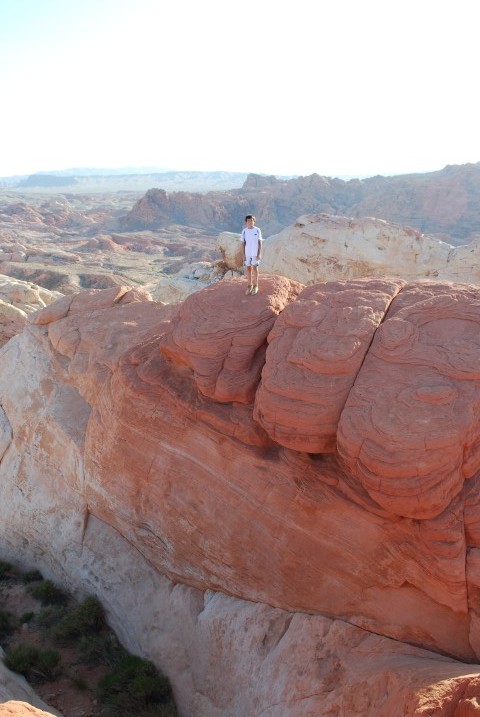

The next day we got up early to climb Observation Point in Zion National Park. This area gets HOT this time of year, so I wanted to climb in as much comfort as possible. This is an 8-mile round trip hike, from the canyon floor to the rim. We've done most of the other hikes there before, and I wanted to do something fairly hard, because we need to train for Mount Whitney in July.
Observation Point is a great climb. Not as famous or rewarding as Angel's Landing, but still very worth doing. If you still have energy, add on Hidden Canyon as a side trip. Here is a picture from the top.

We finished with Observation Point about 12:30 and still had about five hours to kill before the eclipse started. So we hung out by the river for a while and poked around Springdale. I highly recommend the Bumbleberry milkshakes, which are made with real pie. They are available in a gift ship by the Bubbleberry Inn, adjacent to Wildcat Willies.
So, I'm finally ready to talk about the eclipse. Sorry it took so long. I overheard a lot of people were going to watch the eclipse from Zion or Bryce National Parks. However, my son had school the next day, so we watched it from Saint George, to hit the road immediately afterward.
You would think for all my enthusiasm for eclipses I would have a telescope with all the necessary eclipse accoutrements to watch it. Nope. I just had two pieces of glass that are used in a welder's mask. One is not enough and you can't see anything with three. These are easily available in a large hardware store, but don't wait until the last minute. I wanted to buy more a few days before the eclipse and the local home depot was sold out. The ones I did have I purchased about two months before, in preparation.
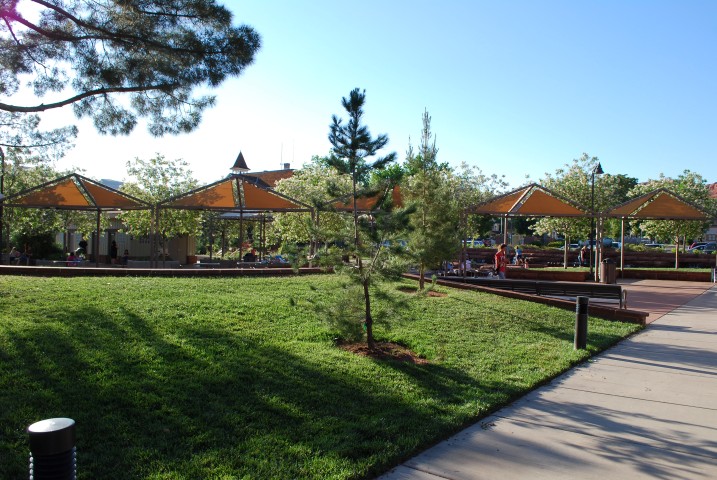
I knew from a previous visit there is a very nice park next to the Saint George Tabernacle. This park doesn't seem to have a name, and isn't on the maps, which is strange for such a nice park. It has lots of water features for kids to play in and art sculptures.
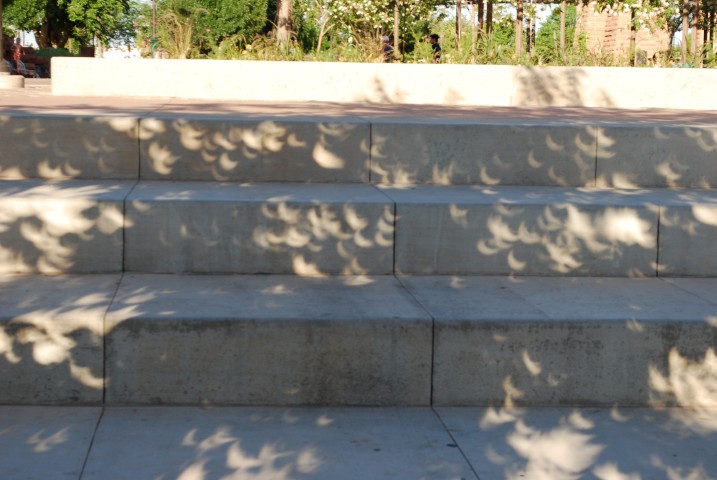
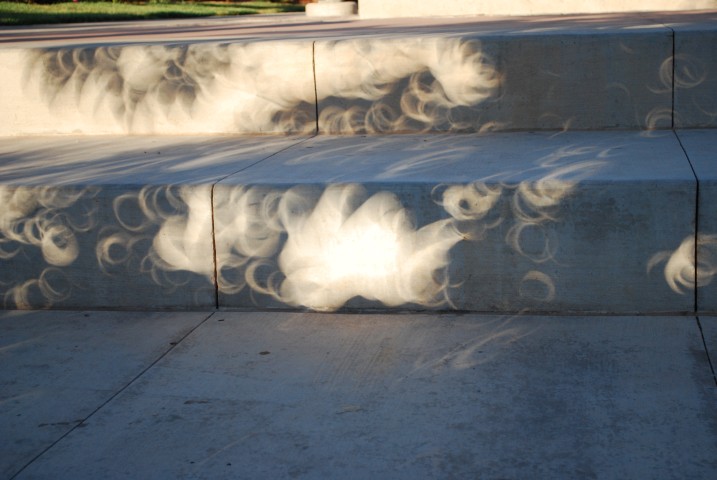
My son and I found a spot by an open field with some good trees. Trees are important because as the sun shines through them during an eclipse you can see an outlines of the sun in the places the sunlight pokes through in the shadow. If there are no trees available, you can create the same effect by making a waffle pattern with your fingers.
As my son and I passed the glass back and forth we got the attention of a group of about a dozen people. They were curious about what we were doing so I explained it and let them borrow the glass. They were all very grateful and amazed. The effect of the light through trees was also of much interest on nearby steps.
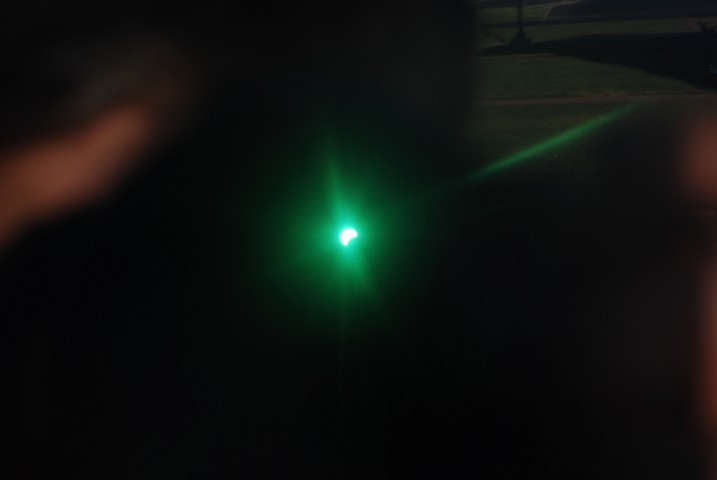
I tried unsuccessfully to take a picture. This is what I saw through my normal camera with one piece of welders' glass. So, when the eclipse reached its pinnacle, where it appeared like a ring of fire, the entire park was noticeably not as hot and bright. I was quite the temporary celebrity for having the glass as everyone took a few seconds with it and passed it on. During this time you could see rings of sunlight on the steps.
After a couple minutes the ring of fire turned back to a crescent, and the show was pretty much over. So, now I can say I've seen both a total eclipse and an annular eclipse. Of course, I've seen lots of partial ones as well.

After doing the amateur thing for the last two, I'm ready to take it to the next step for the total eclipse of August 21, 2017, which will cut from Oregon to South Carolina. I'm already after my father to sell me his telescope, which he used to watch the eclipse "partial style" from southern California.
Comments (14)
Thanks for the photos and blog Wizard, I enjoyed them very much. Did your daughter not want to take the trip?
I am curious about the petroglyphs. Is the "black" a natural feature of the rock, or is it scorched? If it is scorched, it is surprising that it would last past the first rain. If it is natural, I don't see the same black face on many other rocks in the photos.
Something is not making sense. The idea seems to be that we got an annular eclipse because the moon is so far from earth, as you put it: "When the moon is relatively far from the earth, it doesn't completely cover the sun, causing what looks like a ring of fire, and is known as an annular eclipse"
But we just experienced a "Super Moon" on May 6th. This meant the moon was as close to earth as it ever gets. How is it possible that things could change that fast?
Wikipedia on the super moon. The super moon was also extensively covered in the newspaters.
PS: yes, great post, I didnt realize there was a place you could go to in the US that would have that many petrogyphs.
I love the steps photos!
Try to find a place with a pond for the next eclipse, or better yet with several small puddles. You can see a reflection of the event on the surface. This also sometimes happens on car windshields.
Photographing an eclipse is notoriously hard. For a total one, you may want to resurrect an old 35mm film camera and look for ultra-high ISO rating like 1,600 or more, and try to get a photo of the corona.
Odiousgambit, the Moon orbits the Earth in 28 days. For the 14 days between May 6th and the 20th, that's exactly half an orbit.
Yes, the black is a natural feature of the rock. You see it sometimes here at Red Rock, but it is more common at Valley of Fire. What causes it? I just assumed a higher iron content in the rock, but I've been wrong before. What makes me doubt that is it seems to be just on the surface.
That is indeed a good question about the Super Moon. You stumped me with that one. I think I'm going to have to use my lifeline and call Doc in here to help out.
1) Wizard: How/when did you steal all of my photos from Valley of Fire? Seriously, I think I have photos of the exact same petroglyphs.
2) My browser says that "petroglyphs" is incorrectly spelled, and it's Firefox, not a Micro$oft product.
3) I think Nareed has given the correct answer already. If the full moon occurred at the perigee of the moon's orbit, giving a super moon, then the preceding and following new moons (and the associated opportunities for solar eclipse) should occur very near to the apogee of the moon's orbit. For a really nice total eclipse, you would like to have a new moon, a perigee of the orbit, and alignment of the earth, moon, and sun.
4) I am not an astronomer, regardless of how much the Wizard would like for me to answer every science-oriented question, so don't wager your entire bankroll on that answer.
Great stuff.
I had heard that an alternate way to 'view' the eclipse was to look at shadows. I never realized just what they meant. Thanks for that.
---
Regarding the "Super moon" and the eclipse.
The moon's orbit is elliptical. Only when it's close approach is during a full moon does the moon appear large enough to be called a "super moon". But this also means that for the new moon prior and following, it is nearly at the furthest points in it's orbit.
That super moon was about 2 weeks prior to the eclipse, and the moon's orbit is about 29 days......
Neat pic Mike!
We were on the 27th floor in Reno, which apparently Northern Nevada had the PERFECT view (KOLO-8 was asked by National News companies for their pics)
I actually have a couple nice welding hoods, so we took those and it was quite a sight...I was going to try taking a picture, but I was seriously afraid it would burn the lense out of the camera (LOL, I've never tried taking a picture directly into the sun; and I thought the welding shields would blur it completely)
Thank you for all the answers to the new moon question. Does anyone have anything about the black petroglyph rocks?
Based on the replacement glass I purchased at Lowes, I would think that a welder's mask would not be sufficient. Or can one put in two panes? I tried looking at the eclipse through one pane, which I could do, but it was too bright to look at for more than a second.
naturally a new moon is what you want for an eclipse, but my hat is off to those of you who realized the perigee full moon is immediately followed by an apogee new moon [right?]. That was not intuitive to me or the Wizard but I can kind of picture it.
oops, apogee full moon is immediately followed by an perigee new moon
altho both statements are evidently true
Yes, odiousgambit, both statements are true. In this particular case, it was a perigee full moon (super moon) followed by an apogee new moon (annular eclipse).
By the way, I'm sure most of you already know this, even if you didn't "know" it....
The moon's orbital plane is not the same as the earth's orbital plane. If it were the same, there would be an eclipse every month. Actually two each month - solar and lunar.
I'm not sure whether it's more useful to post here or in the eclipse discussion thread, but I though I would provide this link to an article about photographing a solar eclipse. I saved the article just in case I survive to 2017 and have an opportunity to attempt photographing the total eclipse that year.