


Random and more random


I can set the dice at the table and occasionally hit my 7-11 come-out wins, and that seems less random than normal. Or I can set for the point and hit that right away, and that seems like hitting a rifle shot in an arcade game. But sometimes, the earth just moves a little and my swing isn't right or the dice hit the wall a little different and everything falls apart. Think about how a pendulum rotates around as the earth rotates around. The good cycles don't last long and it's on to the next.

There are 12 general tests mentioned in the second volume of Donald Knuth's The Art of Computer Programming; however, the first one is, "Count the number of times each result comes up, and see how close they get to being equal," which makes the "random" sequence 1, 2, 3, 4, 1, 2, 3, 4, 1, 2, 3, 4, ... "truly" random.
Some methods work better if the range of numbers needed is limited. For example, if you want to simulate a dice roll or a roulette wheel spin, you can do what I did for a hardware project in college over 40 years ago; the aforementioned "1, 2, 3, 4, 1, 2, 3, 4, ..." method, but really fast (I ran it at 1,000,000 results per second), with the number chosen when someone pushes a button. This doesn't work as well with larger numbers, as there are some people who can time the button to 1/10,000 of a second; if the RNG is driving a slot machine with a selection rate of 1,000,000 per second, if you know when the jackpot number came up, you can reduce the probability of finding it again to 1 /100.
The "standard" method is this: to generate a random integer from 0 to N - 1 for some N, find two numbers M and A, let R be any of the integers in the range, then generate the next number = (M R + A) mod N. If M and A meet certain conditions (A and N do not share any factors > 1; M - 1 is a multiple of every prime factor of N; N is not a multiple of 4 and/or M - 1 is a multiple of 4), then any set of N consecutive numbers will have every number from 0 to N - 1 exactly once. Some of these are "more random" than others; there is a specific test for this. One set of M, A, and N that failed miserably was IBM's random number function that it included in its large computers.
I once saw a method for an old-school IBM 1130 "big-iron" computer that generated random numbers by "reading" them from the line printer.


One of they early 'home-user' randomizers was to to randomize a list of items 3 or 7 times then randomly select item(s). You might say shuffle a deck of cards 3 or 7 times (chosen randomly), then select random cards from the deck. *** Of course this is NOT the way card games are dealt, after the 3 or 7 shuffle, cards are dealt off-the-top. *** It would be interesting to know if this method is used in poker websites... they might be illegal if NOT dealt consecutively off-the-top after shuffle.

Quote: technicsIs there such a thing as more random? I understand that regular craps tables, mini crap tables, and bubble craps games are all producing random outcomes, but is one more random than the other? Do all RNG’s produce the same degree of randomness I.e.are Excell RNG functions as random as RNG’s used by casino games? Or is a random number a random number no matter how it’s produced ? Just wondering..
link to original post
In an esoteric sense I would say some RNG's are more random than others, but honestly none of them ar random they are just the output of a formula. If you run an RNG multiple times with the same inputs you will always get the same outputs.

Now, we would think that if we wrote this
10 HGR2
20 HPLOT RND(1) * 280, RND(1) * 192
30 GOTO 20
and ran it forever, then we would eventually see the screen fill up with dots. After nH_n iterations, we should have the board filled on average, right? It is a "coupon collector" problem.
But if we did run it forever, we would see something like this for all times after 7 minutes or so:
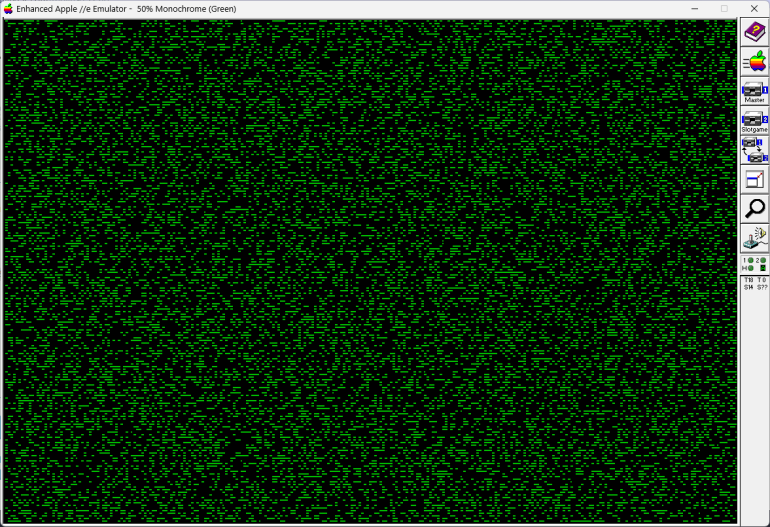
Turns out that the period, math word for how long the stream is, is really short. It starts repeating the sequence after a short time. If print out the RNG values for our thing, we would see a sequence of 37,758 numbers that would just keep repeating. It is a "bad" RNG. It is only random for a very short time, then it is very predictable.
"Good" RNGs have much larger streams. PCG-random is 2^64, which would take 58.5 million years to exhaust if we go through 10,000 numbers per second. Mersenne twister is 2^19000-whatever minus 1.
Quote: acesideI just read an online article, Random Seeds and Reproducibility. There are two aspects of each RNG, seed and reproducibility. The RNG I’m using has several millions of seed numbers for me to choose one from, but I haven’t understood these things. For each seed, the RNG produces a fixed number sequence, which is pseudo-random.
link to original post
One of the ways to use that is to use "real" random entropy to select a seeded sequence. One of the common ways to collect random entropy is to observe timing data from physically wiggling a mouse.
(If you need a valid entropy pool, don't use a "jiggler" to keep Teams from sleeping. Duh.)
Quote: itsmejeffTurns out that the period, math word for how long the stream is, is really short. It starts repeating the sequence after a short time. If print out the RNG values for our thing, we would see a sequence of 37,758 numbers that would just keep repeating. It is a "bad" RNG. It is only random for a very short time, then it is very predictable.
"Good" RNGs have much larger streams. PCG-random is 2^64, which would take 58.5 million years to exhaust if we go through 10,000 numbers per second. Mersenne twister is 2^19000-whatever minus 1.
link to original post
The length of a period is not necessarily a sign of a "good" RNG. The "random" sequence 1, 2, 3, ..., 2^65,536 has a period of 2^65,536, but I would hardly call it "random."
You can generate a random sequence of period 2^N using the formula I mentioned above (if R is the most recent number, or the seed if you have not started yet, the next number is (R M + A) mod 2^N, if A is any odd number and M is any positive integer that is 1 more than a multiple of 4. If you want a period of 10^N, then A is any odd number that does not end in 5, and M is 1 more than a multiple of 20.
Quote: DanburyI would like to add that wind noise and radioactivity are natural sources of random generation. At my college back in the late 70's the computer center had a box with geiger tube attatched. This was for seed generation.
link to original post
Wow, I am shocked it had a Geiger counter attached in the 1970's. Do you mind me asking which college?

Quote: DanburyI would like to add that wind noise and radioactivity are natural sources of random generation. At my college back in the late 70's the computer center had a box with geiger tube attatched. This was for seed generation.
link to original post
What, you didn't just hang a microphone out the window and pick up street noise?


