


RTP of online Mines games

Do you all believe the game is rigged/not as it appears, or that the 94% RTP is an aggregate of various betting scenarios?
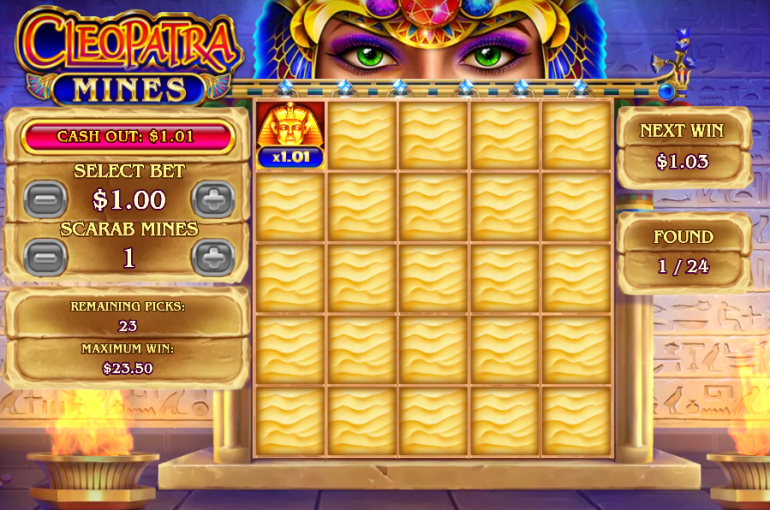

If the game plays "true", you would win 96% of the time in the setup pictured (if you quit after one guess), but your RTP would be 96.96%. (For every $25 spent, you would expect to get back 24 x $1.01 = $24.24.)
My question is: does the game play true?


Quote: DobrijYes, the first move's RTP is 96.96%. But in games like these, each move typically has its own EV, and the higher the win rate, the lower the RTP. Therefore, the manufacturer probably indicated the average RTP%
link to original post
NO, this is not an average RTP. This is the optimal RTP that you can attain. You need to randomly select squares until you blow up or find all the non-mine squares to achieve this RTP. Nowhere in the rules do they say what the RTP is if you cash out early. It is probably similar. I know of games where the RTP is slightly lower for cashing out, but only because they game rounds the payoff down to the nearest penny (based on a dollar bet).
My guess (based on other similar games) is that they recalculate the cashout payoff after every selection based on the math of the game. They calculate the exact amount that would give you a 96.96% RTP, and then round down.
I suspect that the optimal EV is achieved by taking more risk because the penny rounding has a less negative affect on your cashout offer the higher the offer is. I have built math models of other games that shows that this is how those other games are constructed. I don't have any motivation to do the math for Mines. Maybe someone else can work it out.

Quote: findingEVSo when it's a 5x5 board with 1 mine, just to clarify, do you think you will safely survive the first pick 96% (24/25ths) of the time on average? Is the game honestly picking one spot that has a mine and 24 safe spots?
link to original post
Again, I have not tested Mines, nor have I done the math. For other games where I have worked out the math assuming random placement, it agrees to the penny for payouts that are six significant digits. Mines apparently uses a table based on dollar bets, so the payoff for $1 might be $4.85 and the payoff for a $100 bet will be $485.00. That is, they do not give you the the $485.xx that the math would give you.
You can easily run auto play in demo mode and verify that the placements are roughly random (or not). I don't care to do this, but I have collected statistics on other games for days to understand how they work.
Quote: MentalQuote: findingEVSo when it's a 5x5 board with 1 mine, just to clarify, do you think you will safely survive the first pick 96% (24/25ths) of the time on average? Is the game honestly picking one spot that has a mine and 24 safe spots?
link to original post
Again, I have not tested Mines, nor have I done the math. For other games where I have worked out the math assuming random placement, it agrees to the penny for payouts that are six significant digits. Mines apparently uses a table based on dollar bets, so the payoff for $1 might be $4.85 and the payoff for a $100 bet will be $485.00. That is, they do not give you the the $485.xx that the math would give you.
You can easily run auto play in demo mode and verify that the placements are roughly random (or not). I don't care to do this, but I have collected statistics on other games for days to understand how they work.
link to original post
Here is a purchase screen from "The Wizard of Oz We're Not In Kansas Anymore".
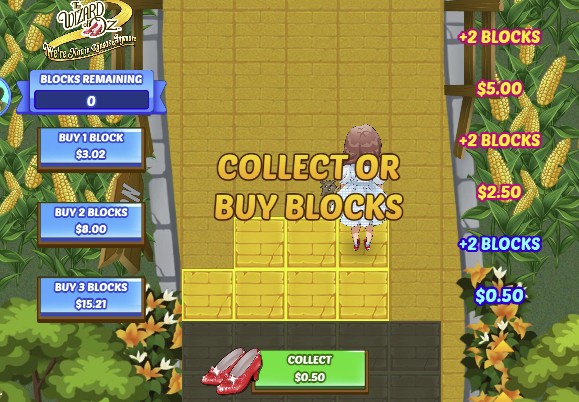
This is a new game to me, and I don't have any idea of how to calculate the RTP for the purchase blocks. I do note that there are three purchase options. A proper mathematical model for the game should be able to predict all three values simultaneously (rounded to a penny), and so the model will be severely constrained. The rules below don't give a clear picture of what happens in the game. You should try it at min bet or in demo mode to understand the mechanics in detail I don't understand it..
Quote: Purchase Rules
Blockchain™ Mechanic
Each game starts with 9 blocks. A series of 9 randomly selected blocks fall into the playing area and stack on top of each other.
Reaching a level with +2 blocks adds an extra 2 blocks to the total blocks which are then dropped on the top of the path.
Reaching a level with a cash prize awards a win. Only the highest prize reached is awarded.
The game ends when no blocks remain or the top level is reached.
Extra block purchases
When all blocks in the base game have been dropped the player can choose to purchase extra blocks to continue the game.
All blocks below the top two rows are blocked out for extra block purchases.
1, 2 or 3 blocks can be purchased with the associated prices of each displayed on the buttons.
Extra block purchases are only offered where an improved win is possible and where the potential win is greater than the purchase price.
The total staked so far is displayed in the information bar.
Return to Player
The overall theoretical return to player is {{game_rtp}}%
Extra block purchase theoretical return to player is 94.34%
Randomization
Blocks are selected randomly from a weighted list of predefined shapes. The same weights are used in the base game and extra block purchases.
Blocks always drop into the lowest point possible.
I assume that the purchase prices are done correctly and pricing mistakes cannot be exploited. The only case that I know of where purchase prices are wrong is a buyback feature for BJ that does not take into account all of the cards that have been played. These errors are not enough to get you to +EV.


