


A blackjack training game with dynamic Basic Strategy charts


August 28th, 2026 at 4:33:47 AM
permalink
Hey everyone,
I’ve been working on a blackjack training game called **Blackjack Training**, and it’s finally finished and available on Steam.
The project started during my studies and has grown quite a bit over the years. The goal was to build something specifically for practicing blackjack strategy and card counting rather than simply playing a casino game.
It includes:
* Basic Strategy training
* Hi-Lo deviations
* True Count
* Instant feedback when you make an incorrect decision
* Configurable casino rules and deck numbers
* Surrender and other rule variations
* Statistics and performance tracking
* A 3D casino environment
One of the things I wanted to do differently is make the *Basic Strategy chart dynamic with card-counting deviations*.
The chart doesn't simply show a static Basic Strategy decision. When playing with deviations enabled, the recommended action changes according to the current True Count and the selected rules.
For example, with a 16 vs. 10, the chart can show "Hit" at a True Count below 0 or "Stand" at 0 or higher, rather than always displaying the basic-strategy decision.
So the chart itself reflects the deviation you're supposed to make at the current count.
The game page is now online on Steam:
/app/4934240/Blackjack_Training/
Since this community is specifically interested in blackjack, I thought some of you might find it interesting.
Thanks for taking a look!
I’ve been working on a blackjack training game called **Blackjack Training**, and it’s finally finished and available on Steam.
The project started during my studies and has grown quite a bit over the years. The goal was to build something specifically for practicing blackjack strategy and card counting rather than simply playing a casino game.
It includes:
* Basic Strategy training
* Hi-Lo deviations
* True Count
* Instant feedback when you make an incorrect decision
* Configurable casino rules and deck numbers
* Surrender and other rule variations
* Statistics and performance tracking
* A 3D casino environment
One of the things I wanted to do differently is make the *Basic Strategy chart dynamic with card-counting deviations*.
The chart doesn't simply show a static Basic Strategy decision. When playing with deviations enabled, the recommended action changes according to the current True Count and the selected rules.
For example, with a 16 vs. 10, the chart can show "Hit" at a True Count below 0 or "Stand" at 0 or higher, rather than always displaying the basic-strategy decision.
So the chart itself reflects the deviation you're supposed to make at the current count.
The game page is now online on Steam:
/app/4934240/Blackjack_Training/
Since this community is specifically interested in blackjack, I thought some of you might find it interesting.
Thanks for taking a look!

August 29th, 2026 at 12:31:33 AM
permalink
That dynamic strategy chart sounds like the most useful part to me. A lot of blackjack trainers are fine for memorizing basic strategy, but once you start working with true count deviations you usually end up bouncing between the game and a separate chart.
August 29th, 2026 at 7:23:30 AM
permalink
Yeah, that was actually one of the main things I wanted to get right.
Instead of having to constantly switch between the game and a separate deviation chart, the chart updates based on the current True Count and the selected rules.
And if you make a wrong decision, the game immediately tells you what the correct decision should have been, so you can keep practicing without having to stop and look up the index separately.
Instead of having to constantly switch between the game and a separate deviation chart, the chart updates based on the current True Count and the selected rules.
And if you make a wrong decision, the game immediately tells you what the correct decision should have been, so you can keep practicing without having to stop and look up the index separately.

August 29th, 2026 at 7:40:28 AM
permalink
Quote: HaudiFor example, with a 16 vs. 10, the chart can show "Hit" at a True Count below 0 or "Stand" at 0 or higher, rather than always displaying the basic-strategy decision.
Regarding the hit/stand decision for this particular hand of 16 vs. 10, it should be “hit” when a hi-Lo True count is less than or equal to 0 but “stand” when it is greater than zero?
Another thing is why bother using Hi-Lo? You just use computer-perfect decisions for every situation, just like Wizard’s blackjack calculator.
August 29th, 2026 at 7:42:28 AM
permalink
Computer perfect is impossible to use in real life play.
August 29th, 2026 at 7:43:08 AM
permalink
It is possible with an iPhone app. Just like the video poker app in another thread.
Also, using the Hi-Lo true count to make the hit-stand decision is too rough for winning the hand 16 vs. 10. Players should use the running count for this hand.
Also, using the Hi-Lo true count to make the hit-stand decision is too rough for winning the hand 16 vs. 10. Players should use the running count for this hand.
Last edited by: aceside on Aug 29, 2026

August 29th, 2026 at 4:02:45 PM
permalink
I haven't tried the app, but perhaps when an index play changes the BS play, the app could inform the player. For example, on 16 vs. 10 at a TC of +3, the chart could say "Stand. Hit for TC<= 0" or some other way to notify the user that this is an Index play.
Dog Hand
Dog Hand
August 30th, 2026 at 3:03:41 AM
permalink
Yes, exactly. For 16 vs. 10, the decision is to hit at a True Count of 0 or below, and stand when the True Count is above 0.
As for why I use Hi-Lo: the game is specifically meant to train card counting, so I wanted to use an actual counting system rather than just giving the mathematically perfect decision every time. The point is to practice the process of counting, keeping track of the True Count, and then applying the appropriate deviations.
You can certainly use computer-perfect decisions, but that wouldn't really train you to count cards.
As for why I use Hi-Lo: the game is specifically meant to train card counting, so I wanted to use an actual counting system rather than just giving the mathematically perfect decision every time. The point is to practice the process of counting, keeping track of the True Count, and then applying the appropriate deviations.
You can certainly use computer-perfect decisions, but that wouldn't really train you to count cards.
August 30th, 2026 at 3:06:04 AM
permalink
That makes sense. I was using the True Count because the game supports different numbers of decks, so I wanted the deviations to scale with the remaining decks rather than relying on a fixed running count.
Would you recommend using the running count specifically for 16 vs. 10 regardless of the number of decks, or would the index need to change depending on the number of decks and rules?
Would you recommend using the running count specifically for 16 vs. 10 regardless of the number of decks, or would the index need to change depending on the number of decks and rules?
August 30th, 2026 at 3:08:19 AM
permalink
I see what you mean. For regular Basic Strategy training, the feedback currently just shows when your decision is wrong and what the correct Basic Strategy decision would have been.
I do have this kind of feedback for the Insurance bet, though. It tells you whether you should take Insurance or not based on the current count. I could definitely see the same approach working for index plays as well.
I do have this kind of feedback for the Insurance bet, though. It tells you whether you should take Insurance or not based on the current count. I could definitely see the same approach working for index plays as well.
August 30th, 2026 at 6:12:25 AM
permalink
Quote: HaudiThat makes sense. I was using the True Count because the game supports different numbers of decks, so I wanted the deviations to scale with the remaining decks rather than relying on a fixed running count.
Would you recommend using the running count specifically for 16 vs. 10 regardless of the number of decks, or would the index need to change depending on the number of decks and rules?
link to original post
I would recommend using the running count (RC) for 16 vs. 10, because true count (TC) numbers are not accurate enough. For example, RC=+3, remaining decks=4, so TC=+0.75. Do you round or truncate it to an integer TC number? That’s a difference of one between +1 and 0.
Also, this becomes a math puzzle here. When TC=0 exactly, is it hit or stand? This hand of 16 vs. 10 is very composition dependent too.
Last edited by: aceside on Aug 30, 2026
August 31st, 2026 at 5:06:35 AM
permalink
That’s a good point. I currently use the True Count for the deviations, and I do round it to an integer for the decision thresholds.
I can see how that becomes problematic for 16 vs. 10, especially around the 0 index and with different numbers of decks remaining. The composition-dependent aspect is also something I need to take into account.
I’ll definitely look into using the appropriate Running Count index for 16 vs. 10 rather than treating it like a standard TC-based deviation. Thanks for pointing that out!
I can see how that becomes problematic for 16 vs. 10, especially around the 0 index and with different numbers of decks remaining. The composition-dependent aspect is also something I need to take into account.
I’ll definitely look into using the appropriate Running Count index for 16 vs. 10 rather than treating it like a standard TC-based deviation. Thanks for pointing that out!

August 31st, 2026 at 5:57:09 AM
permalink
The use of the Hi-Lo Count for making an index play on 16 vs.10 is very inefficient because it counts the removal of a six(6) as the same as the removal of a five(5). Here are the Effect of Removal Coefficients on EV for the HIT/Stand decision for the "16 vs. 10"; given a 8D, H17, DAS game. 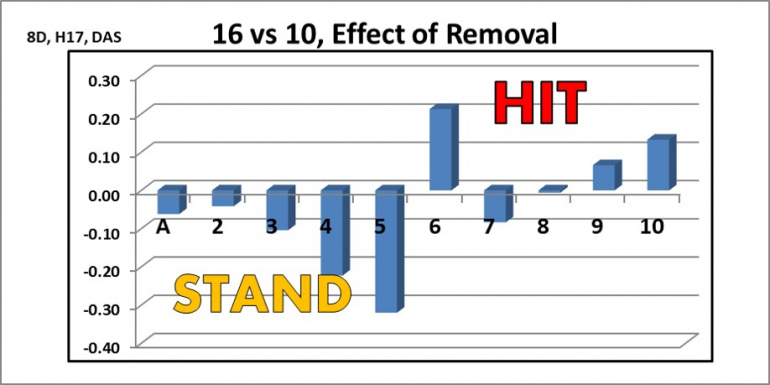
The 16v10 decision is the most important and most frequently occurring "close call" decision in a No Surrender BJ game. It is very unfortunate that the counts designed for changing one's bet size will lead you to make the wrong decision on '16vT' whenever a relatively high fraction of 6's are counted.
The 16v10 decision is the most important and most frequently occurring "close call" decision in a No Surrender BJ game. It is very unfortunate that the counts designed for changing one's bet size will lead you to make the wrong decision on '16vT' whenever a relatively high fraction of 6's are counted.
Last edited by: gordonm888 on Aug 31, 2026
So many better men, a few of them friends, are dead. And a thousand thousand slimy things live on, and so do I.
August 31st, 2026 at 6:23:06 AM
permalink
Having the chart adjust to the current situation could make practice more realistic. It also helps players understand why a particular move is recommended instead of simply memorizing a table. The key would be keeping the interface simple enough to use quickly.
September 1st, 2026 at 4:38:16 AM
permalink
Exactly, that was one of the main ideas behind it. I wanted the chart to be useful while actually playing without getting in the way.
You can toggle it in and out with the Tab key, so it’s there when you need it and out of the way when you don’t. When it’s open, you can still clearly see your hand and the table, so it doesn’t interfere with the gameplay.
I have a screenshot of it on the store page.
You can toggle it in and out with the Tab key, so it’s there when you need it and out of the way when you don’t. When it’s open, you can still clearly see your hand and the table, so it doesn’t interfere with the gameplay.
I have a screenshot of it on the store page.
September 12th, 2026 at 5:32:37 AM
permalink
The statistics should also help players see which situations they keep getting wrong. Having different rules and deck settings is a nice touch for more realistic training. It looks like a useful way to practice without simply relying on a static chart.


