


The Same Slot Title Can Hide Different Math

Introduction
Two slot games can look identical, carry the same name and use the same bonus feature while offering entirely different theoretical returns. The distinction isn’t obvious from the thumbnail and is often found in the game’s help menu, where a percentage that looks like background information tells you which mathematical version you’re actually playing.
It’s possible for studios to supply operators with a few different approved configurations of one game. One version might have a theoretical return of 96 percent, while another uses 94 percent or less. The presentation of the game can stay unchanged, so familiarity won’t confirm that the math is identical.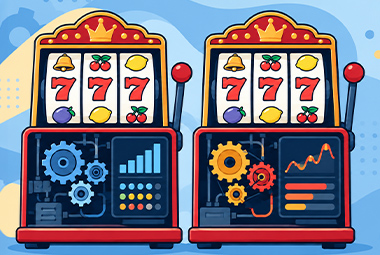
A Game Title Isn’t a Complete Specification
An online casino can carry hundreds or thousands of titles from a number of software studios. Large catalogs make search tools and recognizable artwork useful, but the thumbnail generally tells you about theme rather than probability. You still need to open the individual game’s information panel to identify the rules and published RTP.
The percentage describes the proportion of wagers the game is designed to return across a very large sample. A 96 percent theoretical RTP corresponds to a 4 percent house edge because the two figures add up to 100 percent. Across $10,000,000 in total wagers, the theoretical expected return would be $9,600,000, leaving an expected casino hold of $400,000, although actual results could differ.
This calculation isn’t able to predict what will happen to your own $20 or $200. Short results can fall far above or below the theoretical average because variance dominates small samples.
If the same title is offered at 94 percent instead, its house edge rises to 6 percent. The difference sounds small when written as two percentage points. Mathematically, however, the house edge has increased by 50 percent, moving from four units per hundred wagered to six.
The adjustment can come from smaller symbol awards, altered bonus probabilities or a different contribution from jackpot features. You won’t necessarily see which component changed, but the published percentage summarizes the combined effect of every possible result in that configuration.
RTP and Volatility Tend to Answer Different Questions
In the simplest of terms, RTP tells you the game’s expected long-run return. Volatility describes how unevenly its outcomes are distributed. Having a relatively steady game can produce frequent modest wins, while a highly volatile one can concentrate more of its theoretical return in uncommon features or large prizes.
Two games can therefore share a 96 percent RTP and feel completely different. One might return small amounts regularly while the other might produce long stretches with a minimal amount of activity before a bonus accounts for a large portion of its payback. Neither pattern changes the published long-run percentage.
Hit frequency measures how often any winning result occurs, although a “win” can be smaller than the stake. A high hit frequency can coexist with high volatility when uncommon large outcomes contribute heavily to the return.
A maximum win figure tells you the largest possible payout, but it says nothing about the probability of reaching it. For example, a top prize of 10,000 times the stake identifies one possible result but doesn’t disclose its probability or contribution to RTP.
The Rules Screen Is Part of the Game
The UK Gambling Commission’s remote technical standards require operators to make game rules and information about the likelihood of winning easily available before customers commit to gambling. This can include RTP, house edge or winning probabilities.
Check whether the displayed RTP applies to the entire game. Optional features, jackpot contributions and alternative modes can change the theoretical return, and a bonus purchase can also use different mathematics from ordinary play.
With paytable values, two versions can use the same reel design while simultaneously lowering the value of certain symbols or changing feature probabilities. If the help file lists an RTP range rather than one figure, look for an explanation of which setting applies to the version currently open.
Game information can sit behind an icon or menu and figures quoted by reviews and databases might refer to a configuration offered elsewhere rather than the version in front of you.
Randomness Doesn’t Correct a Losing Run
A lower-than-expected session result doesn’t mean the game must compensate later. In a conventional independently determined random slot, previous outcomes do not influence the probabilities of future spins. Previous losses don’t make a bonus more likely unless the rules explicitly describe a persistent collection or guaranteed-feature mechanism.
The same principle applies after an unusually large win. The game doesn’t need to recover that payment from the next player. Its actual return moves around the theoretical percentage in the short term and should approach the designed figure only as the sample becomes extremely large.
Published RTP is therefore useful, but only when you know which version it describes. Pair it with volatility, hit frequency, paytable details and feature rules. The colorful part of a slot tells you how the game presents itself but the information screen tells you what you agreed to play.
Even a higher-RTP game retains a house advantage, and theoretical returns do not guarantee individual results. Gambling should be treated as entertainment, with spending limits set in advance.
Comments
No comments for this articleRelated Articles:
-

High Risk Slots Practice
May 18, 2020 -
Slots, Systems and Scammers
Sep 14, 2021 -
Fishing Themed Slots - Understanding Their Appeal
Jun 01, 2026 -
Beating the Manhattan Slots Promotion
Jun 26, 2015