


Easy math puzzles
Poll
 | 25 votes (47.16%) | ||
| | 17 votes (32.07%) | ||
| | 7 votes (13.2%) | ||
| | 4 votes (7.54%) | ||
| | 12 votes (22.64%) | ||
| | 4 votes (7.54%) | ||
| | 6 votes (11.32%) | ||
| | 5 votes (9.43%) | ||
| | 12 votes (22.64%) | ||
| | 10 votes (18.86%) |
53 members have voted

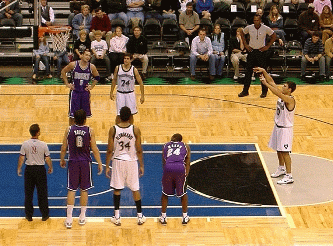
A basketball player’s free throw percentage describes how often they successfully throw the ball into the basket from the free throw line in official games.
If a player’s free throw percentage is initially below 75 percent and later above 75 percent, can it be said with certainty that it was exactly 75 percent at some point in between?

Quote: GialmereLet's shoot some hoops...
A basketball player’s free throw percentage describes how often they successfully throw the ball into the basket from the free throw line in official games.
If a player’s free throw percentage is initially below 75 percent and later above 75 percent, can it be said with certainty that it was exactly 75 percent at some point in between?
link to original post
Intuitively I thought ‘no’. But I can’t think of any scenario that does not include an exact 75%. So I’ll say ‘yes’.
SOOPOO hit 32 straight a few days ago. And had 104/105 earlier this year.

Quote: GialmereLet's shoot some hoops...
A basketball player’s free throw percentage describes how often they successfully throw the ball into the basket from the free throw line in official games.
If a player’s free throw percentage is initially below 75 percent and later above 75 percent, can it be said with certainty that it was exactly 75 percent at some point in between?
link to original post
No.
Proof:
Let the player have made a free throws in b attempts.
If the player went from < 75% to > 75% without ever being at exactly 75%, then it was done in one shot.
In order for this to happen, a / b < 3/4, and (a + 1) / (b + 1) > 3/4
a / b < 3/4 means 4a < 3b
(a + 1) / (b + 1) > 3/4 means 4 (a + 1) > 3 (b + 1), or 4a + 4 > 3b + 3, or 4a + 1 > 3b
4a < 3b < 4a + 1, but this is impossible if a and b are integers as 4a and 4a + 1 are consecutive integers, which means no integer is greater than one and less than the other.
Quote: SOOPOOIntuitively I thought ‘no’. But I can’t think of any scenario that does not include an exact 75%. So I’ll say ‘yes’.
Quote: ThatDonGuyNo.
Proof:
Let the player have made a free throws in b attempts.
If the player went from < 75% to > 75% without ever being at exactly 75%, then it was done in one shot.
In order for this to happen, a / b < 3/4, and (a + 1) / (b + 1) > 3/4
a / b < 3/4 means 4a < 3b
(a + 1) / (b + 1) > 3/4 means 4 (a + 1) > 3 (b + 1), or 4a + 4 > 3b + 3, or 4a + 1 > 3b
4a < 3b < 4a + 1, but this is impossible if a and b are integers as 4a and 4a + 1 are consecutive integers, which means no integer is greater than one and less than the other.
Correct!!
Well done. (ThatDonGuy obviously meant yes.)
--------------------


