


Easy math puzzles
Poll
 | 25 votes (47.16%) | ||
| | 17 votes (32.07%) | ||
| | 7 votes (13.2%) | ||
| | 4 votes (7.54%) | ||
| | 12 votes (22.64%) | ||
| | 4 votes (7.54%) | ||
| | 6 votes (11.32%) | ||
| | 5 votes (9.43%) | ||
| | 12 votes (22.64%) | ||
| | 10 votes (18.86%) |
53 members have voted

Quote: DogHandQuote: WizardYou have a 100-gallon tub full of pure water. Someone pours two gallons of salt into it, which is immediately absorbed. Pure water flows into the tank at a rate of five gallons per minute. Meanwhile, water leaves a hole in the bottom at the same rate. How long will it take for the water to contain 0.1 gallons of salt?
link to original post
Wiz,
Here is my solution:
Dog Hand
link to original post
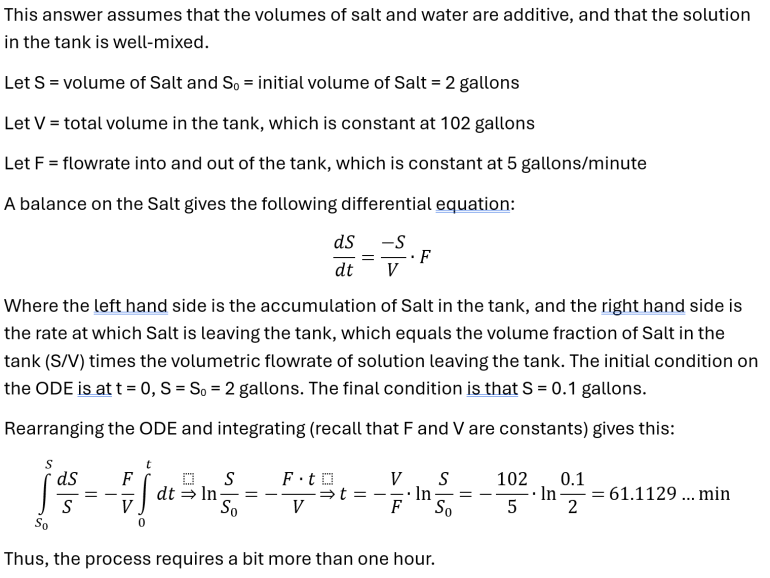
I have a slightly difference answer.
At time t=T min, salt=0.1 gal, water=100 gal.
At time t=x, salt=y. We have dy/dx=-5y/100; therefore, the general solution to the differential equation is
𝑦=A* exp(-x/20)=2*exp(-x/20).
Where we have used: at time t=0 min, salt=2 gal, water=100 gal. Therefore
x=-20 ln(y/2)= -20 ln (0.1/2) = 59.915 min.


Quote: DogHandQuote: WizardYou have a 100-gallon tub full of pure water. Someone pours two gallons of salt into it, which is immediately absorbed. Pure water flows into the tank at a rate of five gallons per minute. Meanwhile, water leaves a hole in the bottom at the same rate. How long will it take for the water to contain 0.1 gallons of salt?
link to original post
Wiz,
Here is my solution:
Dog Hand
link to original post
I agree based on your interpretation of the question. I meant to say the initial 2 gallons of walt was immediately absorbed, like a sponge, into the pure water. Thus, the starting volume of saltwater was still 100 gallons. However, I'll take the blame for the ambiguous wording and give you credit. This one was beer worthy.


?
Quote: Ace213
?
link to original post
I disagree, but could be wrong.

Because of symmetry, T(r,c) = T(c,r), which reduces the number of equations involved
T(3,3) = 0
T(3,2) = 1 + 1/3 T(2,2) + 1/3 T(3,1) {+ 1/3 T(3,3)}
T(3,1) = 1 + 1/3 T(3,2) + 1/3 T(2,1) + 1/3 T(3,0)
T(3,0) = 1 + 1/2 T(3,1) + 1/2 T(2,0)
T(2,2) = 1 + 1/2 T(3,2) + 1/2 T(2,1)
T(2,1) = 1 + 1/4 T(3,1) + 1/4 T(2,2) + 1/4 T(1,1) + 1/4 T(2,0)
T(2,0) = 1 + 1/3 T(3,0) + 1/3 T(2,1) + 1/3 T(1,0)
T(1,1) = 1 + 1/2 T(2,1) + 1/2 T(1,0)
T(1,0) = 1 + 1/3 T(2,0) + 1/3 T(1,1) + 1/3 T(0,0)
T(0,0) = 1 + T(1,0)
T(1,0) = 1 + 1/3 T(2,0) + 1/3 T(1,1) + 1/3 (1 + T(1,0))
2/3 T(1,0) = 4/3 + 1/3 T(2,0) + 1/3 T(1,1)
T(1,0) = 2 + 1/2 T(2,0) + 1/2 T(1,1)
This is 8 equations in 8 unknowns; I won't bother with the details of solving them here, but T(1,0) = 305/7, so T(0,0) = 23 + 1 = 312/7
Edit: I read the problem wrong - I had 4 streets in each direction

If there are three roads across and three roads down, then do I assume the drunk is walking down the middle of these roads, and hence there are only nine junctions/places where they can change direction.
$AB
CDE
FGZ
This would imply the points are (0,0)(1,0)(2,0)(0,1)...(2,2).
Or is the puzzle using the side-walks so has (0,0) thru (3,3).
For a 3x3 puzzle there is some symmetry so some of the junctions would have the same values as the ones. Also the middle square has to go to A or C, so has the same value as B. The puzzle therefore simplifies to $-A=B=C-X where
(i) $tart has to go to A. Hence EV(A)=EV($tart)+1.
(ii) A has one chance to go to $tart or two chances to go to B. Thus the expected number of turns from A to exit is 1 + average{ $,B,B }.
(iii) B has two chances to go to A, or two chances to go to C (i.e. has equal chances). (ev{B}=1 + average{A,C} )
(iv) C has one chance to eXit or two chances to return to B. (ev{C}=1 + average{0, B, B} )
(v) X is the exit, so has zero more moves!
$ A B
a B C
b c X
 x  x-1 -?-
... -?- ...
... ... ...
 x  x-1 x-3
... x-3 ...
... ... ...
 x  x-1 x-3
... x-3 x-7.
... ... ...
 x  x-1 x-3
... x-3 x-7
... ...x-18
Quote: ThatDonGuy18
link to original post
I agree!
Yes, it is 3x3 roads. It can be simplified as follows:
ABC
BDE
CEH
Where
A = starting location
H = home
B = 17
C = 15
D = 15
E = 11
It's not a coincidence C and D are the same since they both have a 50/50 chance of leading to B or E.
BAB
CDC
EXE
In other words, he must get from A to X. How many moves does it take on average?
I also get 12 from B, 10 from C, 9 from D, and 6 from E
Quote: ThatDonGuy12
I also get 12 from B, 10 from C, 9 from D, and 6 from E
link to original post
I agree!
You have a pile of N coins, where N is 11 or higher. 10 of the coins are heads-up, and the rest are tails-up.
You are blindfolded, and have to divide the coins into two piles, each of which has the same number of heads-up coins.
Once you are blindfolded, you cannot tell which coins are heads-up (and they are mixed after you are blindfolded, so you cannot go from memory), but you are allowed to flip over any number of coins, both before and after dividing the coins into piles.
How do you do it?
Quote: ThatDonGuyHere's a variation on a puzzle that I think I saw here once...
link to original post
1. Divide the coins into two piles so that pile 1 has 10 coins and pile 2 has the rest.
2. Flip over all the coins in pile 1.
Here is why it works.
Before the flip, here is the distribution of coins by pile, where t is the total:
Pile 1: h heads, 10-h tails
Pile 2: 10-h heads, t-20+h tails
After the flip:
Pile 1: 10-h heads, h tails
Pile 2: 10-h heads, t-20+h tails
This one is an old classic I've seen in many puzzle books.

X! - X = X^X
^ is the exponent operator
This one is pretty easy
X! = X^X *+ X
When X=1, 1!=1, 1^1+1=2;
When X=2, 2!=2, 2^2+1=5;
When X=3, 3!=6, 6^6+1=46,657.
When n is large, this trend continues, so there is no solution.
that 0^0 = 1.
There is actually a considerable amount of debate over the value of 0^0.
Unsure how to get there without brute force to narrow down the number or graphing it on a computer.
I am confused here:
What is the math formula for 0.1! ?

Quote: harrisThe gamma function would be used here
link to original post
π! = ???
π π = ???
(Heck, the real challenge was formatting the above text.)

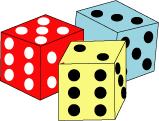
Fast Eddie has three standard dice. One of them is red, one is yellow, and one is blue.
He rolls all three and the total is 13.
He then rerolls the red and yellow dice, and the new total (for all three dice) is 6.
He then rerolls the red and blue dice, and the new total is 15.
Finally, he rerolls the yellow and blue dice, and the new total is 7.
What was the value of each of the dice after each roll?
Start with the red/blue reroll.
Since the total increased by 9, and yellow did not change, the red + blue sum increased by 9.
This means that it either went from 2 to 11, or from 3 to 12.
Since the total with the yellow die is 15, there are four (R, Y, B) pairs of old and new dice:
(1, 4, 1) - (5, 4, 6); (1, 4, 1) - (6, 4, 5); (1, 4, 2) - (6, 3, 6); (2, 4, 1) - (6, 3, 6)
The yellow/blue reroll caused the total to decrease by 8, so the yellow + blue sum decreased by 8, which means that their sum before the reroll was at least 10.
The only one of the four pairs that has this is (1, 4, 1) - (5, 4, 6), so the dice after the red/yellow dice roll are Red 1, Yellow 4, Blue 5, after the yellow/blue dice roll are Red 5, Yellow 4, Blue 6, and after the yellow/blue dice roll are Red 5, Yellow 1, Blue 1
Since the blue die after the red/yellow dice roll was 1, and that die was not rolled, it was 1 in the original roll; the only way the dice can sum to 13 is if the other two are both 6s.
Initial roll: Red 6, Yellow 6, Blue 1
After Red/Yellow Reroll: Red 1, Yellow 4, Blue 1
After Red/Blue Reroll: Red 5, Yellow 4, Blue 6
After Yellow/Blue Reroll: Red 5, Yellow 1, Blue 1

Direct: https://youtu.be/VHZA-Vgblw0
I welcome all kind comments. Please keep in mind I make nothing off of this and it's just a hobby. Somebody will probably mention the reflection of the lights but I'm not sure what I can do about it while still having the lights on me. Otherwise, it would be too dark.
Quote: ThatDonGuy
Start with the red/blue reroll.
Since the total increased by 9, and yellow did not change, the red + blue sum increased by 9.
This means that it either went from 2 to 11, or from 3 to 12.
Since the total with the yellow die is 15, there are four (R, Y, B) pairs of old and new dice:
(1, 4, 1) - (5, 4, 6); (1, 4, 1) - (6, 4, 5); (1, 4, 2) - (6, 3, 6); (2, 4, 1) - (6, 3, 6)
The yellow/blue reroll caused the total to decrease by 8, so the yellow + blue sum decreased by 8, which means that their sum before the reroll was at least 10.
The only one of the four pairs that has this is (1, 4, 1) - (5, 4, 6), so the dice after the red/yellow dice roll are Red 1, Yellow 4, Blue 5, after the yellow/blue dice roll are Red 5, Yellow 4, Blue 6, and after the yellow/blue dice roll are Red 5, Yellow 1, Blue 1
Since the blue die after the red/yellow dice roll was 1, and that die was not rolled, it was 1 in the original roll; the only way the dice can sum to 13 is if the other two are both 6s.
Initial roll: Red 6, Yellow 6, Blue 1
After Red/Yellow Reroll: Red 1, Yellow 4, Blue 1
After Red/Blue Reroll: Red 5, Yellow 4, Blue 6
After Yellow/Blue Reroll: Red 5, Yellow 1, Blue 1
link to original post
Correct!!
Well done. It's sort of a math/logic puzzle. Consider ThatDonGuy's solve to be official.
--------------------------------------------
Today's jokes are brought to you by the number 7.
The man had enough and decided to do what the voice in his head asked him to do:
He quit his job, sold the car, emptied his bank account, went to a casino, found a roulette table, and bet everything on number 7.
The wheel started turning, and the ball landed on 15.
And the voice goes: "Ahhh, shit!"
Seven: Well, for my whole life I've been in prime condition, and I don't anticipate that changing anytime soon.
Batman: That's great to hear. What do you consider your second power to be?
Seven: 49
----------------------------------
Apologies to the mods for that 4-letter word punchline.
At the end of the video, I’d suggest you generalize the 3x3 maze to 4x4, and possibly 100x100. Does this solution converge to a math formula of some sort?

I would like to suggest that any problem that contains direction and in particular, angular direction, contains a North point.
Quote: WizardI made a new YouTube channel devoted to math and related topics like logic puzzles and math-based magic tricks. It has only five videos so far. I'd appreciate a few views. Here is one on the drunkard's walk problem we recently discussed.
Direct: https://youtu.be/VHZA-Vgblw0
I welcome all kind comments. Please keep in mind I make nothing off of this and it's just a hobby. Somebody will probably mention the reflection of the lights but I'm not sure what I can do about it while still having the lights on me. Otherwise, it would be too dark.
link to original post
Is there a proof that |B| / |A| is the correct answer?
Quote: acesideAt the end of the video, I’d suggest you generalize the 3x3 maze to 4x4, and possibly 100x100. Does this solution converge to a math formula of some sort?
link to original post
Given that the Wizard's solution involves the determinants of two N x N matrices, I would say, no, there is no "easy math formula."
Here's how I learned to take determinants of matrices - if anybody has a better/easier way, then by all means, let us know:
For a 2 x 2:
| a    b |
|        | = ad - bc
| c    d |
For an N x N:
Let Mr,c be the value at row r, column c of matrix M
det(M) = M1,1 x (the determinant of the (N-1) x (N-1) matrix which is M with row 1 and column 1 removed)
- M1,2 x (the determinant of the (N-1) x (N-1) matrix which is M with row 1 and column 2 removed)
+ M1,3 x (the determinant of the (N-1) x (N-1) matrix which is M with row 1 and column 3 removed)
- M1,4 x (the determinant of the (N-1) x (N-1) matrix which is M with row 1 and column 4 removed)
+ ...
A 100x100 matrix requires calculating the determinants of 100 99 x 99 matrices, each of which requires calculating the determinants of 99 98 x 98 matrices, and so on.
ABC
DEF
GHI
First, replicate the first two columns, as so:
ABCAB
DEFDE
GHIGH
Then the determinant is as follows. Note every product is along a diagonal line and they move from left to right.
AEI * BFG * CDH - GEC * HFA * IDB
Quote: WizardThank you for the comments. That general method for determinants is how I was taught also. However, there is a shortcut for a 3x3. Let it be:
ABC
DEF
GHI
First, replicate the first two columns, as so:
ABCAB
DEFDE
GHIGH
Then the determinant is as follows. Note every product is along a diagonal line and they move from left to right.
AEI * BFG * CDH - GEC * HFA * IDB
link to original post
I assume you mean the determinant is (AEI + BFG + CDH) - (GEC + HFA + IDB)
However, the drunk’s home is stated to be at “the center south” of the maze, but it’s exactly at the point of “f”, which is a new point I introduce here.
What we really count in this puzzle is the number of straight segments that the drink walks, so it’s not the number of turns that the drunk takes. Is this right? In other words, we can ask this question, how many miles does the drunk need to walk to get home?
Quote: acesideWhat we really count in this puzzle is the number of straight segments that the drink walks, so it’s not the number of turns that the drunk takes. Is this right? In other words, we can ask this question, how many miles does the drunk need to walk to get home?
link to original post
Yes. I was confused by the use of "turns" at first as well, but in the problem, "turns" refers to the number of moves between intersections.
a=1+2 b/3+c/3;
b=1+a/2+c/2;
c=1+b/3+d/3+e/3;
d=1+a/4+b/2;
e=1+c/2.
Why do we need this constant value “1” in each equation? We can just set the constant value as “0” in each equation. Right?
Actually, I believe the fifth equation should be:
e=c/2+1/2.
Because there a 1/2 chance that the drunk would be home in one straight segment.
Quote: acesideI ask because I don’t understand these five simultaneous equations:
a=1+2 b/3+c/3;
b=1+a/2+c/2;
c=1+b/3+d/3+e/3;
d=1+a/4+b/2;
e=1+c/2.
Why do we need this constant value “1” in each equation? We can just set the constant value as “0” in each equation. Right?
Actually, I believe the fifth equation should be:
e=c/2+1/2.
Because there a 1/2 chance that the drunk would be home in one straight segment.
link to original post
It is the expected number of "moves" needed to get from each of those points to the home.
From a, it takes 1 move plus 2/3 of the expected number of moves from b (actually, 1/3 of the expected number of moves from the b on the left plus 1/3 of the expected number of moves from the b on the right, but due to symmetry, both b values are the same) plus 1/3 of the expected number of moves from c.
As for the last equation, e = 1 + c/2 is correct as the number of moves needed = 1 + 1/2 x (the number needed from home, which is zero) + 1/2 x (the number needed from point c) = 1 + c/2.
Quote: ThatDonGuyYes. I was confused by the use of "turns" at first as well, but in the problem, "turns" refers to the number of moves between intersections.
link to original post
Thanks, that's a good point. I added to the video description to try to avoid the confusion in what I mean by a "turn."
A snowplow covers twice as much distance in the first hour as the second. His speed is inversely proportional to the depth of the snow. Snow falls at a constant rate. How much time elapsed between when it started snowing and when the snowplow started plowing?
Direct: https://youtu.be/liHNeNNCNhE
Quote: ThatDonGuyQuote: acesideI ask because I don’t understand these five simultaneous equations:
a=1+2 b/3+c/3;
b=1+a/2+c/2;
c=1+b/3+d/3+e/3;
d=1+a/4+b/2;
e=1+c/2.
Why do we need this constant value “1” in each equation? We can just set the constant value as “0” in each equation. Right?
Actually, I believe the fifth equation should be:
e=c/2+1/2.
Because there a 1/2 chance that the drunk would be home in one straight segment.
link to original post
It is the expected number of "moves" needed to get from each of those points to the home.
From a, it takes 1 move plus 2/3 of the expected number of moves from b (actually, 1/3 of the expected number of moves from the b on the left plus 1/3 of the expected number of moves from the b on the right, but due to symmetry, both b values are the same) plus 1/3 of the expected number of moves from c.
As for the last equation, e = 1 + c/2 is correct as the number of moves needed = 1 + 1/2 x (the number needed from home, which is zero) + 1/2 x (the number needed from point c) = 1 + c/2.
link to original post
I started to understand these five equations, but this also brings up another problem with this math puzzle. At the corner points of this 3x3 maze, the drunk will always move forward without hesitation, because there is no option for him to move backward. We can just eliminate these corner points “b” and “e” and make them smoothly round. In that case, what is the expected “moves” for the drunk to go home?
In other words, there is no intersection at these points “b” and “e”.
Quote: acesideI started to understand these five equations, but this also brings up another problem with this math puzzle. At the corner points of this 3x3 maze, the drunk will always move forward without hesitation, because there is no option for him to move backward. We can just eliminate these corner points “b” and “e” and make them smoothly round. In that case, what is the expected “moves” for the drunk to go home?
In other words, there is no intersection at these points “b” and “e”.
link to original post
Yes, there is. "Moving backward" - more accurately, "turning around" - is always an option. A "turn" is not necessarily 90 degrees. For that matter, if the drunk moves from a to d, then it can continue moving forward to home; it does not have to turn 90 degrees to either of the two c's.
At b, the drunk can move to either a or c.
At d, the drunk can move to either c or home.
Quote: WizardThis one probably got asked here years ago. Feel free to work it out before watching the video.
A snowplow covers twice as much distance in the first hour as the second. His speed is inversely proportional to the depth of the snow. Snow falls at a constant rate. How much time elapsed between when it started snowing and when the snowplow started plowing?
Direct: https://youtu.be/liHNeNNCNhE
link to original post
I agree
Let a be the rate at which snow falls; at time t, the depth of the snow = at, and the velocity of the plow is p/(at) for some constant p
Let T be the time at which the plow starts; the amount of snow at time (T + t) = a (T + t)
Distance = INTEGRAL(0, t) (p / (a (T + x)) dx)
= p / a INTEGRAL(0, t) (dx / (T + x))
= p / a INTEGRAL(0, t) (d(T + x) / (T + x))
= p (ln (T + t) - ln T) / a
= p/a ln ((T + t) / T) / a
The plow covers 3/2 of the distance in 2 hours as it did in 1
p/a ln ((T + 2) / T) = 3/2 p/a ln ((T + 1) / T)
ln ((T + 2) / T) = 3/2 ln ((T + 1) / T)
(T + 2) / T = ((T + 1) / T)^(3/2)
(T + 2) / T = (T + 1) sqrt(T + 1) / (T sqrt(T))
T + 2 = (T + 1) sqrt(T + 1) / sqrt(T)
(T + 2) / (T + 1) = sqrt((T + 1) / T)
(T + 2)^2 / (T + 1)^2 = (T + 1) / T
T (T + 2)^2 = (T + 1)^3
T^3 + 4 T^2 + 4 T = T^3 + 3 T^2 + 3 T + 1
4 T^2 + 4 T = 3 T^2 + 3 T + 1
T^2 + T - 1 = 0
T = -1/2 +/- sqrt(5)/2; since T > 0, T = (sqrt(5) - 1) / 2
For a golden rectangle, what is the length of the short side divided by the length of the long side ?
:strip_icc()/pic9870664.jpg)
For decorating accents in her living room, Lisa bought three bags of marbles, colored red, blue, and green.
Each bag held the same number of marbles.
She emptied the red marbles into the first bowl, the blue marbles into the second bowl, and the green marbles into the third bowl.
To mix them up, she scooped up some (but not all) of the marbles in the first bowl and mixed them into the marbles that were in the second bowl.
Then she scooped up some of the marbles in the second bowl and mixed them into the marbles that were in the third bowl.
Finally, she scooped up some of the marbles in the third bowl and mixed them into the marbles that remained in the first bowl.
She scooped up the same number of marbles each time.
When she was finished, each bowl contained a pretty blend of colors in which no color present in the mixture constituted more than half or less than a fourth of the marbles in the bowl.
When she finished there were 12 red marbles in third bowl.
1) What was the total number of marbles?
2) How were the colors divided among the bowls?
Bonus) How many marbles did the scoop hold?
Then it’s a 3x3 grid of how many ways 633, 543 and 444 can be permutated with rows and columns summing twelve
Let (r, b, g) denote the number of red, blue, and green marbles in a bowl
Let n be the number of each color
At the start, the bowls are (n, 0, 0), (0, n, 0), and (0, 0, n)
Let s be the size of the scoop
After the first scooping, the bowls are (n-s, 0, 0), (s, n, 0), and (0, 0, n)
Let p be the number of red marbles in the second scooping; there are s-p blue marbles
After the second scooping, the bowls are (n-s, 0, 0), (s-p, n-(s-p), 0), and (p, s-p, n)
Let q be the number of red marbles and r be the number of blue marbles in the third scooping; there are s-q-r green marbles
After the third scooping, the bowls are (n-s+q, r, s-q-r), (s-p, n-(s-p), 0), and (p-q, s-p-r, n-(s-q-r))
Note that there are n marbles in each bowl after the three scoopings
We are given that p - q = 12, so q = p - 12
Since there are 12 red marbles in the third bowl, n/4 <= 12 <= n/2, so 24 <= n <= 48
Each number of marbles of a color in a bowl is either 0 or between n/4 and n/2
Substitute for q
The numbers that are not constants are:
12+n-s-p
r
s+p-r-12
s-p
n+p-s
s-p-r
12+n-p+r-s
n/4 <= r <= n/2
n/4 <= s-p - r
s-p <= n/2, so s-p - r <= n/2 - r
n/4 <= s-p - r <= n/2 - r
If r >= n/4, then n/2 - r < n/4, so r = n/4
s-p - n/4 = n/4, so s-p = n/2
Substitute for r and s-p:
12+n-s-p
n/4
s+p-r-12
n/2
n/2
n/4
12+n-p+r-s
Ignoring the values containing only n:
12+n-s-p
s+p-r-12
12+5/4 n-s-p
n/4 <= 12-s-p+n, so n/2 <= 12-s-p+5/4 n
n/2 >= 12-s-p+5/4 n
Therefore, 12-s-p+5/4 n = n/2, and 12+3/4 n = s+p
(s+p) + (s-p) = n/2 + 12 + 3/4 n
2s = 5/4 n + 12
s = 5/8 n + 6
Since s is an integer, n is a multiple of 8, so it is one of {24, 32, 40, 48}
Correspondingly, s = {21, 26, 31, 36}
r = n/4 = {6, 8, 10, 12}
p = s - n/2 = {9, 10, 11, 12}
q = p - 12, but q >= 0, so p = 12 and q = 0, which means n = 48, s = 36, and r = 12
The total number of marbles = 144
The colors are divided among the bowls as follows:
Bowl 1: 12 red, 12 blue, 24 green
Bowl 2: 24 red, 24 blue, 0 green
Bowl 3: 12 red, 12 blue, 24 green
The scoop held 36 marbles

