


Easy math puzzles
Poll
 | 25 votes (47.16%) | ||
| | 17 votes (32.07%) | ||
| | 7 votes (13.2%) | ||
| | 4 votes (7.54%) | ||
| | 12 votes (22.64%) | ||
| | 4 votes (7.54%) | ||
| | 6 votes (11.32%) | ||
| | 5 votes (9.43%) | ||
| | 12 votes (22.64%) | ||
| | 10 votes (18.86%) |
53 members have voted

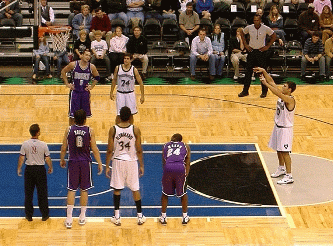
A basketball player’s free throw percentage describes how often they successfully throw the ball into the basket from the free throw line in official games.
If a player’s free throw percentage is initially below 75 percent and later above 75 percent, can it be said with certainty that it was exactly 75 percent at some point in between?

Quote: GialmereLet's shoot some hoops...
A basketball player’s free throw percentage describes how often they successfully throw the ball into the basket from the free throw line in official games.
If a player’s free throw percentage is initially below 75 percent and later above 75 percent, can it be said with certainty that it was exactly 75 percent at some point in between?
link to original post
Intuitively I thought ‘no’. But I can’t think of any scenario that does not include an exact 75%. So I’ll say ‘yes’.
SOOPOO hit 32 straight a few days ago. And had 104/105 earlier this year.

Quote: GialmereLet's shoot some hoops...
A basketball player’s free throw percentage describes how often they successfully throw the ball into the basket from the free throw line in official games.
If a player’s free throw percentage is initially below 75 percent and later above 75 percent, can it be said with certainty that it was exactly 75 percent at some point in between?
link to original post
No.
Proof:
Let the player have made a free throws in b attempts.
If the player went from < 75% to > 75% without ever being at exactly 75%, then it was done in one shot.
In order for this to happen, a / b < 3/4, and (a + 1) / (b + 1) > 3/4
a / b < 3/4 means 4a < 3b
(a + 1) / (b + 1) > 3/4 means 4 (a + 1) > 3 (b + 1), or 4a + 4 > 3b + 3, or 4a + 1 > 3b
4a < 3b < 4a + 1, but this is impossible if a and b are integers as 4a and 4a + 1 are consecutive integers, which means no integer is greater than one and less than the other.
Quote: SOOPOOIntuitively I thought ‘no’. But I can’t think of any scenario that does not include an exact 75%. So I’ll say ‘yes’.
Quote: ThatDonGuyNo.
Proof:
Let the player have made a free throws in b attempts.
If the player went from < 75% to > 75% without ever being at exactly 75%, then it was done in one shot.
In order for this to happen, a / b < 3/4, and (a + 1) / (b + 1) > 3/4
a / b < 3/4 means 4a < 3b
(a + 1) / (b + 1) > 3/4 means 4 (a + 1) > 3 (b + 1), or 4a + 4 > 3b + 3, or 4a + 1 > 3b
4a < 3b < 4a + 1, but this is impossible if a and b are integers as 4a and 4a + 1 are consecutive integers, which means no integer is greater than one and less than the other.
Correct!!
Well done. (ThatDonGuy obviously meant yes.)
--------------------
In Tetris, players try to efficiently pack a rectangular space with pieces that can have seven different shapes. As it happens, if you have exactly one of each of those seven possible pieces, then it is impossible to arrange them into a rectangle. But there is one piece you can discard that will allow you to make such an arrangement.
Which piece must be discarded?
Show the 2 rectangles that the 6 correct shapes can make. (Assuming you can think of a way to show it.)
Just as in Tetris, you may rotate pieces but not reflect them. In other words, if the pieces were cutouts on a table, then you could slide them and spin them but never lift them off the table.


Buuuuzzzzzzzzzzzzzz.............
No solves comrades? Stories were true. Western powers are weak and decadent. Launching nukes.
Each piece, no matter how it is placed, will cover exactly two white squares and two black squares of the rectangle’s checkerboard, except for the T-shaped piece, which will cover three of one shade and one of the other. Any rectangle built from Tetris pieces must contain an even number of squares total (four squares per piece). This means the rectangle will have an equal number of black squares and white squares. The T-shaped piece will create an imbalance that none of the other pieces can correct.
Discarding the T-shaped piece, we can create a 3 × 8 or a 4 × 6 rectangle from the other pieces like so:
:strip_icc()/pic9878744.gif)
Note that with two sets of pieces, the two T shapes could be offset to compensate for each other, thus allowing a rectangle to form.
---------------------

Melvin and Rachel have created new thermometer scales.
On the Melvin scale, water freezes at 5° M and boils at 45° M.
On the Rachel scale, water freezes at 50° R and boils at 110° R.
What temperature on the Melvin scale is 74° R?
Quote: GialmereSun is shinin' in the sky. There ain't a cloud in sight...
Melvin and Rachel have created new thermometer scales.
On the Melvin scale, water freezes at 5° M and boils at 45° M.
On the Rachel scale, water freezes at 50° R and boils at 110° R.
What temperature on the Melvin scale is 74° R?
link to original post
Quote: GialmereSun is shinin' in the sky. There ain't a cloud in sight...
Melvin and Rachel have created new thermometer scales.
On the Melvin scale, water freezes at 5° M and boils at 45° M.
On the Rachel scale, water freezes at 50° R and boils at 110° R.
What temperature on the Melvin scale is 74° R?
link to original post
74° R is 24/60, or 2/5, of the way from freezing to boiling
On the Melvin scale, this would be 5 + 2/5 x (45 - 5) = 21° M
Why do I have the feeling the answer to your next question is -85° ?

Quote: GialmereSun is shinin' in the sky. There ain't a cloud in sight...
Melvin and Rachel have created new thermometer scales.
On the Melvin scale, water freezes at 5° M and boils at 45° M.
On the Rachel scale, water freezes at 50° R and boils at 110° R.
What temperature on the Melvin scale is 74° R?
link to original post
Conventionally The letter R refers to the Rankine Temperature, so Rachel would not be able to use that nomenclature for her own temperature scale.
Quote: KevinAA
21
Quote: ThatDonGuy
74° R is 24/60, or 2/5, of the way from freezing to boiling
On the Melvin scale, this would be 5 + 2/5 x (45 - 5) = 21° M
Why do I have the feeling the answer to your next question is -85° ?
Correct!
Very good.
Consider ThatDonGuy's solve to be official.
--------------------
