


State Keno Math

I found that the worst option was 1-spot Keno option, with an RTP of 50%, while the "best" option, 5-spot, had a RTP of ~60.32%.
Interestingly, there is an option to spend an additional amount equal to the original wager in order have a chance at a bonus multiplier. From what I could calculate, the average multiplier is about 2.001%, making it worth it (which surprised me).
Additionally there are some other drawing games like "money dots" that the New York government does that I haven't analyzed yet.
Has anyone attempted to use math to find the house edges for various state-run keno / lottery games? While this type of math is within our area of study, I assume most people here consider it a waste of time to analyze due to the extremely high house edge.
Edit: changed terminology to make this more understandable
In contrast, the New York Pick 10 jackpot (which is basically 10-spot Keno but only once a day) has an RTP around 50%. Other daily or twice-daily drawings that I looked at had an either 48% or 50% RTP. I am surprised that anyone plays these, but now I am tempted to try it for just 50¢.

I would be really surprised if there was a +EV situation in New York State as the couple scratch offs I calculated had around a 64% house edge.

Quote: harrisI just checked out of curiosity and found that Money Dots, which is connected to the Keno that happens every four minutes, has an equal house edge of around 60% RTP.
In contrast, the New York Pick 10 jackpot (which is basically 10-spot Keno but only once a day) has an RTP around 50%. Other daily or twice-daily drawings that I looked at had an either 48% or 50% RTP. I am surprised that anyone plays these, but now I am tempted to try it for just 50¢.
link to original post
How else can the downtrodden get rich?

https://www.ohiolottery.com/games/touch-n-win/4-spot-keno
I kind of like the Pick 3 game in NYS. Doesn't say what the RTP is. This game goes back decades. For a $1 you won't win more than $500. I'm guessing RTP isn't over 50%.
https://ny.pick-3.com/odds-and-prizes
You divide the "Prize" by the "Odds"
Anyways they are all either 48% or 50% RTP depending on the play type.

I find it sad and pathetic that the "odds of winning" are only openly stated as "1 in 28" (for example, varies by game of course). Anyone who claims that it's not a racket to exploit the poor and ignorant masses, explain why the EV or RTP % is buried in the fine print.
But at least that is true for multimillion dollar lotteries that cost $1. I'd argue that it offers some ray of hope for otherwise hopeless people and that is at least a plausible social benefit.
But scratchers offer no chance of changing your life circumstances and merely burn 50% of what you pay to play. And yet they are most popular with the down trodden. I find that mortally repugnant.
Quote: harrisYes I was just looking at the scratch offs on their website.
I would be really surprised if there was a +EV situation in New York State as the couple scratch offs I calculated had around a 64% house edge.
link to original post
Hey here's a potential project for you on your site: scrape the data from the state lottery sites where they announce the instant lottery wins and you can calculate and provide the approximate edge given that information.

Quote: dcjohnIn AZ all lottery games (that I have looked into including draw and scratchers) have an RTP/EV of 50%. In case there's any subtle difference it's stated that 50% of sales revenue goes to winners.
I find it sad and pathetic that the "odds of winning" are only openly stated as "1 in 28" (for example, varies by game of course). Anyone who claims that it's not a racket to exploit the poor and ignorant masses, explain why the EV or RTP % is buried in the fine print.
link to original post
Not to defend state lotteries, but there are no games in a casino where they tell you the RTP.

Quote: KevinAAQuote: dcjohnIn AZ all lottery games (that I have looked into including draw and scratchers) have an RTP/EV of 50%. In case there's any subtle difference it's stated that 50% of sales revenue goes to winners.
I find it sad and pathetic that the "odds of winning" are only openly stated as "1 in 28" (for example, varies by game of course). Anyone who claims that it's not a racket to exploit the poor and ignorant masses, explain why the EV or RTP % is buried in the fine print.
link to original post
Not to defend state lotteries, but there are no games in a casino where they tell you the RTP.
link to original post
Depends on the game, and the casino. There was a time when every slot machine in the Australian state of Victoria, which includes the city of Melbourne, had to make this information available.
Quote: ChumpChangeI kind of like the Pick 3 game in NYS. Doesn't say what the RTP is. This game goes back decades. For a $1 you won't win more than $500. I'm guessing RTP isn't over 50%.
https://ny.pick-3.com/odds-and-prizes
link to original post
How many state lotteries do? I thought California made it a point to have its RTP as close to 50% as it could get - 50% to the players, 34% to the state's general fund (well, "to the schools," but it would end up replacing the money that was moved from the schools budget to the general fund, so I just cut out the middleman), and 16% for "administration."
Don't all state-run Pick-3 games pay 500 for 1? That's what made the illegal ones more popular; they tended to pay 600-1.

Quote: KevinAAQuote: dcjohnIn AZ all lottery games (that I have looked into including draw and scratchers) have an RTP/EV of 50%. In case there's any subtle difference it's stated that 50% of sales revenue goes to winners.
I find it sad and pathetic that the "odds of winning" are only openly stated as "1 in 28" (for example, varies by game of course). Anyone who claims that it's not a racket to exploit the poor and ignorant masses, explain why the EV or RTP % is buried in the fine print.
link to original post
Not to defend state lotteries, but there are no games in a casino where they tell you the RTP.
link to original post
Most table games have an element of strategy that is assumed to be mathematically optimized when calculating the "House Advantage"
Take the game of Casino Hold'em. No one has ever published a mathematically optimal strategy for the game, much less memorized it, so the mathematical House Advantage is nothing like the real-life "return to player." Publishing a computer-generated number for house advantage to six significant digits is meaningless, unless you also publish the "strategy" that was used by the looping code.
If a player does not know how to play Blackjack or Ultimate Texas Hold'em or Video Poker perfectly, then isn't it false advertising to post an RTP?
Here's my latest win of $70K over 90 hands at +22% RTP with an average bet of near $3.5K and a total bet of $313K. Notice I'm pegging this chart at both -25% and +25%. One shoe is just over 60 hands.
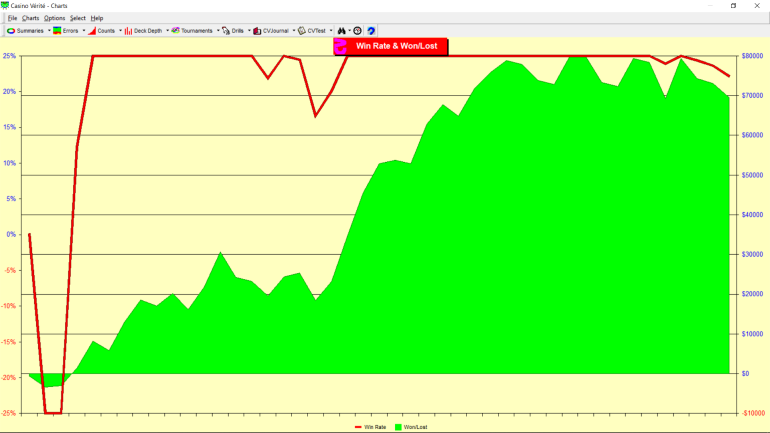
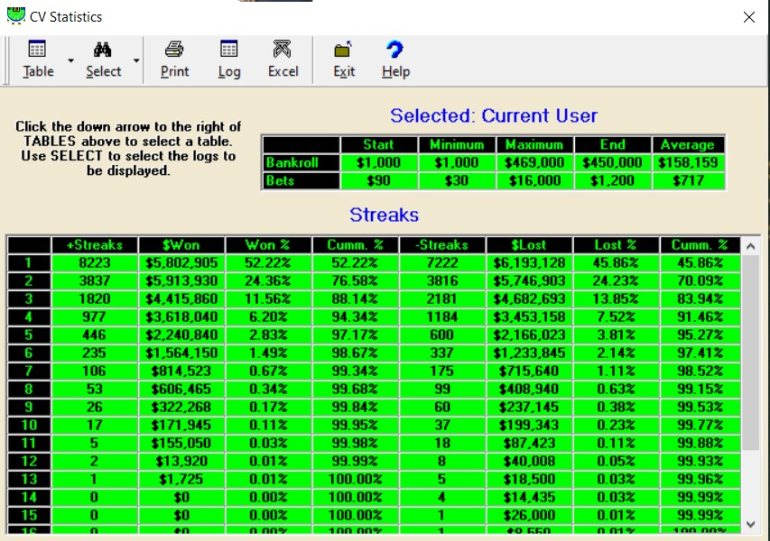
One thing I find appalling is that the Dealer has more winning streaks than the Player does after 2 in a row. I use my progressions most of the time so I'm making up for lost ground using those. But maybe the game is punishing me for using them in it's algo. So I won 30,567 hands and lost 34,528 hands for a total loss of 3,961 hands. That totals to 65,095 hands. 30,567/65,095 = 46.957% of hands won, so it must be discounting about 6K pushes.
If this was next year and I was flat betting $100/hand, I'd have won $3,056,700 and lost $3,452,800 for a $396,100 loss. With session reporting, I'd report I lost 90% of $3,452,800 which equals $3,107,520; and it would cover all of my winnings so I could report $0 income from gambling. I'm figuring a -6.085% RTP. $6,1134,000 / $6,509,500 = 93.915%.
But if this was next year and I used my progressions, I could report $50.93 million bet and $51.35 million won. $50.93 million x 90% = $45.837 million. So I would owe taxes on the difference of $51.35 million minus $45.837 million which equals $5.513 million or over 13X my actual income from gambling. Multiplying my 0.8% win rate by 12.5 equals 10%. Session reporting is dead if you are winning.
There's two ways to figure this and I haven't picked the right one yet. I should be adding up Buy-ins and Cash-outs per day. I'd get much smaller numbers but still get that 0.8% win. Nope, add up my wins vs losses per day. Online gambling won't be so lucky when they give you your coin-in and coin-out numbers.
Quote: ThatDonGuyQuote: KevinAAQuote: dcjohnIn AZ all lottery games (that I have looked into including draw and scratchers) have an RTP/EV of 50%. In case there's any subtle difference it's stated that 50% of sales revenue goes to winners.
I find it sad and pathetic that the "odds of winning" are only openly stated as "1 in 28" (for example, varies by game of course). Anyone who claims that it's not a racket to exploit the poor and ignorant masses, explain why the EV or RTP % is buried in the fine print.
link to original post
Not to defend state lotteries, but there are no games in a casino where they tell you the RTP.
link to original post
Depends on the game, and the casino. There was a time when every slot machine in the Australian state of Victoria, which includes the city of Melbourne, had to make this information available.
link to original post
Also Europe, but we are talking about the USA here.
Quote: ThatDonGuyQuote: ChumpChangeI kind of like the Pick 3 game in NYS. Doesn't say what the RTP is. This game goes back decades. For a $1 you won't win more than $500. I'm guessing RTP isn't over 50%.
https://ny.pick-3.com/odds-and-prizes
link to original post
How many state lotteries do? I thought California made it a point to have its RTP as close to 50% as it could get - 50% to the players, 34% to the state's general fund (well, "to the schools," but it would end up replacing the money that was moved from the schools budget to the general fund, so I just cut out the middleman), and 16% for "administration."
Don't all state-run Pick-3 games pay 500 for 1? That's what made the illegal ones more popular; they tended to pay 600-1.
link to original post
California is "special" in that all of its draw games pay prizes on a pari-mutuel basis. Their house edge is not 50% on average, it's exactly 50% on every game every day. Personally I think that's stupid. Are they worried that too many people will win? Small states don't do that and they run a much bigger risk of paying out more in winnings than wagers than the huge state of California.
In California, a $1 pick 3 ticket will pay more than $500 if fewer than 1 in 1000 tickets win, and will pay less than $500 if more than 1 in 1000 tickets win.
In all other states, the lottery is gambling (like any casino), but they have the advantage (in the case of the lottery, a massive advantage).


