

License or Monopoly? An Analysis of the Nordic Region's Two Approaches to Regulating the Casino Industry

Introduction
Across the entire Nordic region, gambling regulation has moved along two very different paths. Some countries have embraced licensing systems and opened up their markets to lots of big name operators - as long as they adhere to strict standards. And the others have gone down the monopoly route… where it’s the state that oversees the gambling in that region.
Both of these routes focus on the same things… player protection, controlling the markets and making money. However, that’s where the similarities end - as the player experience and development of the industry are very, very different.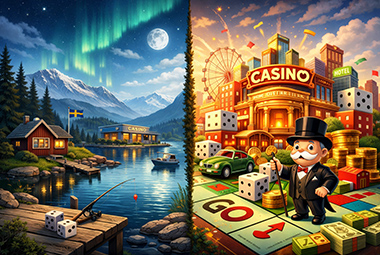
The Monopoly Model Norway and Finland
Norway’s Controlled Environment
First, we have Norway that takes a very linear approach - as the state has the monopoly over most gambling activities. As such, the market is dominated by government-controlled companies whose aim is to make sure everything is kept centralised and gambling-related harm is kept to a minimum. However, despite these restrictions, there are a lot of players who still play at international casinos, which creates a rather unique dynamic, where strict regulation meets external markets.
However, to play safely, especially when looking at international sites, there are sites like Kongebonus, the expert driven casino guide in Norway, spearheaded by David Nilsen, which has become synonymous with iGaming knowledge in Norway, to help players make the safest and best gambling decisions and find those sites that are licensed by regulatory bodies such as the UKGC.
It’s resources like this that help Norwegian players to have a better understanding of the online casino environment - especially when they’re thinking about trying options outside of the domestic monopoly.
Finland’s State-Led System
Finland follows a similar monopoly structure to Norway - with most gambling being controlled by one, single state owned entity. And their goal is the same as Norway’s - to prioritise public welfare and minimalise the risks of gambling related problems, with gambling operations primarily controlled by a single state-owned entity.
Everything is overseen by the National Police Board of Finland, which is responsible for monitoring compliance and enforcing regulations.
However, recently Finland has been having discussions about whether or not the monopoly model will be able to continue competing with international online sites. As it gets easier to play online, it gets harder to control - so there’s the potential for regulatory changes in the future.
The Licensing Model Sweden and Denmark
Sweden’s Structured Open Market
Then there’s Sweden that moved to a licensing system in 2019 - and this had a huge impact on their industry. In Sweden, private operators can apply for a licence as long as they can prove they meet strict regulatory requirements.
It’s the Swedish Gambling Authority that oversees the market and makes sure they fully comply with player protection, advertising and responsible gambling rules. As such, they’ll need to be licensed and offer various responsible gambling tools like deposit limits and self-exclusion options.
Ultimately, this way, they’re aiming to push Swedish players to sign up with regulated platforms rather than the many unlicensed alternatives. By giving them a solid choice of good options, they’ve got just the right balance of safety and freedom.
Denmark’s Balanced Approach
Denmark adopted their licensing system earlier on, in 2012, and it’s considered by many to be one of the most stable and regulated markets in Europe. To operate in the region, a casino will need to get a licence and adhere to the strictest standards - but they are allowed to compete within the market.
The Danish Gambling Authority oversees it all and focuses on factors like transparency and protecting players. And because of this, Danish players can enjoy a decent selection of safe, regulated sites that offer a good - and safe experience.
This has proven to be a success - because most players choose to play on licensed sites rather than unlicensed and unregulated ones.
Key Differences Between the Two Models
There are some very big differences between the way the two different models work:
- Market Access: With the licensing system, it allows for lots of operators; whereas monopolies only allow for state entities to operate in the market.
- Player Choice: Licensed markets means players have a lot more choice, while it’s a lot more limited under a monopoly.
- Regulatory Control: With monopolies it’s centralised, but with licensing systems it’s distributed but still very structured.
- Adaptability: Those with licensing models are often a lot quicker to respond to technological changes.
Effectively, licensing is focused on controlled competition, while monopolies are more focused on full oversight and restrictions.
Trust and Player Protection
No matter what the model, trust is essential. Players have to know that the site they’re playing on meets the highest standards, which is why they look for sites that are licensed and regulated by regulatory bodies such as the UKGC.
Ultimately, safety always has to be the priority and players have to feel safe.
A Region in Transition
The Nordic region may be close geographically, but their gambling systems can seem worlds apart. Sweden and Denmark have embraced licensed competition, while Norway and Finland still want to stay in full and complete control.
However, the lines are blurring. Because of factors like online casinos, changing player behaviour, and the continuing discussions on how to move forward - there’s every reason to think things might change.
Comments
No comments for this articleRelated Articles:
-

The rise of online gambling in Norway
Feb 05, 2025 -
Casino Gambling the Smart Way Book Review
Nov 09, 2021