


Live blackjack: the EV of every decision, from the remaining shoe


It reads the table's card data on Evolution, Pragmatic and Playtech, then prices hit, stand, double and split for each hand from the exact cards left in the shoe. Hit/stand/double are calculated exactly; splits are simulated. It also tracks the true count.
A quick check: 16 v 10 in an 8-deck shoe flips to stand just above TC 0, where the published index puts it.
Read-only, no clicking or betting. Most casinos don't allow tools like this, so check the terms first.
BlackjackLens.com
3-day free trial if anyone wants to test it.

Quote: BlackjackLens
A quick check: 16 v 10 in an 8-deck shoe flips to stand just above TC 0, where the published index puts it.
Even though this statement has been published, the rigorous math has not been demonstrated anywhere.
Also, if you track every card that has been revealed in a shoe, there is no point of using the concept of true count to measure the advantage, which is meant to be used by a human brain, so more logic is needed here.
TC hit stand
-0.25 -.5360 -.5408
0 -.5389 -.5423
+0.25 -.5456 -.5436
+0.51 -.5459 -.5457
+1.03 -.5536 -.5493
so stand takes over somewhere between 0 and +0.25. if you've got a specific composition you want me to run, post it.
and yeah agreed on TC. the app prices everything off the actual remaining cards, the TC is just there because that's what people are used to looking at.

For the purposes of evaluating the 16 vs T decision the standard counts mis-categorizes the 6 as a low card. The standard index method is very inefficient for evaluating this decision. If you are tracking the removal of all the cards you have a chance to do a more powerful calculation.
Here are the standard Effect of Removal coefficents for the 16 vs T decision with 8 decks.
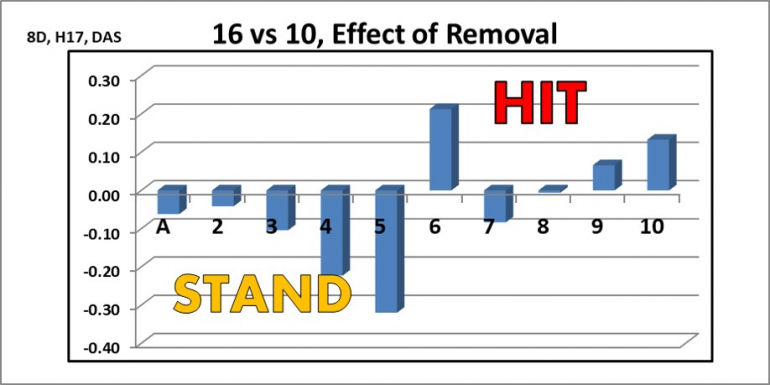
Notice that lumping the 6s into the same category with 2-5 make the standard counts very inefficient at evaluating this option.
also means my table above undersells it a bit, since removing 2-6 evenly lets the 6s cancel out part of the 4s and 5s. the app doesn't care about TC for the decision, it just runs the actual remaining cards.
yours is H17 though right? ours was S17, so the numbers won't match exactly
Stand these: 259, 277, 349, 358, 448, 457, 556, 24T, 33T, A5T, A78.
Hit these: 268, 367, 466, A69.
How would the Hi-Lo true count change the Hit/Stand decision for each of the above 16 vs 10 situations? Also, what is the Hi-Lo deviation index if we bundle all these together?
Quote: acesideThis part has been discussed here, but let me bring up again. There are altogether fifteen unique 3-card 16 hands. Against a dealer upcard of 10 and in basic strategy, player should
Stand these: 259, 277, 349, 358, 448, 457, 556, 24T, 33T, A5T, A78.
Hit these: 268, 367, 466, A69.
How would the Hi-Lo true count change the Hit/Stand decision for each of the above 16 vs 10 situations? Also, what is the Hi-Lo deviation index if we bundle all these together?
link to original post
Of course, it you had a given true count and any of these card combinations came out you would simply modify the count for the removal of these cards (and the dealers Ten.) As I've said, the 6 is a poison pill weighing against Standing but standard counting systems treat it as a small rank whose removal makes you want to stand. OP has a computer identifying and logging cards and should consider using the EOR coefficients rather than the coefficients in the Hi-Lo Count System or its variants.
Quote: acesideThe thing is that using a computer to play every hand optimally will not improve the card counting very much, I believe. A simple Hi-Lo count would do the trick, so a hi-Lo deviation index for 3-card 16 vs 10 is important.
link to original post
I don't agree with either sentence in your statement.
You claim to be a mathematician. Why don't you do calculations yourself and show us your results? Rather than constantly asking others on this forum to do calculations for you?
Here's some questions I have for you that I believe that you (or anyine else) should be easily able to answer.
1) For the 17 three-card 16 v10 that you identify, how often does each occur with an 8 deck shoe and what is the EV for Stand and for Hit for each of those hands?
2) How often do each of the two-card variants for 16v10 occur and what are the EVs for Stand and HIT for each of those?
3) How often do each of the four-card variants for 16v10 occur and what are the EVs for each one of those? I guarantee you that 6622v10 is played differently that 5542v10.
After you've posted those results, maybe you can lay out a rationale why a member in this forum should be interested in calculating index plays for some subset of those hands.
I think these are reasonable rules-of-thumb for math geeks:
1. You should do a certain amount of work yourself to make sure that your requests of other members are well-formulated and worthwhile.
2. You should contribute to the forum by posting results of your own work occasionally and not just persistently ask other members to do calculations for you.
In today’s blackjack games, surrender is often offered. This means the majority of two-card 16 vs 10 are actually surrendered, and there is no hit/stand decision for this hand. What is left to consider is the hit/stand decision for three-or-more-card 16 vs 10. This portion of hands is roughly 50% of all such hands, so it is worth considering them separately.
Quote: acesideFirstly, I think OP is doing a great work and I am very interested. Secondly, there are people who have dedicated several decades in blackjack card counting, so I would like to hear what they may say about this. I am just a beginner having my side of understanding.
In today’s blackjack games, surrender is often offered. This means the majority of two-card 16 vs 10 are actually surrendered, and there is no hit/stand decision for this hand. What is left to consider is the hit/stand decision for three-or-more-card 16 vs 10. This portion of hands is roughly 50% of all such hands, so it is worth considering them separately.
link to original post
Those are fair points; however personally I seldom see any BJ games with Surrender offered anymore. And if Surrender is indeed offered there are Surrender decisions that should be analyzed for optimization against the count.
The reason I am encouraging you to use an online BJ calculator to analyze the various 16vs 10 hands is so that you can develop a fundamental understanding of how close the Hit/Stand decisions are and how much the various ranks actually influence the decision. You can also then take those 17 sets of three-card 16s and lump them into two groups and then think about the count indices for those groups. I am trying to guide you on how to learn to estimate these calculations yourself in your head.
You may not understand how much resistance (and hilarity) you would get from card counters when you propose 17 new count indices for three-card 16vs 10.
And I am serious when I say that if you are a mathematician who is constantly asking others to do calculations and post their results then eventually as a matter of courtesy you should post quantitative results of your own analyses. Otherwise, people will begin to wonder about you.
(2,5,9) vs 10,
(2,6,8) vs 10,
(2,5,7,2) vs 10,
(2,2,6,6) vs 10.
In basic strategy, half of these are hit and half are stand.
I would not consider Aceside to be a mathematician but that's ok

